
Aviation Alphabet Quiz
How the Scales are Structured
Who Usually Takes This Test?
See How You Compare
Below is a preview of how scores are typically distributed across each scale.
Example Questions From the Test
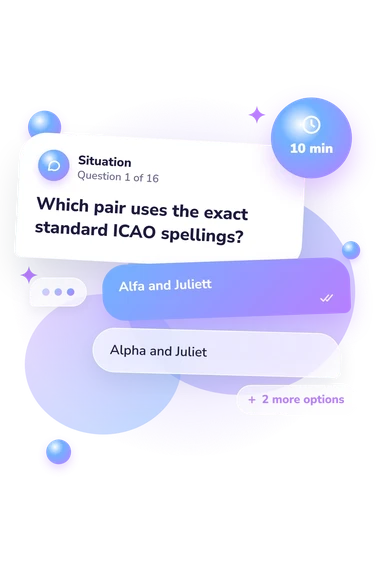
- Alfa and Juliett
- Alpha and Juliet
- Alfa and Juliet
- Alpha and Juliett
- Kilo
- Charlie
- Quebec
- Yankee
- M
- N
- V
- K
Aviation Alphabet Quiz - Description and methodology of the test
For learners, aviation personnel, and anyone practicing radio-style letter transmission, the aviation alphabet quiz offers a focused way to check recognition of standard ICAO code words. Pilots and other aviation users can use this pilot alphabet quiz to identify practice needs before working with call signs, registrations, routes, or short radio messages. The result can help you decide whether to refresh the alphabet before practising radio-style transmission.
What This Assessment Measures
Rather than measuring personality or general aviation skill, this assessment checks whether a reader can recognize and use standardized code words assigned to letters. It suits learners, dispatchers, pilots, controllers, and anyone practicing precise transmission.
This kind of aviation spelling alphabet test also reveals where familiar alternatives, reversed sequences, or near-matching words cause errors.
The questions cover these practical skills:
- Exact spelling recognition shows whether standard forms such as Alfa and Juliett are distinguished from familiar variants.
- Letter-to-word recall indicates how reliably a code word can be linked to its written letter.
- Short-sequence transcription shows whether spoken groups can be entered in the correct order.
The single displayed scale, Aviation Alphabet Knowledge (0-16), measures knowledge of the standard ICAO alphabet. Its bands are Foundation to build (0-6), Developing knowledge (7-12), and Strong knowledge (13-16).
Methodology and Evidence Base
Each item pairs a short prompt with answer choices. It tests code-word-to-letter recognition, exact ICAO spelling, and transcription of short spoken sequences, using plausible distractors that differ in wording, letter choice, or order. The format is a structured knowledge check, not a personality inventory.
Responses produce the displayed knowledge score and its descriptive bands; this result is not an official proficiency assessment or certification.
Content is conceptually consistent with the International Radiotelephony Spelling Alphabet, which supplies the code words and spellings. This online questionnaire is not the ICAO document or an adaptation of it.
Cox and Vinagre examine confusions in aircraft call signs, showing why phonetic distinction and letter order matter in communication. Their study provides context for the tasks, not evidence that this quiz is reliable or valid.
To support ICAO alphabet practice, review missed pairs and rehearse them in call signs, registrations, and short messages. Attention, prior exposure, and current practice can affect performance, so the result describes this item set rather than complete radio-operation ability.
- International Civil Aviation Organization. Annex 10 - Aeronautical Telecommunications - Volume II - Communication Procedures including those with PANS status. 7th ed. Montreal: ICAO; 2016.
- Cox, Stephen J., and Lluis Vinagre. Modelling of confusions in aircraft call signs. Speech Communication. 2004;42(3-4):289-312. 10.1016/j.specom.2003.09.006
Updated: