
Dental Instruments Quiz
How the Scales are Structured
Who Usually Takes This Test?
See How You Compare
Below is a preview of how scores are typically distributed across each scale.
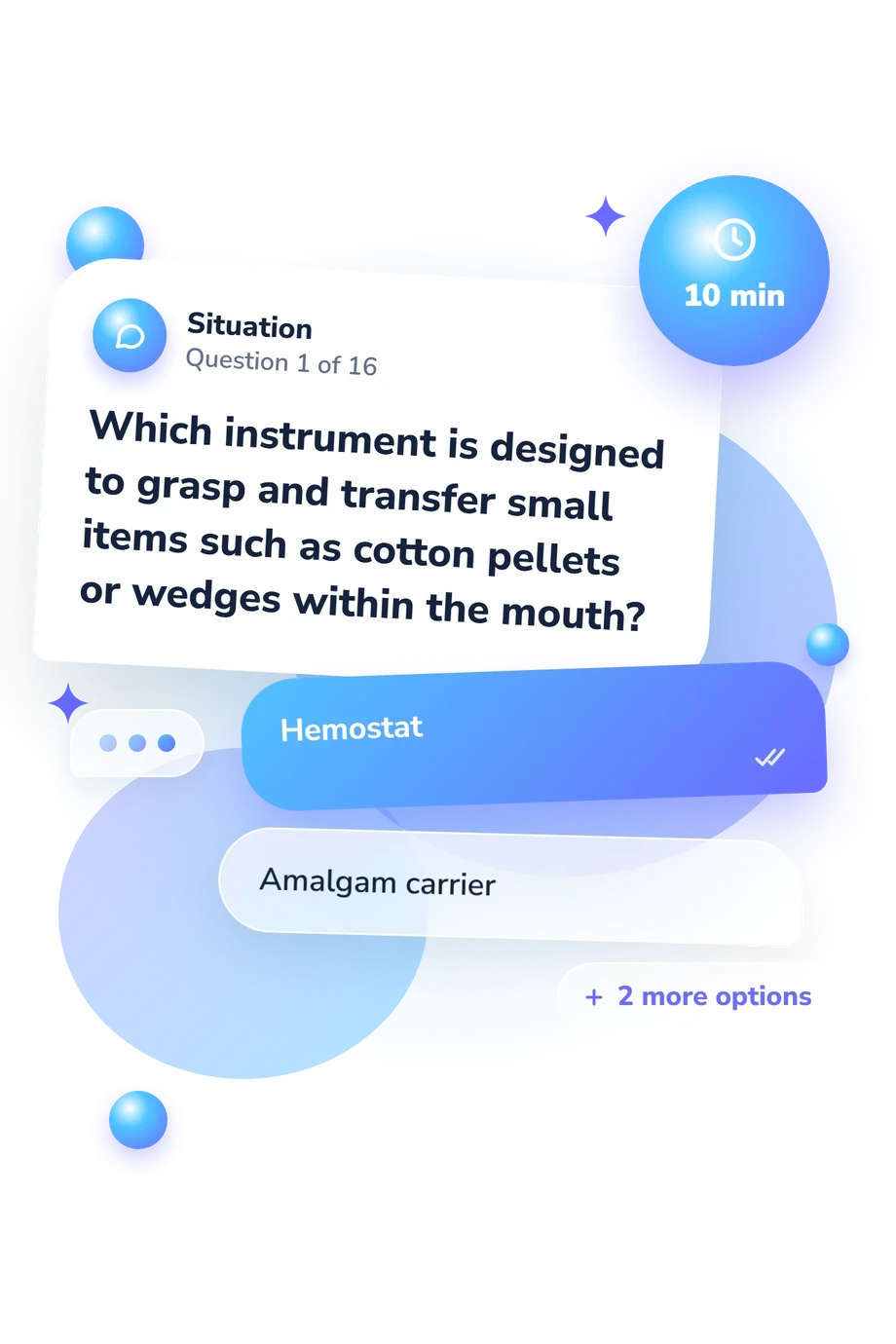
Example Questions From the Test
- Hemostat
- Amalgam carrier
- Cotton pliers
- College-type mouth mirror
- K-file
- Finger spreader
- Barbed broach
- Gutta-percha plugger
- Periosteal elevator
- Extraction forceps
- Rongeur
- Bone file
Dental Instruments Quiz - Description and methodology of the test
Students, trainees, and dental team members can use the dental instruments quiz to locate terminology worth reviewing before coursework, skills practice, or supervised clinical work. For dental assistants reviewing instruments, the assessment organizes common names around the chairside functions that may need attention. The result supports focused preparation before supervised practice.
What This Assessment Explores
Questions place instruments in short clinical situations and ask for the best functional match. They cover examination, periodontal care, restorative procedures, extraction, surgery, endodontics, and moisture control, so the result reflects whether names can be connected to chairside use.
The main groups represented are:
- Examination and periodontal instruments show recognition of mirrors, probes, explorers, scalers, and curettes used for inspection or deposit removal.
- Restorative instruments distinguish carriers, condensers, burnishers, carvers, excavators, and matrix systems by procedural stage.
- Surgical, endodontic, and support instruments cover luxation, tooth removal, flap elevation, canal shaping, evacuation, and rubber dam preparation.
The exercise helps learners organize dental instrument knowledge by function, giving concrete review areas rather than a separate profile. These are thematic areas, not separately scored dimensions: stronger overall performance suggests broader command of the tested topics, while missed items indicate where review may help.
Methodology and Scientific Basis
Each item presents a clinical prompt and four answer choices; selecting the best functional match tests recognition and application rather than free recall. Results use the Dental Instruments Knowledge scale, which summarizes recognition of common dental instruments and their clinical purposes: 0-16, with Foundation 0-6, Developing 7-12, and Strong 13-16. The displayed result is one overall score for performance on these items, reported through descriptive bands rather than separate topic scores. It tells learners which level of performance they reached on this set of instrument-function questions.
The content is conceptually consistent with the functions described in Dental Instruments (Boyd, 2023). Robinson and Boyd’s 2023 dental-assisting reference adds context for terminology and chairside workflow, but this questionnaire is not presented as a published adaptation of either source.
This dental instruments test can prioritize revision, but its knowledge score does not establish professional readiness because it does not assess manual technique, infection-control performance, speed, or judgment under pressure. Elemam and Abdelaal (2025) support combining structured knowledge checks and instructor feedback with broader competency assessment.
Results depend on attention, memory, and current familiarity and may change after study or with unfamiliar wording.
- Boyd, Linda Bartolomucci. Dental Instruments: A Pocket Guide. 8th ed. Elsevier, 2023. ISBN 9780323873901.
- Robinson, Debbie S., and Linda Bartolomucci Boyd. Modern Dental Assisting and Boyd: Dental Instruments, 8e Package. 14th ed. Elsevier, 2023. ISBN 9780323884044.
- Elemam, Ranya F., and Heba M. Abdelaal. The impact of structured assessment attempts and instructor feedback on clinical competency development in dental assistant training. BMC Medical Education, vol. 25, article 1412, 2025. 10.1186/s12909-025-07842-z
Updated: