
Green Flag Quiz
How the Scales are Structured
Who Usually Takes This Test?
See How You Compare
Below is a preview of how scores are typically distributed across each scale.
Example Questions From the Test
- Guatemala
- Uruguay
- Argentina
- Honduras
- Jordan
- Iran
- Belarus
- Lebanon
- Italy
- Ireland
- Côte d’Ivoire
- France
Green Flag Quiz - Description and methodology of the test
Curious learners, geography students, travelers, and anyone who enjoys visual recall can use this national flag quiz to examine how confidently they recognize national flags. The green flag quiz offers a focused snapshot of knowledge through description-based questions with four country choices, helping you notice which visual clues are familiar and which deserve review. Its result summarizes recognition of the designs included here.
What This Assessment Explores
The questionnaire measures flag recognition through colors, emblems, layouts, lettering, maps, and unusual shapes. It suits readers who want to test the designs presented here and see which visual cues support identification.
Questions in this flag identification quiz also distinguish similar choices. Prompts may describe a Nordic cross, national emblem, map, or non-rectangular format, requiring visual clues to identify one country.
These item themes are recognition cues, not separate scored dimensions:
- Color and band patterns show how arrangement and palette guide recognition.
- National emblems show whether symbolic details are linked accurately to their countries.
- Maps, lettering, and unusual formats show recognition beyond familiar rectangular tricolors.
The single displayed scale, World Flag Knowledge, ranges from 0 to 16. Flag Explorer covers 0-6, Developing Spotter covers 7-12, and World Flag Expert covers 13-16. These bands describe recognition within the included designs.
Methodology and Evidence Base
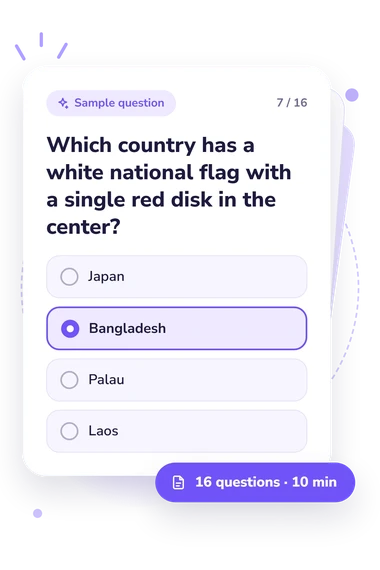
Each item gives a description of a flag and four country choices. Selecting the best match combines reading comprehension with visual-semantic recall. The final result aggregates performance across the questionnaire and assigns it to one of the displayed descriptive bands, with no separate subscore for colors, emblems, maps, or shapes.
The questionnaire’s format is conceptually consistent with Morales-Ramírez’s 2023 study linking geographic knowledge with flag recognition, particularly because several items use geographic and visual knowledge together. It is not an adaptation or validation of that study. Research by Kalampokas, Mentizis, Vrochidou, and Papakostas compares flag structure, color, and symbols computationally; that work offers context for the cues used here rather than evidence about this questionnaire. Smith’s 1975 book provides historical context for flags as markers of identity.
This world flags quiz supports self-checking and learning through recognition of the included designs. Results may vary with prior travel, classroom exposure, language familiarity, and momentary attention. A lower band may reflect limited opportunity to learn particular designs, while a strong result indicates recognition within these items rather than complete global flag knowledge.
- Morales-Ramírez, Carlos A. (2023). Seeing the World through Maps: The Effectiveness of Map Knowledge in Flag Recognition. Cartographica 58(1):39-46. 10.3138/cart-2022-0021
- Kalampokas, Theofanis, Dimitrios Mentizis, Eleni Vrochidou, and George A. Papakostas (2023). Connecting national flags - a deep learning approach. Multimedia Tools and Applications 82:39435-39457. 10.1007/s11042-023-15056-y
- Smith, Whitney (1975). Flags Through the Ages and Across the World. New York: McGraw-Hill.
Updated: