
Funny Mother Daughter Quiz Questions
How the Scales are Structured
Who Usually Takes This Test?
See How You Compare
Below is a preview of how scores are typically distributed across each scale.
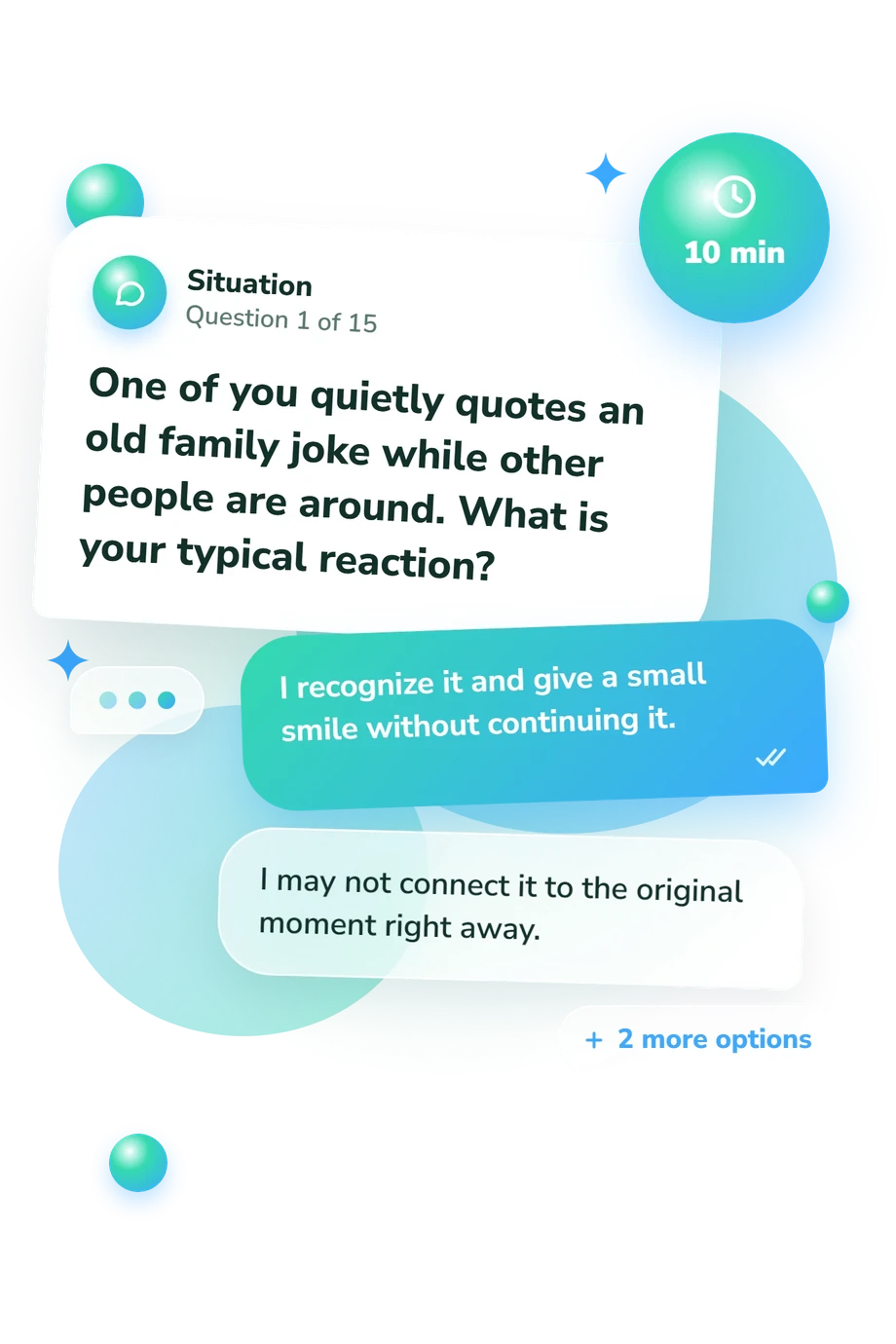
Example Questions From the Test
- I recognize it and give a small smile without continuing it.
- I may not connect it to the original moment right away.
- I answer with the matching line or expression almost automatically.
- I laugh and add a related detail from the original joke.
- We give a shortened version so everyone has the context.
- We politely suggest that someone else tell it this time.
- We launch into the familiar version, emphasizing the best moments.
- We deliver the full production, including impressions and each other’s assigned parts.
- I use the new word in a joke before returning to the conversation.
- I give the word a definition, backstory, and possible starring role in future texts.
- I understand the intended word and answer the message normally.
- I send a laughing reaction or briefly point out the typo.
Funny Mother Daughter Quiz Questions - Description and methodology of the test
Designed for mothers and daughters who enjoy noticing the comic side of ordinary life, this assessment invites reflection on moments of humor in conversation, memories, errands, and family routines. The Funny Mother Daughter Quiz Questions assessment gives a respondent a playful profile of how shared humor typically works between them. For mothers and daughters, these mother and daughter quiz questions can start a conversation about a relationship's distinctive comic style.
What This Test Measures
Scenarios explore patterns in shared comedy, while the result describes the respondent's view of them-not closeness, honesty, or memory importance. Answers to mother daughter quiz questions do not independently show how comedy is created.
The three scales capture different routes into shared comedy:
- Comic Storytelling (0-15) places the result in Moment Keepers (0-5), Story Polishers (6-10), or Family Narrators (11-15), reflecting how shared experiences become stories.
- Shared Comedy Language (0-15) places the result in Fresh Context (0-5), Familiar Signals (6-10), or Comedy Shorthand (11-15), reflecting reliance on callbacks.
- Spontaneous Playfulness (0-15) places the result in Quiet Spark (0-5), Playful Openings (6-10), or Ready for a Bit (11-15), reflecting readiness for improvised fun.
No band is better; each describes a different comic style.
Methodology and Evidence Base
Each item presents a mother-daughter situation with four response options. Choices move from literal reactions to callbacks, stories, impressions, and improvised play, so the profile captures how respondents view a pair's comic pattern.
Conceptually, the assessment is a mother-daughter humor quiz consistent with research on family joking, not an adaptation of those instruments. Paine et al. (2019) is the closest match, addressing recurring knowledge and interaction in shared humor. Fiadotava (2020) adds a digital family-communication perspective; Reese, Haden, and Fivush (1993) examines mother-child conversations about the past, conversational style, and memory; Bureau et al. (2023) offers comparison for relational playfulness. Together, these studies provide conceptual context, not validation or provenance for this questionnaire.
The three totals appear as 0-15 scores with catalogue-defined bands, but individual answer points are unspecified, so ranges should not be reverse-engineered. Self-report reflects current mood, recent interactions, cultural references, and memory. The catalogue bands describe profile categories; the cited studies do not validate this questionnaire or establish clinical norms for its scores. Use the profile for reflection and conversation rather than as a clinical conclusion.
- Amy L. Paine, Nina Howe, Gassiaa Karajian, Dale F. Hay, and Ganie DeHart. “H, I, J, K, L, M, N, O, PEE! Get it? Pee!”: Siblings’ shared humour in childhood. British Journal of Developmental Psychology, 37(3), 336-353, 2019. 10.1111/bjdp.12277
- Anastasiya Fiadotava. Sharing Humour Digitally in Family Communication. The European Journal of Humour Research, 8(1), 95-111, 2020. 10.7592/EJHR2020.8.1.fiadotava
- Elaine Reese, Catherine A. Haden, and Robyn Fivush. Mother-child conversations about the past: Relationships of style and memory over time. Cognitive Development, 8(4), 403-430, 1993. 10.1016/S0885-2014(05)80002-4
- Jean-François Bureau, Khachadour Bandk, Audrey-Ann Deneault, Jessica Turgeon, Harshita Seal, and Patricia Brosseau-Liard. The PPSQ: assessing parental, child, and partner's playfulness in the preschool and early school years. Frontiers in Psychology, 14, 1274160, 2023. 10.3389/fpsyg.2023.1274160
Updated: