
Ramayana Quiz
How the Scales are Structured
Who Usually Takes This Test?
See How You Compare
Below is a preview of how scores are typically distributed across each scale.
Example Questions From the Test
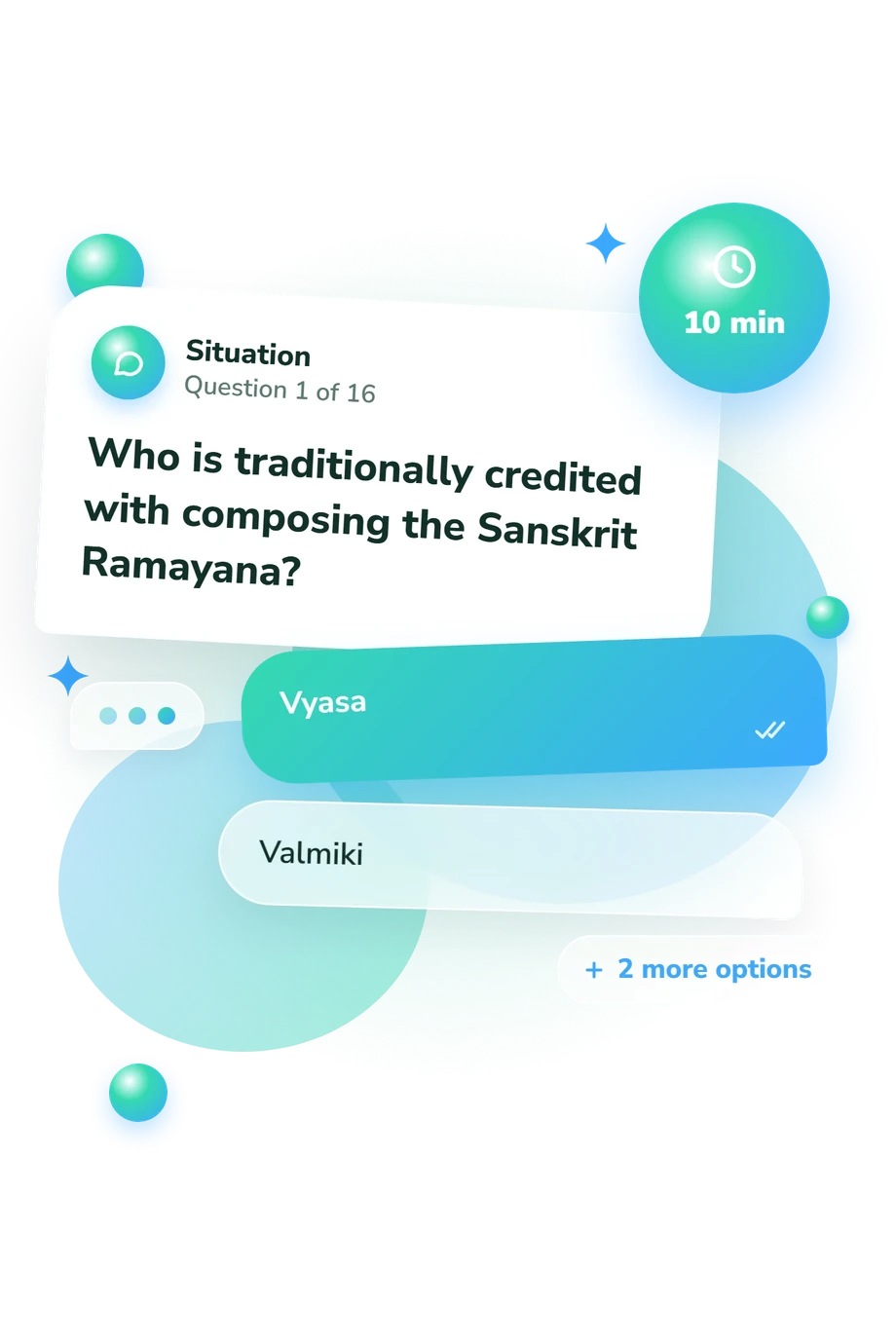
- Vyasa
- Valmiki
- Kalidasa
- Tulsidas
- Kaikeyi invokes two boons granted to her by Dasharatha
- A royal council removes him after a military defeat
- Bharata demands the throne and orders Rama away
- Rama voluntarily abandons succession to become an ascetic
- They board the Pushpaka Vimana in several groups
- The ocean permanently parts to create a dry road
- They use a fleet secretly maintained by Vibhishana
- The vanara forces construct a bridge across the water
Ramayana Quiz - Description and methodology of the test
Readers who want to revisit the epic or check how securely its story has stayed with them can use this ramayana quiz as a focused knowledge check. It suits learners, general readers, and people preparing for discussion. The result highlights overall Ramayana knowledge through familiarity with major characters, episodes, relationships, and themes, while leaving specific topics for you to review from your own answers.
What This Assessment Explores
The questionnaire measures knowledge of the Sanskrit epic through characters, relationships, turning points, sequence, and themes. The Ramayana-related quiz questions test recognition and connections rather than personal opinion, making the assessment useful for readers checking recall or preparing for discussion.
Items address exile, Sita’s abduction, Hanuman’s search, the journey to Lanka, and the war. They also test consequences, secondary figures, and chronology. The displayed result uses these descriptive bands:
- Ramayana Knowledge (0-16) summarizes recognized knowledge of major events, relationships, and themes.
- Foundation (0-6) indicates recognition of some central elements and room to revisit characters and events.
- Developing (7-12) indicates a solid grasp with details and connections still to strengthen.
- Strong (13-16) indicates broad, accurate knowledge across the narrative.
These bands should be read with awareness that Ramayana traditions and retellings can differ.
Methodology and Evidence Base
Each item offers four answer choices and asks for the option that best fits the narrative. Together, the items cover authorship, exile, relationships, Sita’s abduction, Hanuman’s search, the route to Lanka, and the war. The four-option question-and-answer format tests recognition, connections, and sequence in a quiz on Ramayana characters and events rather than attitudes or personal experiences.
The score summarizes performance across the items and is interpreted through the displayed bands. It describes overall familiarity with the narrative rather than supplying topic-level feedback; readers can choose topics to revisit by considering their own answers and the traditions or translations they have encountered.
Its subject matter is conceptually consistent with the English Valmiki Ramayana translation, which provides a primary textual reference for the narrative. Bhatt and Shah’s critical edition supports attention to textual transmission, while Richman’s edited volume provides context for the diversity of South Asian tellings. This questionnaire is not an adaptation of those works.
The result is a descriptive knowledge score against the displayed bands. Prior reading, preferred retelling, translation, memory, and current attention can affect performance, while differing Ramayana traditions may change which answer feels familiar.
- Valmiki. The Ramayana of Valmiki: The Complete English Translation. Translated by Robert P. Goldman, Sally J. Sutherland Goldman, Rosalind Lefeber, Sheldon I. Pollock, and Barend A. van Nooten; revised and edited by Robert P. Goldman and Sally J. Sutherland Goldman. Princeton University Press, 2021. 10.1515/9780691225029.
- Bhatt, G. H., and U. P. Shah, eds. The Valmiki Ramayana: Critical Edition. 7 vols. Oriental Institute, Baroda, 1960-1975.
- Richman, Paula, ed. Many Ramayanas: The Diversity of a Narrative Tradition in South Asia. University of California Press, 1991. 10.1525/9780520911758.
Updated: