
Hamster Quiz
How the Scales are Structured
Who Usually Takes This Test?
See How You Compare
Below is a preview of how scores are typically distributed across each scale.
Example Questions From the Test
- Gnawing sharpens their cheek pouches for carrying food
- Their incisors grow continuously and need normal wear
- Gnawing replaces the need for a balanced diet
- Their adult teeth fall out and regrow every few months
- Wait until the hamster tries it before making changes
- Add juicy fruit to replace drinking water
- Remove the bottle overnight to prevent leaking
- Fix or replace it promptly and confirm that water flows
- Strongly scented cedar shavings
- Fluffy cotton nesting fiber that separates into long strands
- Unscented paper-based bedding designed for small animals
- Clumping cat litter used as the main burrowing material
Hamster Quiz - Description and methodology of the test
People considering hamster ownership can use this hamster quiz to check whether their practical knowledge matches an animal’s needs. It is intended for prospective and current keepers who want clearer guidance on housing, handling, feeding, and welfare. A hamster care quiz of this kind produces an educational result: it identifies familiar topics and areas where further preparation could improve everyday decisions.
What This Assessment Explores
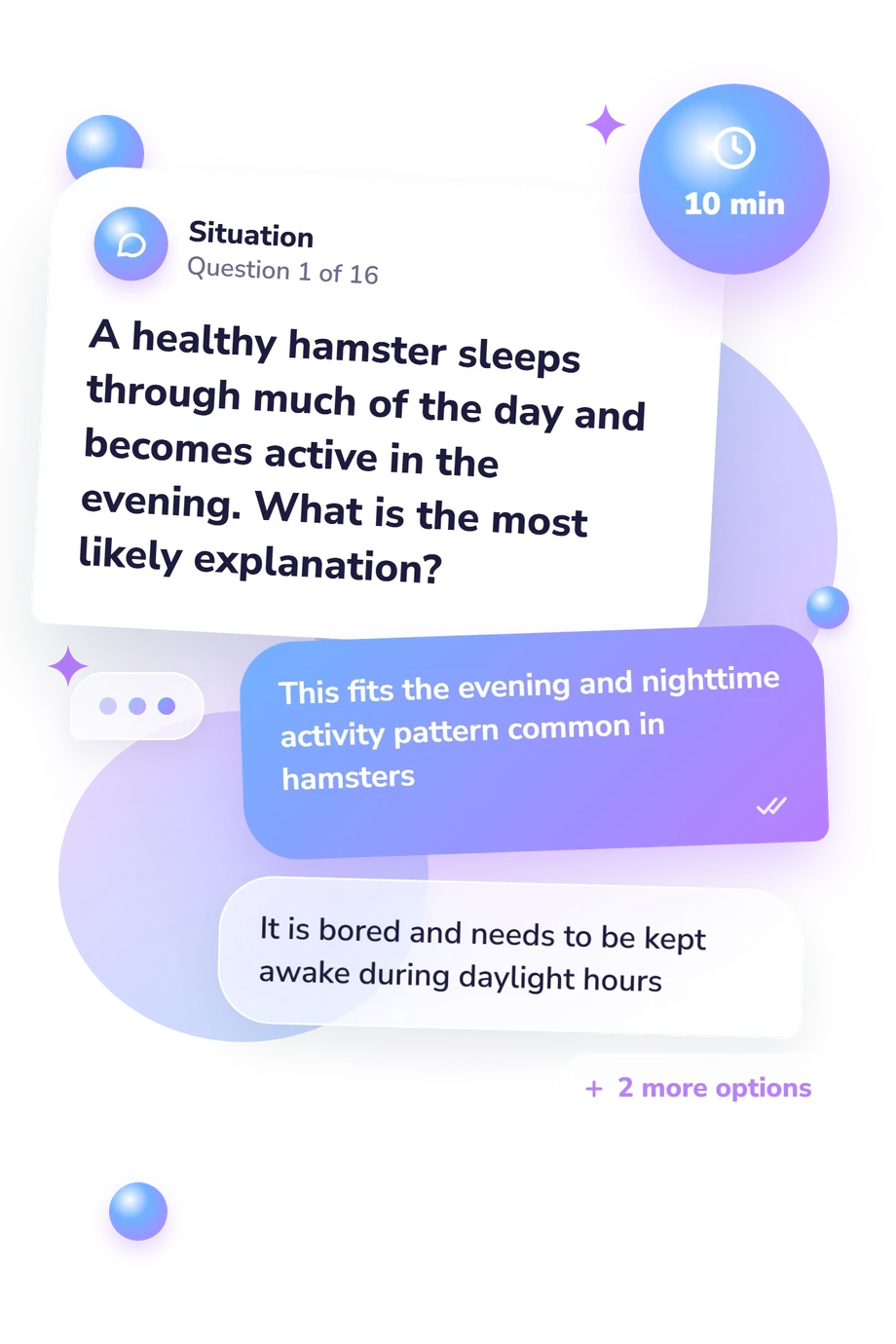
Questions present concrete care situations rather than personality traits. The format makes this a hamster knowledge test: readers must recognise normal evening activity, choose safe handling and housing, provide appropriate food and water, and respond when illness or injury may be present. This suits prospective and current keepers.
The result covers four practical dimensions:
- Activity and handling show whether normal rhythms and calm approaches are understood.
- Housing and enrichment indicate whether bedding, wheels, bathing, security, and placement support welfare.
- Feeding and oral health reflect knowledge of food changes, water access, incisors, and cheek pouches.
- Illness and welfare show whether warning signs prompt appropriate action.
Hamster Knowledge: 0-16 summarises these answers. Foundational (0-6) signals basics to review; Developing (7-12) shows useful knowledge with some gaps; Strong (13-16) reflects broad practical understanding. The result is educational, not veterinary advice.
Methodology and Evidence Base
Each item describes a concrete observation or care decision with four answer choices. Selecting the best option tests recognition and application rather than specialist recall. The hamster care questions address behaviour, housing, nutrition, grooming, handling, and signs that may require veterinary attention.
Scoring combines responses into one displayed total. No separate subscales or clinical cutoffs are presented, so the score is a broad educational summary: it can identify topics for review but does not establish competence in every situation.
Fox and Neville (2024) is the closest published evidence because it examines owner-reported Syrian hamster welfare. Hauzenberger, Gebhardt-Henrich, and Steiger (2006) add experimental evidence on bedding depth and behaviour, while Frohlich’s Merck Veterinary Manual review supports care guidance and recognition of illness. The questionnaire is conceptually consistent with these sources, not an adaptation or validation of them.
This self-report tool has no stated population norms, reliability estimates, or independent clinical validation. Answers may reflect guessing, prior experience, current context, and self-awareness, so the result is best used to direct further learning and day-to-day care decisions.
- Fox, Alice, and Vikki Neville. “Burrowing for Answers: Investigating Syrian Hamster Welfare through Owner Surveys.” Veterinary Record 195, no. 9 (2024): e4534. 10.1002/vetr.4534
- Hauzenberger, Andrina R., Sabine G. Gebhardt-Henrich, and Andreas Steiger. “The Influence of Bedding Depth on Behaviour in Golden Hamsters (Mesocricetus auratus).” Applied Animal Behaviour Science 100, nos. 3-4 (2006): 280-294. 10.1016/j.applanim.2005.11.012
- Frohlich, Jennifer. “Hamsters.” Merck Veterinary Manual. Full review May 2026; last updated July 2026.
Updated: