
Fahrenheit 451 Part 3 Quiz
How the Scales are Structured
Who Usually Takes This Test?
See How You Compare
Below is a preview of how scores are typically distributed across each scale.
Example Questions From the Test
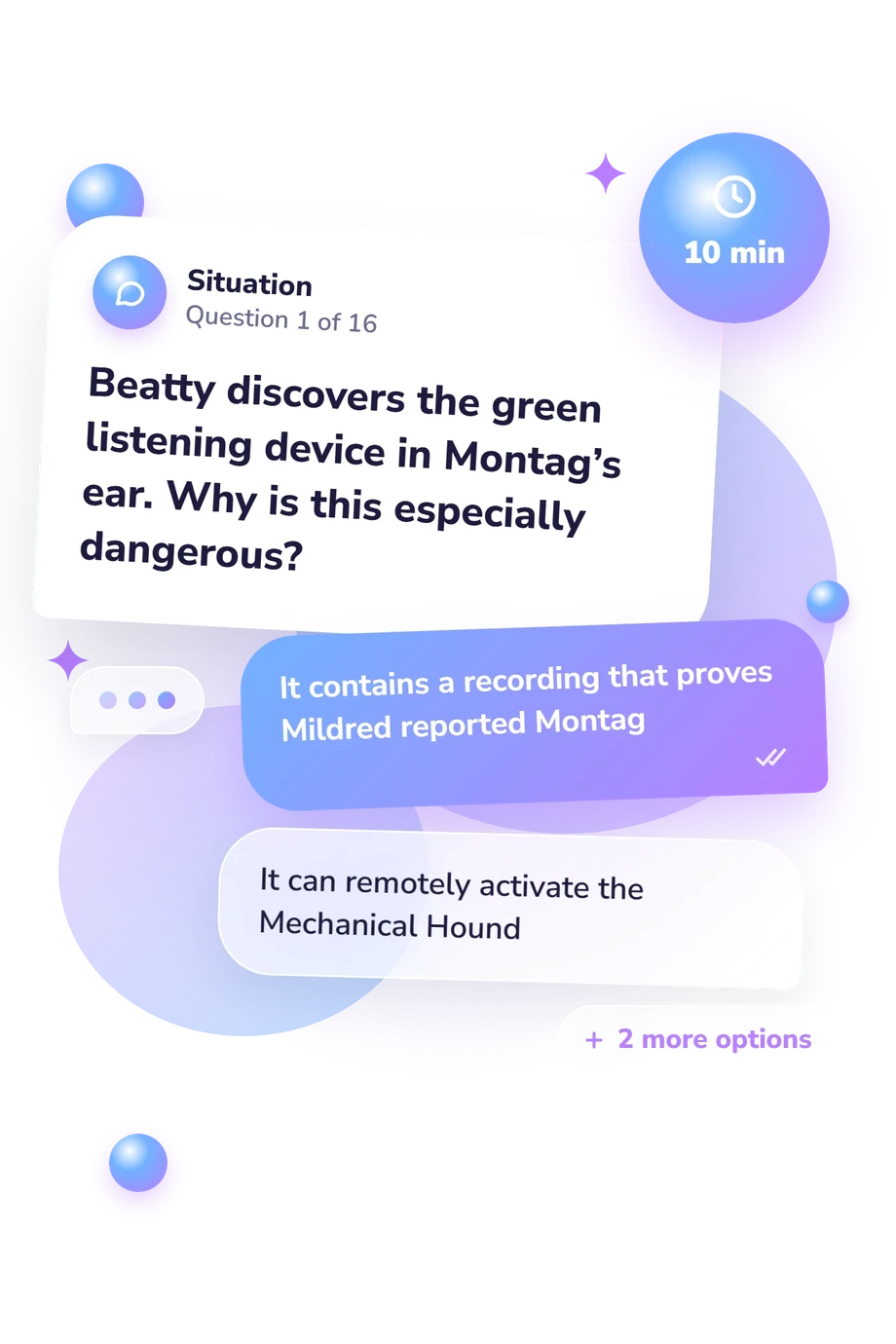
- It contains a recording that proves Mildred reported Montag
- It can remotely activate the Mechanical Hound
- It could lead Beatty to Faber, whom Beatty threatens to trace
- It identifies the members of Granger’s group by name
- They kill an uninvolved pedestrian and identify him as Montag
- They replay old footage of Beatty capturing a fugitive
- They announce that Montag surrendered outside the city
- They show Faber being arrested in Montag’s place
- Chicago, to find a former university professor
- New York, to contact an underground broadcaster
- Denver, to locate Granger’s camp
- St. Louis, to meet a retired printer
Fahrenheit 451 Part 3 Quiz - Description and methodology of the test
Readers who have studied Part 3 and want to check their understanding can use the Fahrenheit 451 Part 3 Quiz as a focused reading check. The result helps you decide whether your grasp of the section is secure or whether a return to the text would be useful. Fahrenheit 451 Part 3 questions also let you test specific interpretations without turning the exercise into a judgement of literary ability.
What This Assessment Explores
Part 3 follows Montag through flight, concealment, the river, and Granger’s community. Questions check events and significance through surveillance, public deception, memory, responsibility, renewal, and preserved literature. It measures knowledge, not personality or literary worth.
For a reader taking the Part 3 Fahrenheit 451 quiz, the result shows whether plot knowledge supports interpretation. Fahrenheit 451 Part 3 Knowledge (0-16) appears as Foundation (0-6), which calls for revisiting the escape sequence, Granger’s group, and ending; Developing (7-12), reflecting the central plot and themes with details or interpretations to review; or Strong (13-16), showing clear command of events, motives, symbols, and conclusion.
These areas organize the questions:
- Escape and pursuit show how Montag flees and who tracks him.
- Public narratives show how authorities manufacture apparent success.
- Memory, renewal, and literature show how the ending links survival to rebuilding.
Methodology and Scientific Basis
Each item presents an event, motive, symbol, or interpretive point with four answer choices. The format tests textual understanding rather than agreement or frequency: selecting the best-supported option makes this a knowledge check. Checking answers to the Part 3 Fahrenheit 451 quiz before responding would weaken the result because it should reflect unaided recall.
The content anchor is Bradbury (1953). Seed (1994) places the novel’s concerns alongside postwar dystopian control, while McCray and Campbell (2023) connect literacy with freedom. These works support the literary interpretation of the questions; the online questionnaire is built around Bradbury’s novel.
Scoring uses the selected answers to produce the displayed knowledge result and its bands, describing performance on the tested Part 3 material rather than overall reading ability. Familiarity with the novel, rereading history, memory under pressure, and uncertainty between plausible interpretations can affect performance. A strong score shows command of the selected content, while an uneven score identifies passages to revisit.
- Bradbury, Ray. Fahrenheit 451. New York: Ballantine Books, 1953.
- Seed, David. "The Flight from the Good Life: Fahrenheit 451 in the Context of Postwar American Dystopias." Journal of American Studies 28, no. 2 (1994): 225-240. 10.1017/S0021875800025470.
- McCray, Carissa, and Harley Campbell. "Literacy is Freedom." The New Ray Bradbury Review, no. 7 (2023): 89-100. 10.18060/27572.
Updated: