
Can I Trust Him Quiz
How the Scales are Structured
Who Usually Takes This Test?
See How You Compare
Below is a preview of how scores are typically distributed across each scale.
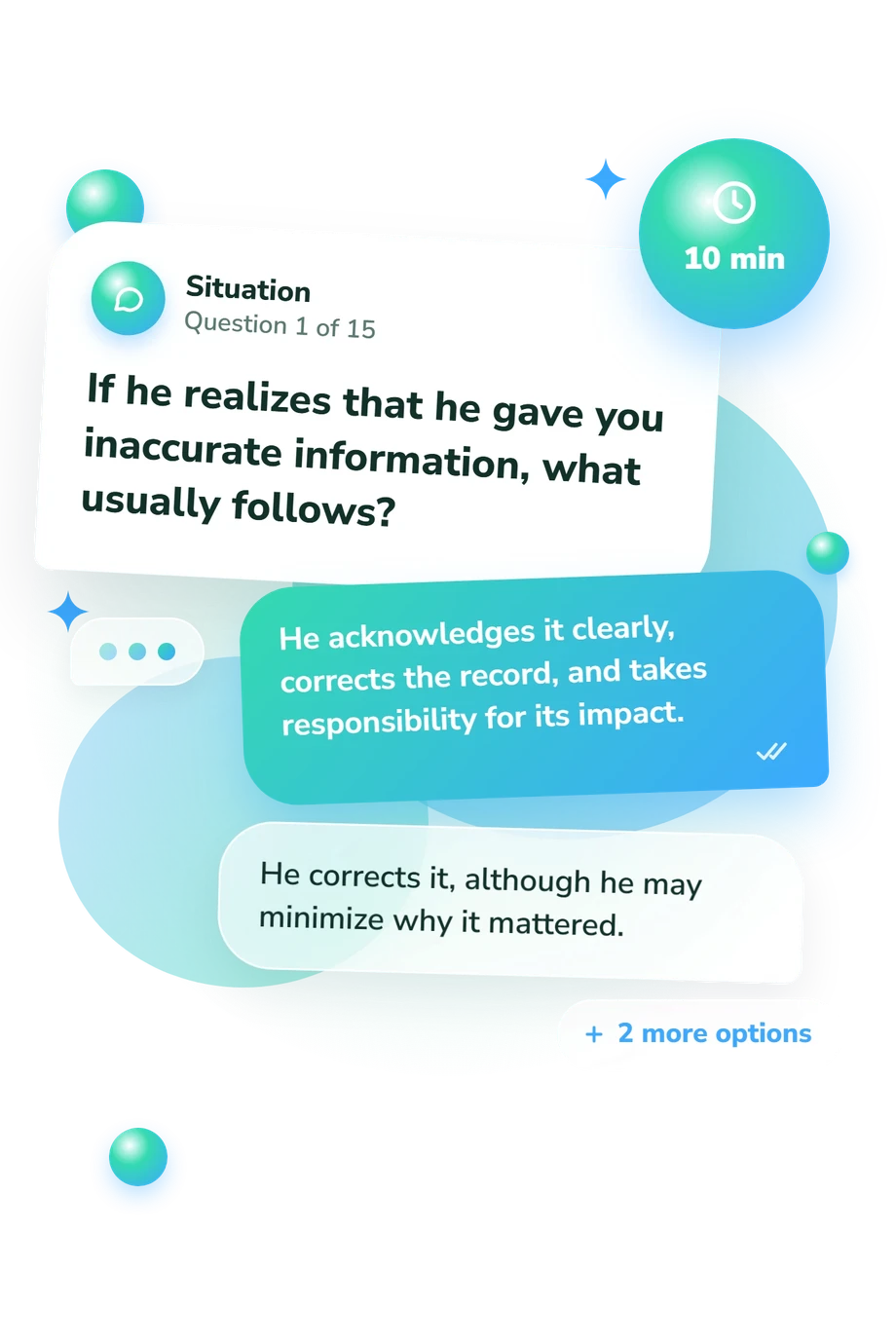
Example Questions From the Test
- He acknowledges it clearly, corrects the record, and takes responsibility for its impact.
- He corrects it, although he may minimize why it mattered.
- He admits only the parts that I can already demonstrate.
- He continues denying or rewriting events despite clear inconsistencies.
- The interactions regularly seem to cross what we agreed, and my concerns remain unresolved.
- Most interactions fit our agreement, but one or two patterns still feel ambiguous.
- He stays within the boundaries we discussed and addresses gray areas openly.
- I have noticed repeated loopholes or technical excuses around the agreement.
- He would likely explain the context, answer questions, and recognize why hearing it elsewhere affected me.
- He would probably discuss some of it while insisting the rest should not matter.
- He would be more focused on who told me than on giving a clear account.
- He would likely offer shifting versions or pressure me to disregard what I learned.
Can I Trust Him Quiz - Description and methodology of the test
People who feel uncertain about a partner’s honesty, reliability, or respect for agreements can use the Can I Trust Him Quiz to organize observations instead of judging one isolated incident. It gives structure to a quiz about whether you should trust your husband, especially when reassurance and troubling details coexist. The result offers a focused self-reflection profile, showing which parts of the relationship feel aligned and which deserve attention.
What This Assessment Explores
The questionnaire examines trust through concrete relationship situations rather than a single verdict. Items address inaccurate information, exclusivity gray areas, independence, promises, availability, boundaries, and difficult conversations. These themes help distinguish an isolated disappointment from a repeated pattern.
The result helps examine whether you should trust him by separating the concern into three observable dimensions:
- Boundaries and Exclusivity (0-15) shows whether stated limits and shared agreements receive consistent respect; Boundaries need attention (0-5), Uneven alignment (6-10), or Respectful alignment (11-15).
- Consistency and Follow-Through (0-15) shows how reliably plans, promises, availability, and effort line up; Unsteady pattern (0-5), Mixed consistency (6-10), or Strong follow-through (11-15).
- Honesty and Open Communication (0-15) shows how directly he addresses discrepancies and difficult questions; Significant uncertainty (0-5), Partial openness (6-10), or Candid communication (11-15).
This framing turns a broad feeling into patterns you can review.
Methodology and Scientific Basis
Methodologically, this is a structured self-report questionnaire. Each item presents a relationship scenario with four response choices, and you select the option that best matches the pattern you have observed rather than an idealized moment.
Responses are grouped into the displayed dimensions and assigned an interpretive band. The calculation summarizes your selections; it cannot verify his statements, detect hidden behavior, or prove fidelity. These bands are categories for this questionnaire, not clinical norms. A score therefore cannot settle whether he is trustworthy in every situation.
The evidence base begins with the Dyadic Trust Scale (Larzelere & Huston, 1980), which is conceptually consistent with this questionnaire, not an adaptation of it. Rempel, Holmes, and Zanna (1985) describe trust as a developing judgment about a partner. Roggensack and Sillars (2014) address explicit and ambiguous honesty rules, while Muise, Belu, and O’Sullivan (2021) address negotiated exclusivity agreements.
Current emotions, memory, self-awareness, limited information, and response bias can shape a self-report result; the format helps examine whether you trust him, while conduct that feels coercive, threatening, or unsafe outweighs a reassuring score.
- Larzelere, R. E., & Huston, T. L. (1980). The Dyadic Trust Scale: Toward Understanding Interpersonal Trust in Close Relationships. Journal of Marriage and the Family, 42(3), 595-604. 10.2307/351903
- Rempel, J. K., Holmes, J. G., & Zanna, M. P. (1985). Trust in Close Relationships. Journal of Personality and Social Psychology, 49(1), 95-112. 10.1037/0022-3514.49.1.95
- Roggensack, K. E., & Sillars, A. (2014). Agreement and understanding about honesty and deception rules in romantic relationships. Journal of Social and Personal Relationships, 31(2), 178-199. 10.1177/0265407513489914
- Muise, M. D., Belu, C. F., & O'Sullivan, L. F. (2021). Unspoken, yet understood: Exploring how couples communicate their exclusivity agreements. The Canadian Journal of Human Sexuality, 30(2), 196-204. 10.3138/cjhs.2021-0011
Updated: