
How Old Is My Soulmate Quiz
How the Scales are Structured
Who Usually Takes This Test?
See How You Compare
Below is a preview of how scores are typically distributed across each scale.
Example Questions From the Test
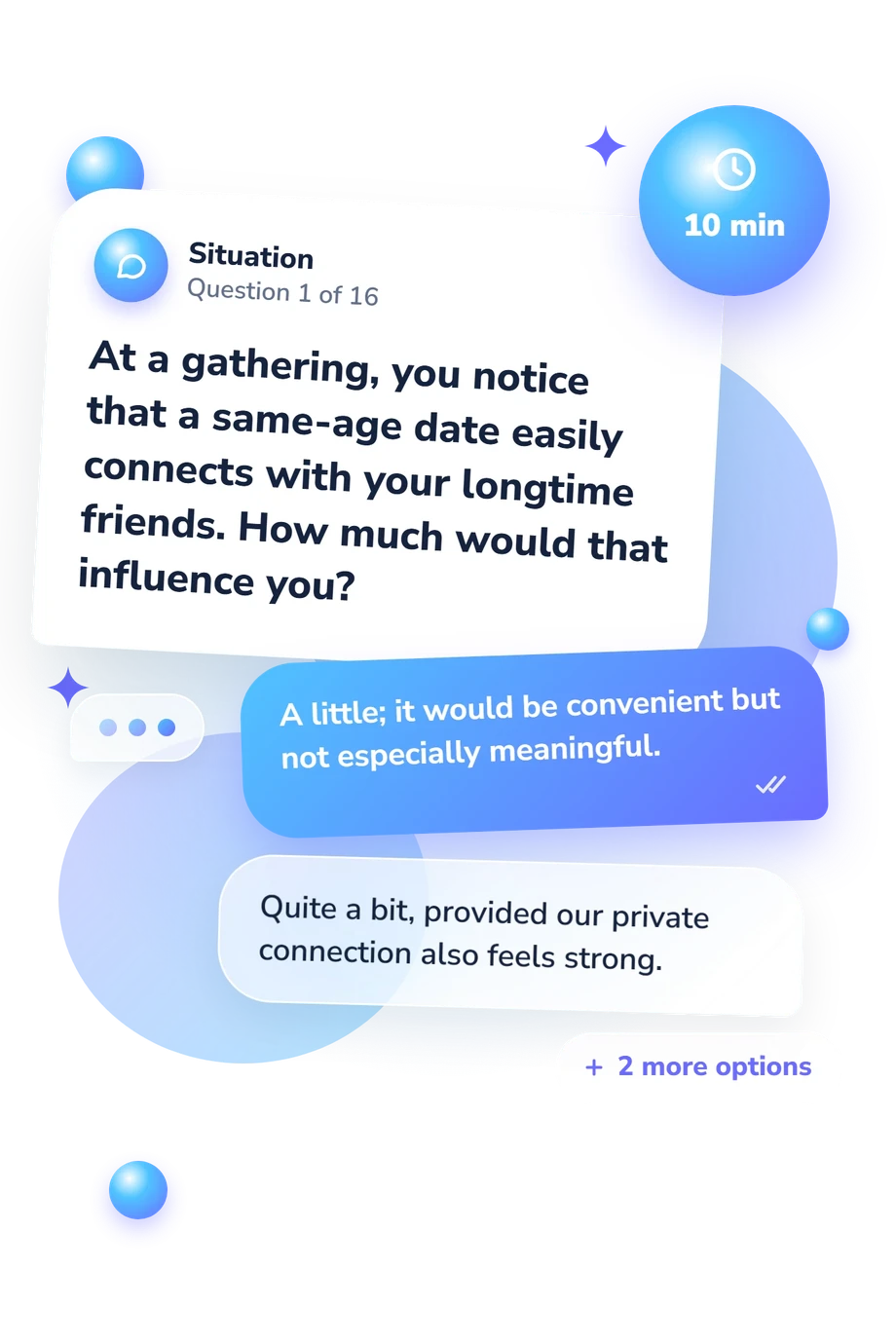
- A little; it would be convenient but not especially meaningful.
- Quite a bit, provided our private connection also feels strong.
- Hardly at all; fitting into different generations can be interesting.
- A great deal; shared social context is part of the relationship I want.
- Finding a few shared references while keeping most interests separate.
- Treating the difference as an enjoyable way to learn from each other.
- Having a partner who already understands most of those references.
- Building new shared traditions if conversation still flows naturally.
- Somewhat important, though I enjoy explaining references too.
- Not important; curiosity matters much more than shared memories.
- Very important because that familiarity helps me feel understood.
- A pleasant bonus, but I may prefer contrasting perspectives.
How Old Is My Soulmate Quiz - Description and methodology of the test
For readers exploring how age differences fit their romantic preferences, the How Old Is My Soulmate Quiz offers a structured way to interpret age-related relationship priorities. It suits anyone reflecting on a soulmate age gap and the expectations they bring to adult relationships. Taking it can clarify which age patterns feel most natural and which practical questions deserve further reflection.
What This Assessment Explores
Scenarios cover age difference preferences, social context, planning, and caregiving.
Four dimensions follow:
- Much-Older Adult Match (0-12) measures affinity for a consenting adult partner at least ten years older: Generational Gap Not Preferred (0-4), Thoughtfully Open (5-8), or Strong Affinity (9-12).
- Older Adult Match (0-12) measures affinity for a consenting adult partner three to nine years older: Limited Pull (0-4), Selectively Open (5-8), or Strong Affinity (9-12).
- Similar-Age Match (0-12) measures affinity for a consenting adult partner no more than two years older or younger: Age Peers Not Essential (0-4), Peer-Age Appeal (5-8), or Strong Affinity (9-12).
- Younger Adult Match (0-12) measures affinity for a consenting adult partner at least three years younger: Different Direction (0-4), Open with Conditions (5-8), or Strong Affinity (9-12).
Methodology and Evidence Base
Each item presents an adult relationship scenario with four response options. The choices address cultural familiarity, independence, maturity, social context, financial or career timing, future planning, and willingness to negotiate differences. Responses are summarized into four profile scores, but the option weights are not stated, so exact arithmetic cannot be reconstructed.
The highest score indicates the strongest affinity in the profile. When another result falls within one point of it, the outcomes are interpreted together as a blended pattern. The questionnaire is conceptually consistent with Buunk et al. (2001), which examined preferred partner-age limits, Antfolk (2017), which studied considered and actual partner-age boundaries, and Lehmiller and Agnew (2008), which examined commitment in heterosexual age-gap relationships. It is not an adaptation of those published studies.
As an online self-report questionnaire, it has no stated norms, reliability estimates, or clinical cutoffs. Scores can reflect current experiences, social expectations, and self-awareness when considering an age gap relationship. Read the strongest and near-tied affinities as prompts to examine your age-related priorities; the result cannot forecast a particular relationship or soulmate.
- Bram P. Buunk, Pieternel Dijkstra, Douglas T. Kenrick, and Astrid Warntjes (2001). Age preferences for mates as related to gender, own age, and involvement level. Evolution and Human Behavior, 22(4), 241-250. 10.1016/S1090-5138(01)00065-4
- Jan Antfolk (2017). Age Limits: Men's and Women's Youngest and Oldest Considered and Actual Sex Partners. Evolutionary Psychology, 15(1), 1474704917690401. 10.1177/1474704917690401
- Justin J. Lehmiller and Christopher R. Agnew (2008). Commitment in Age-Gap Heterosexual Romantic Relationships: A Test of Evolutionary and Socio-Cultural Predictions. Psychology of Women Quarterly, 32(1), 74-82. 10.1111/j.1471-6402.2007.00408.x
Updated: