
Area and Perimeter Quiz
How the Scales are Structured
Who Usually Takes This Test?
See How You Compare
Below is a preview of how scores are typically distributed across each scale.
Example Questions From the Test
- 15 metres
- 27 metres
- 30 metres
- 36 metres
- 14 centimetres
- 49 centimetres
- 196 centimetres
- 28 centimetres
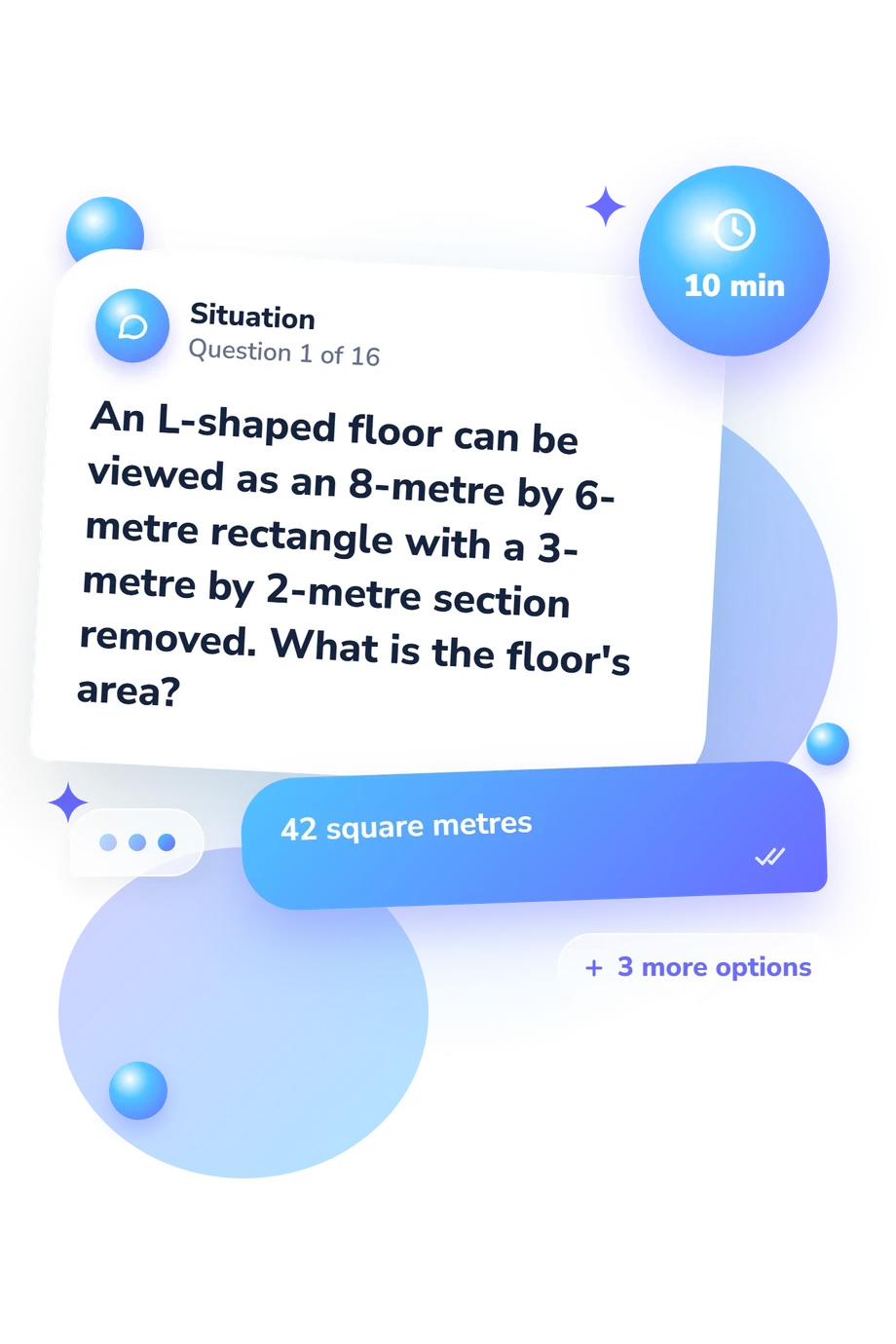
- 40 square metres
- 26 square metres
- 13 square metres
- 80 square metres
Area and Perimeter Quiz - Description and methodology of the test
Students, teachers, and independent learners can use this assessment to check how well they connect formulas, units, and visual reasoning. The area and perimeter quiz gives a focused picture of overall performance across familiar and composite shapes, placing the respondent in a knowledge band and suggesting broad practice priorities. It offers a practical starting point for area and perimeter practice before everyday measurement problems become more complex.
What This Assessment Measures
The tasks distinguish area, or surface covered, from perimeter, or distance around a boundary. Standard and composite figures require the respondent to select dimensions, apply formulas, and keep units consistent.
Together, the items indicate how someone handles direct calculations, missing dimensions, unit conversion, and multi-step comparisons. This quiz on area and perimeter highlights themes that may benefit from revision.
The questions cover three skill areas:
- Area calculations show whether surface is found from relevant dimensions and expressed in square units.
- Perimeter calculations show whether the complete boundary is included and expressed in linear units.
- Composite shapes and comparisons show whether figures are split, converted, and compared accurately.
Performance is reported on the single Area and Perimeter Knowledge scale (0-16). Foundations to review (0-6) calls for review, Developing knowledge (7-12) shows progress, and Strong knowledge (13-16) reflects accurate application.
Methodology and Evidence Base
Each item offers four answer options. The area and perimeter questions cover direct calculations, missing dimensions, unit conversion, comparisons, and conceptual changes such as slanting a parallelogram without changing its base or perpendicular height. Distractors target errors such as treating area as a linear measure or altering a composite figure's boundary.
This selected-response method checks mathematical understanding rather than habits or feelings. The questionnaire reports one descriptive score on the displayed scale; cited studies provide conceptual context but do not validate this online version. No standardized norms or reliability evidence are established for it.
The content is conceptually consistent with Machaba (2016) on separating area from perimeter. It also connects with Abed and Alkhateeb (2003) on calculation performance and Outhred and Mitchelmore (2000) on intuitive understanding of rectangular area. These studies provide context, not evidence that this questionnaire reproduces their instruments.
Use the score to guide practice by reviewing definitions and units after foundational errors, then working on composite figures, missing dimensions, and multi-step comparisons. Attention, instruction, guessing, and current confidence can influence responses, so the result is a focused snapshot of attainment.
- Machaba, France M. (2016). The concepts of area and perimeter: Insights and misconceptions of Grade 10 learners. Pythagoras, 37(1), Article 304. 10.4102/pythagoras.v37i1.304
- Abed, Adnan S., and Haitham M. Alkhateeb. (2003). Area and perimeter calculations by education majors. Perceptual and Motor Skills, 97(3 Pt 2), 1265-1266. 10.2466/pms.2003.97.3f.1265
- Outhred, Lynne N., and Michael C. Mitchelmore. (2000). Young children's intuitive understanding of rectangular area measurement. Journal for Research in Mathematics Education, 31(2), 144-167. 10.2307/749749
Updated: