
Am I a Hippie Quiz
How the Scales are Structured
Who Usually Takes This Test?
See How You Compare
Below is a preview of how scores are typically distributed across each scale.
Example Questions From the Test
- Choose a proven technique and follow clear instructions.
- Look at examples before adapting one to my taste.
- Experiment with several materials and see what develops.
- Begin with a loose idea but allow the process to change it.
- Offer specific help when my schedule has room for it.
- Help them find a reliable paid or professional service.
- Coordinate a small support circle so the effort is shared.
- Check in and help once if there is an urgent need.
- Replace it with a dependable new model that is easy to maintain.
- Look for a new model with better energy efficiency.
- Buy a refurbished or secondhand replacement.
- Try to repair it or have it repaired before replacing it.
Am I a Hippie Quiz - Description and methodology of the test
People curious about whether their everyday choices reflect hippie culture can use the Am I a Hippie Quiz as a guided self-reflection exercise. It considers values expressed through creativity, consumption, relationships, conflict, and life direction rather than appearance or historical labels. As a hippie quiz, it gives you a profile of affinities, helping you notice which parts of this cultural outlook feel natural, selective, or less relevant.
What This Assessment Explores
Questions explore how personal freedom, ecological responsibility, cooperation, and social expectations shape everyday preferences. The test suits readers reflecting on their values, not seeking a historical membership label. Results describe three affinities and the situations behind them.
The displayed dimensions are:
- Creative Freedom & Nonconformity (0-15) measures affinity for self-expression, unconventional paths, experimentation, and questioning expectations: Convention-Comfortable (0-5); Individual Within Structure (6-10); Free-Spirited Expression (11-15).
- Earth-Conscious Simplicity (0-15) measures affinity for lower-impact choices, reuse, mindful consumption, and less material focus: Convenience-Oriented (0-5); Practical Mindfulness (6-10); Simplicity-Centered (11-15).
- Peace, Openness & Community (0-15) measures affinity for cooperation, peaceful resolution, shared support, and openness to different views: Independent Focus (0-5); Selective Community Spirit (6-10); Strong Communal Affinity (11-15).
The useful question in an are you a hippie personality quiz is which values resonate, not which band is best.
Methodology and Scientific Basis
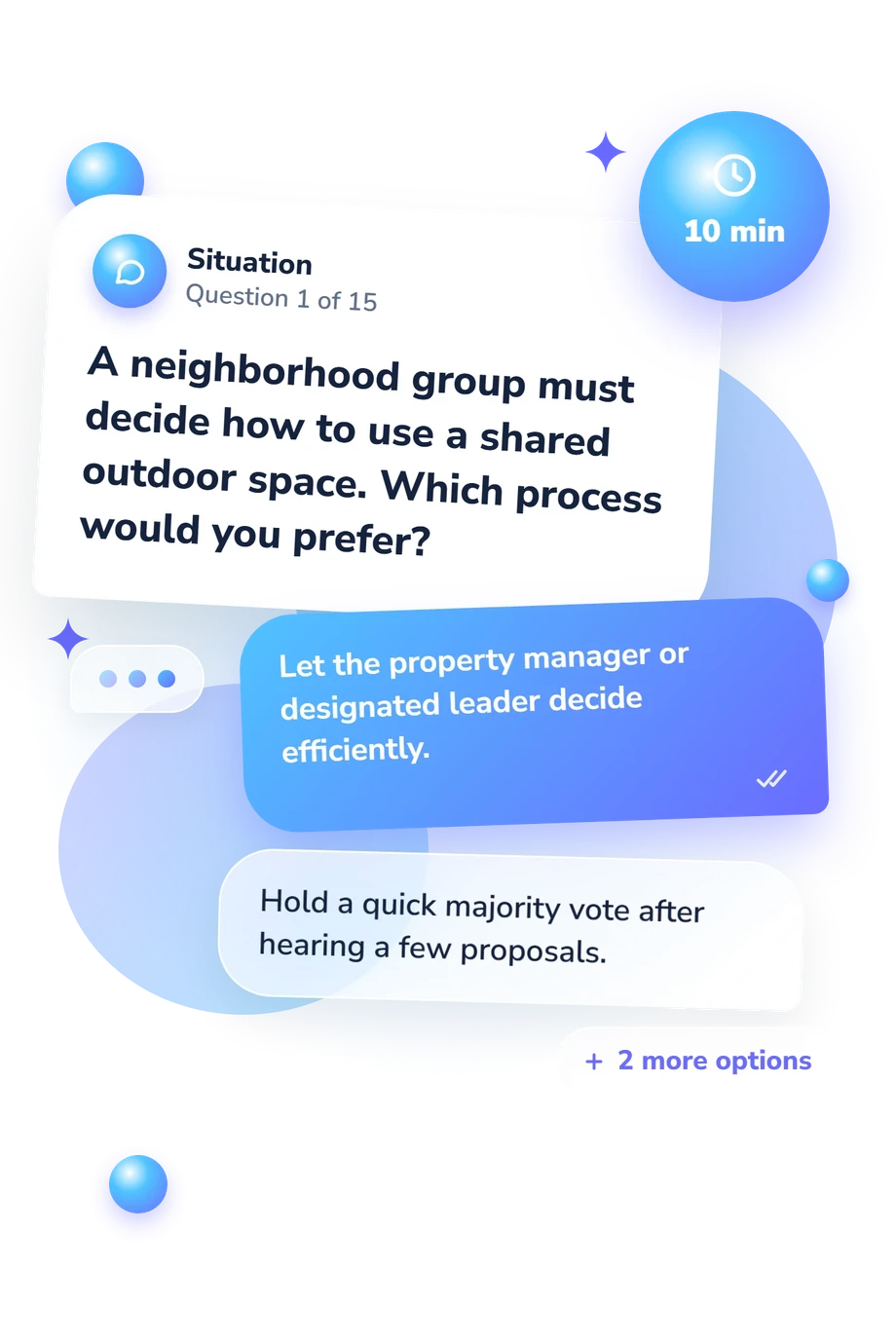
Each item presents a scenario and four response choices. The situations cover shared decisions, creative experimentation, consumption, conflict, helping others, repair, and life direction. Choosing your usual preference creates a structured self-report pattern.
Scoring is profile-based rather than a single identity score: responses are summarized across three dimensions and placed in their displayed bands. These bands describe affinity, not virtue or moral worth; cost, access, health, time, and current circumstances may shape what is practical.
Conceptually, the questionnaire is consistent with Levin and Spates (1970), whose analysis highlighted nonconformity, communal orientation, and alternative social ideals. Miller’s 2011 historical work and Miller’s 1999 study of communes add context for simplicity, shared support, and freedom as cultural themes. Those sources support interpretation, but this is a self-reflection questionnaire, not an adaptation or restandardized research instrument.
A reader can use it as an are you a hippie quiz without reducing a person to one label. The result is best treated as a current pattern rather than a fixed identity. The profile answers the how hippie are you quiz question only in a limited, descriptive sense, because self-awareness and imagined context influence answers.
- Levin, Jack, and James L. Spates. (1970). Hippie Values: An Analysis of the Underground Press. Youth & Society, 2(1), 59-73. 10.1177/0044118X7000200104
- Miller, Timothy A. (2011). The Hippies and American Values (2nd ed.). Knoxville, TN: University of Tennessee Press.
- Miller, Timothy. (1999). The 60s Communes: Hippies and Beyond. Syracuse, NY: Syracuse University Press. 10.2307/j.ctvfjd0qw
Updated: