
Mendelian Genetics Quiz
How the Scales are Structured
Who Usually Takes This Test?
See How You Compare
Below is a preview of how scores are typically distributed across each scale.
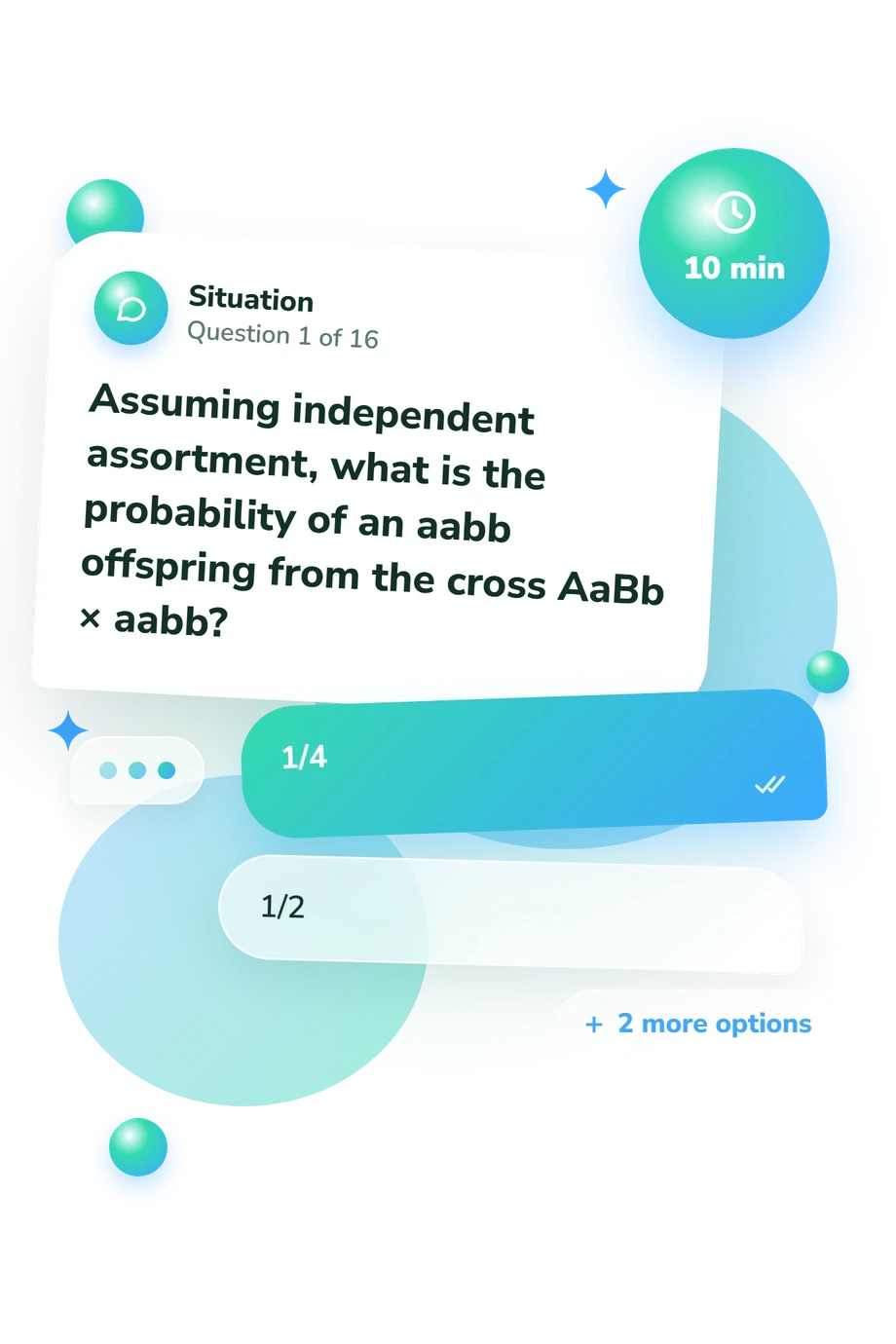
Example Questions From the Test
- 1/4
- 1/2
- 3/4
- 1/16
- GG, containing two dominant alleles
- Gg, containing two different alleles
- gg, containing two recessive alleles
- A gamete carrying only the G allele
- 1/4
- 1/2
- 0
- 3/4
Mendelian Genetics Quiz - Description and methodology of the test
Students and independent learners can use the Mendelian Genetics Quiz to check how confidently they apply classical inheritance principles. Its purpose is to reveal whether core ideas transfer from definitions to genetic crosses, probability problems, and inheritance scenarios. Questions in this Mendelian genetics assessment therefore support revision before a biology lesson, exam, or focused study session, while showing which concepts deserve further practice.
What This Assessment Explores
Core Mendelian reasoning is the focus, rather than personality or clinical status. The quiz suits learners who want to distinguish genetic notation from biological meaning, predict offspring outcomes, and match inheritance patterns to evidence. A Mendel genetics quiz format also helps connect terminology with problem-solving.
The question set covers four thematic areas:
- Alleles, genotypes, and phenotypes show whether you can interpret symbols and connect genetic combinations with observable traits.
- Segregation and independent assortment test your use of Mendel’s laws during gamete formation.
- Dominance patterns show whether you can distinguish complete dominance, codominance, incomplete dominance, and recessive transmission.
- Crosses, probability, and linkage reveal how well you calculate outcomes and interpret parental combinations.
Together, these areas indicate practical command of classical inheritance; a higher result reflects more correct answers across the questionnaire.
Methodology and Scientific Basis
Each item presents four answer choices for a definition, cross, probability calculation, or inheritance scenario. One point is awarded for each correct response, with no extra weighting stated.
The result uses the Mendelian Genetics Knowledge scale, 0-16. Foundations to build (0-6) marks concepts needing review. Developing knowledge (7-12) reflects grasp of many central ideas, with further practice useful for probabilities and crosses. Strong command (13-16) indicates accurate use of Mendelian principles across definitions, crosses, and inheritance scenarios.
Conceptually, the content is consistent with Buske and Bartholomei-Santos (2019) and overlaps with topics assessed by the Dominance Concept Inventory, the Genetics Literacy Assessment Instrument, and the Genetics Concept Assessment. Those instruments are comparison points, not evidence of reproduction or adaptation.
The displayed result does not function as an answer key for this Mendelian genetics assessment; it organizes performance as a learning snapshot, and no population norms are supplied. Guessing, attention, prior preparation, and current understanding can affect performance, so use the band to choose what to review rather than as a fixed measure of ability.
- Buske, Rodrigo, and Marlise Bartholomei-Santos. 2019. What is worse: to mislearn or to forget? Knowledge about Mendelian inheritance among high school senior students. Journal of Biological Education, 55(5), 461-471. 10.1080/00219266.2019.1707260
- Abraham, Joel K., Kathryn E. Perez, and Rebecca M. Price. 2014. The Dominance Concept Inventory: A Tool for Assessing Undergraduate Student Alternative Conceptions about Dominance in Mendelian and Population Genetics. CBE-Life Sciences Education, 13(2), 349-358. 10.1187/cbe.13-08-0160
- Bowling, Bethany V., Erin E. Acra, Lihshing Wang, Melanie F. Myers, Gary E. Dean, Glenn C. Markle, Christine L. Moskalik, and Carl A. Huether. 2008. Development and Evaluation of a Genetics Literacy Assessment Instrument for Undergraduates. Genetics, 178(1), 15-22. 10.1534/genetics.107.079533
- Smith, Michelle K., William B. Wood, and Jennifer K. Knight. 2008. The Genetics Concept Assessment: A New Concept Inventory for Gauging Student Understanding of Genetics. CBE-Life Sciences Education, 7(4), 422-430. 10.1187/cbe.08-08-0045
Updated: