
Oral Quiz
How the Scales are Structured
Who Usually Takes This Test?
See How You Compare
Below is a preview of how scores are typically distributed across each scale.
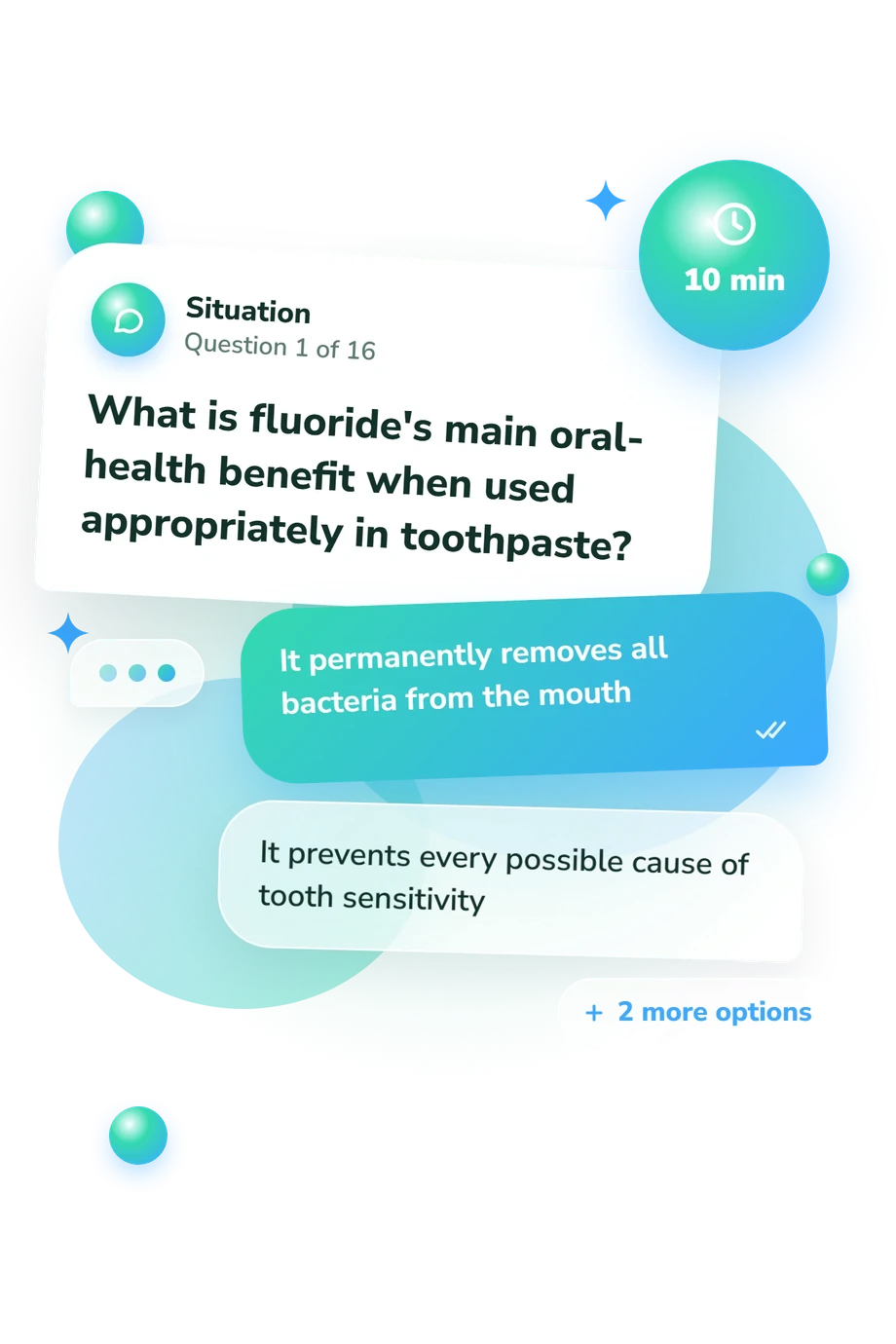
Example Questions From the Test
- Gums that look red or swollen and bleed during cleaning
- Severe pain caused by a fractured jaw
- A deep hole that has reached the tooth nerve
- A tooth suddenly becoming loose after an impact
- Brush at once with extra pressure to remove the acid
- Rinse repeatedly with more of the same drink
- Skip brushing for the rest of the day
- Rinse with water and allow some time before brushing
- About two minutes
- About one minute
- About three minutes
- About five minutes
Oral Quiz - Description and methodology of the test
For readers who want to check how accurately they recognize everyday dental-care guidance, this oral quiz provides a focused knowledge assessment. It suits people reviewing preventive habits, interpreting familiar warning signs, or deciding which topics deserve closer attention. This oral health quiz places your knowledge in one educational band and points to topics that may merit review.
What This Assessment Explores
These items assess practical oral-health knowledge across prevention, recognition, and everyday decisions. They address fluoride, enamel, plaque, interdental cleaning, brushing, diet, saliva, mouthwash, warning signs, and responses to common dental situations. Several questions in this oral-health quiz connect a situation with an appropriate response, so the result reflects applied understanding as well as definitions.
The main themes represented by the questions are:
- Fluoride and enamel protection indicate whether you understand remineralization and appropriate fluoride use.
- Plaque and cleaning indicate whether you recognize effective brushing and interdental care.
- Gums, decay, and exposure patterns indicate how you understand inflammation, dry mouth, and repeated sugar or acid challenges.
- Warning signs and urgent situations indicate whether you recognize persistent changes, trauma, and prompt-care needs.
Your result is reported as Oral Health Knowledge (0-16): Foundations to build (0-6), Developing knowledge (7-12), or Strong knowledge (13-16).
Methodology and Scientific Basis
Each item presents four answer choices. The format moves between definitions, routine-care recommendations, and brief scenarios, so knowledge is tested in context rather than through terminology alone. The displayed result is an overall knowledge score, not separate clinical findings.
As an oral health knowledge test, the questionnaire is conceptually consistent with OHLP (Spinler et al., 2021), which separates oral-health knowledge from knowledge of the dental health system. Macek et al. (2010) supports conceptual knowledge questions in oral-health literacy research, while KROHL (Spivakovsky et al., 2022) is a related knowledge-assessment reference. The questionnaire is conceptually consistent with these published instruments, but should not be read as reproducing any one of them.
Interpret the result as a guide to topics for review, especially daily cleaning, fluoride use, diet, warning signs, and responses to dental problems. Guessing, previous education, scenario interpretation, and current attention can affect performance, and the displayed bands are educational rather than validated clinical cutoffs; persistent symptoms or serious changes require appropriate dental or urgent medical attention.
- Spinler K, Valdez R, Aarabi G, Dingoyan D, Reissmann DR, Heydecke G, von dem Knesebeck O, Kofahl C. Development of the Oral Health Literacy Profile (OHLP)-Psychometric properties of the oral health and dental health system knowledge scales. Community Dentistry and Oral Epidemiology. 2021;49:609-616. 10.1111/cdoe.12688
- Macek MD, Haynes D, Wells W, Bauer-Leffler S, Cotten PA, Parker RM. Measuring conceptual health knowledge in the context of oral health literacy: preliminary results. Journal of Public Health Dentistry. 2010;70(3):197-204. 10.1111/j.1752-7325.2010.00165.x
- Spivakovsky S, Suh YW, Janal MN. Development of KROHL, a tool for evaluating oral health knowledge. PEC Innovation. 2022;1:100100. 10.1016/j.pecinn.2022.100100
Updated: