
Which Gilmore Girls Character Are You Quiz
How the Scales are Structured
Who Usually Takes This Test?
See How You Compare
Below is a preview of how scores are typically distributed across each scale.
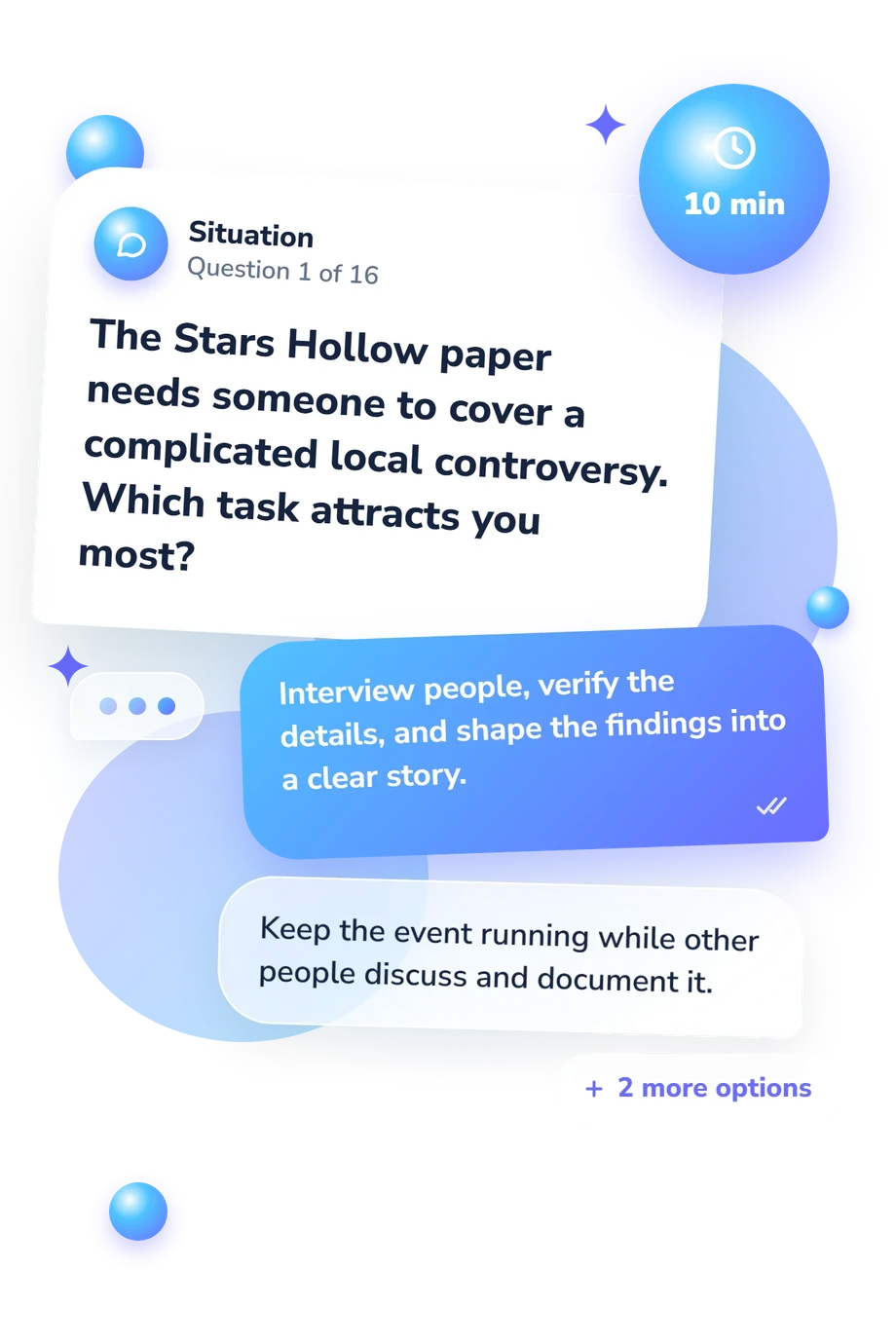
Example Questions From the Test
- Interview people, verify the details, and shape the findings into a clear story.
- Keep the event running while other people discuss and document it.
- Write a sharp opinion piece that pushes readers toward a firm conclusion.
- Collect the town’s funniest reactions and turn them into a lively account.
- Accept the recognition and use the moment to strengthen our connection.
- Downplay it because helping was the point, not being noticed.
- Reflect on what the praise reveals about the relationship.
- Appreciate it, then discuss how the result could be improved next time.
- Gather background information, make a detailed preparation list, and start reading.
- Jump in while the opportunity feels exciting and adapt as I go.
- Assess the practical demands before deciding whether it fits my life.
- Study the competition and create a strategy designed to outperform it.
Which Gilmore Girls Character Are You Quiz - Description and methodology of the test
For fans who want a playful way to reflect on how their choices align with recognizable fictional-character styles, the Which Gilmore Girls Character Are You Quiz turns familiar scenarios into an entertainment-affinity profile. It suits readers who enjoy the series and want to see how their responses resonate with Lorelai, Luke, Paris, or Rory. This Gilmore Girls character quiz offers a way to notice those affinities.
What This Assessment Explores
The questionnaire explores choices involving information, pressure, affection, disagreement, responsibility, and spontaneity. Scenarios set these decisions in Stars Hollow, academic work, practical problems, and close relationships. Rather than assigning one absolute label, the What Gilmore Girl Character Are You Quiz result separates four entertainment affinities; these are not measured personality traits.
These four entertainment-affinity scales describe the result:
- Lorelai Gilmore Affinity (0-12) measures affinity with Lorelai’s improvisational, expressive style: Different Rhythm (0-4), Kindred Spark (5-8), Lorelai Energy (9-12).
- Luke Danes Affinity (0-12) measures affinity with Luke’s grounded, practical care: Different Routine (0-4), Dependable Streak (5-8), Luke Energy (9-12).
- Paris Geller Affinity (0-12) measures affinity with Paris’s intense, competitive approach: Different Drive (0-4), Ambitious Edge (5-8), Paris Energy (9-12).
- Rory Gilmore Affinity (0-12) measures affinity with Rory’s observant, book-centred approach: Different Chapter (0-4), Shared Pages (5-8), Rory Energy (9-12).
Methodology and Evidence Base
Each item offers four response options describing instincts such as researching, improvising, organizing, supporting, challenging, joking, or acting practically. The respondent chooses the option that feels most natural, and the pattern produces four affinity totals. Displayed bands then give each total a plain-language interpretation; the format does not establish a universal psychological point value for every answer.
In practical terms, this Gilmore Girls character test is a custom entertainment-affinity exercise rather than a character-identification measure. Rarity et al. (2022) connect parasocial identification with perceived overlap between audiences and characters. Cohen (2001) describes identification as imaginative engagement with a media character, while Hoffner and Buchanan (2005) examine perceived similarity and character attributes in wishful identification. These studies provide conceptual context only; they do not establish this quiz’s scoring or standardization.
Interpret the result as a playful comparison within the situations presented. It is an entertainment comparison, not a personality assessment: its bands are internal labels rather than established population norms, and mood, context, or self-awareness can influence self-reported choices. A strong affinity therefore suggests resonance with a character’s recognizable style.
- Rarity, Erica C., Matthew R. Leitao, and Abraham M. Rutchick. (2022). Identification With Characters in Parasocial Relationships Predicts Sharing Their Personality Traits. Psychology of Popular Media, 11(2), 111-116. 10.1037/ppm0000389
- Cohen, Jonathan. (2001). Defining Identification: A Theoretical Look at the Identification of Audiences With Media Characters. Mass Communication & Society, 4(3), 245-264. 10.1207/S15327825MCS0403_01
- Hoffner, Cynthia, and Martha Buchanan. (2005). Young Adults' Wishful Identification With Television Characters: The Role of Perceived Similarity and Character Attributes. Media Psychology, 7(4), 325-351. 10.1207/S1532785XMEP0704_2
Updated: