
Antibiotics Quiz
How the Scales are Structured
Who Usually Takes This Test?
See How You Compare
Below is a preview of how scores are typically distributed across each scale.
Example Questions From the Test
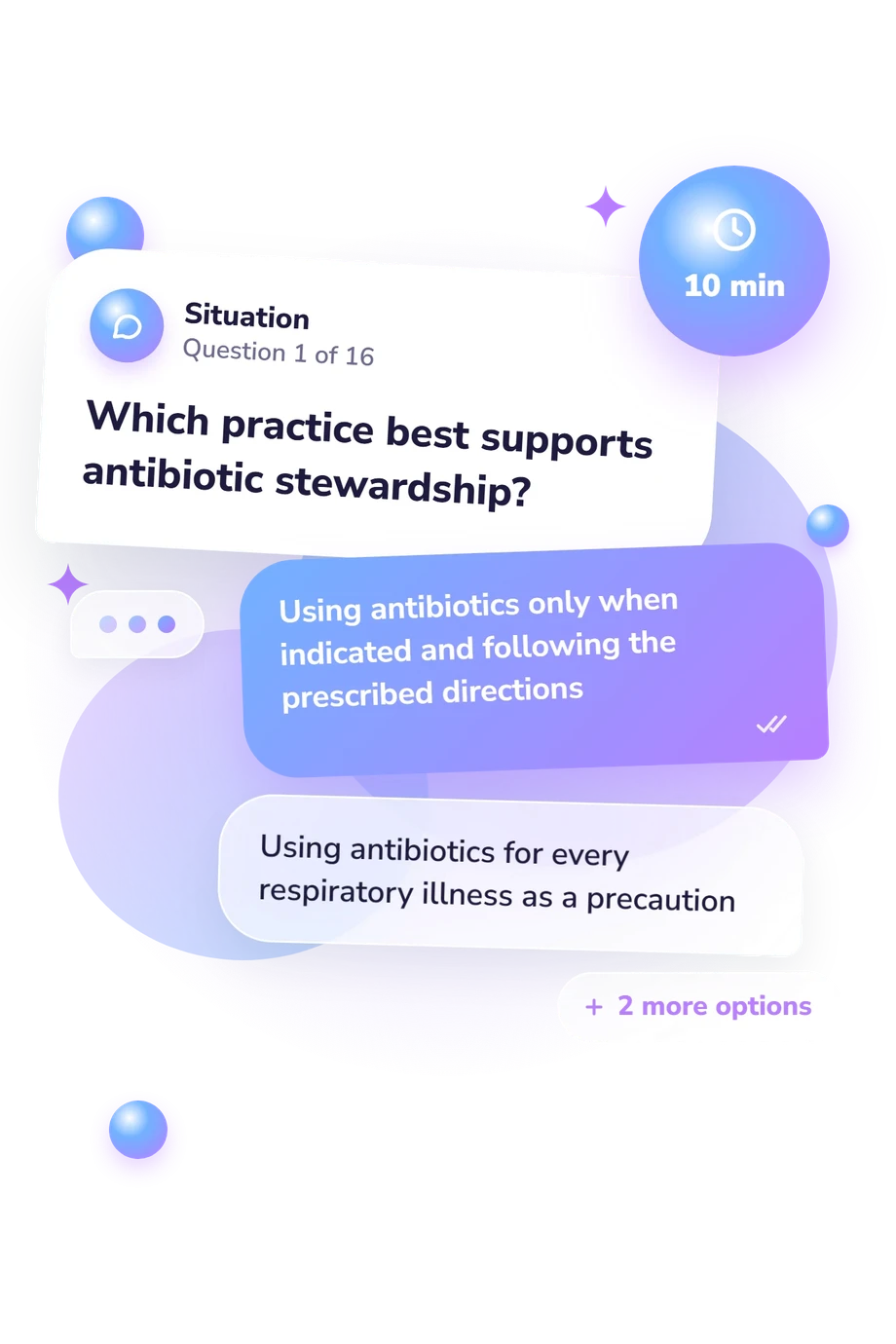
- Using antibiotics only when indicated and following the prescribed directions
- Using antibiotics for every respiratory illness as a precaution
- Saving several doses for the next time symptoms appear
- Choosing broad-spectrum antibiotics whenever a narrower option is available
- Illnesses caused by any infectious organism
- Viral infections that produce a fever
- Certain infections caused by bacteria
- Inflammation regardless of its cause
- It is always weaker and requires a longer treatment course
- It can be used only as a cream or ointment
- It targets a more limited range of bacteria
- It treats viruses as well as bacteria
Antibiotics Quiz - Description and methodology of the test
People who want to rehearse safe antibiotic decisions can use this antibiotics quiz as a focused educational self-reflection tool. It can also serve as a quiz for medical students on antibiotics when revising practical decisions, while remaining accessible to other learners. A single educational score gives a broad indication of current understanding and can help readers prepare focused questions for a pharmacist or clinician.
What This Assessment Explores
The items connect antibiotic principles with everyday decisions. They cover bacterial versus viral illness, cultures, resistance, stewardship, spectrum, prophylaxis, adherence, interactions, pregnancy-related review, and urgent warning signs. The questionnaire also works as an antimicrobial quiz, connecting those themes with practical choices. The result is an educational snapshot of knowledge.
For learners, it can function as a pharmacology quiz on antibiotics, linking concepts to safe treatment decisions. Its single scale is Antibiotics Knowledge, 0-16. Results are labelled Foundations to strengthen (0-6), Developing knowledge (7-12), or Strong knowledge (13-16).
The question themes can be read as follows:
- Treatment and selection show whether you recognize indications, testing, spectrum, and prophylaxis.
- Stewardship and resistance show whether you understand appropriate use and the risks of leftovers.
- Safe use and adherence show how you approach doses, interactions, and treatment changes.
- Risk recognition shows whether you notice serious allergy and other warning signs.
Methodology and Evidence Base
Each item presents a situation with several answer choices, including unsafe alternatives. This self-administered format tests applied recognition: the respondent selects the option that best matches responsible antibiotic use rather than naming a drug. The result is an educational knowledge score; the questionnaire does not specify how individual answers contribute to the displayed total.
For learners, this antimicrobial drugs quiz covers prescribing, adherence, interactions, and adverse reactions. The questionnaire is conceptually consistent with antibiotic-knowledge instruments and educational material, including published antibiotic-knowledge work, Rasch research on antibiotic knowledge assessment in pharmacy students, and the World Health Organization’s 2024 curriculum tool for antimicrobial resistance. It is not a direct adaptation, standardized version, or validated form of them.
When used to review antimicrobial decision-making, the questionnaire can reveal gaps in recall and judgment. Performance can vary with attention, prior teaching, current context, and self-awareness. It is an educational score, not a validated medical assessment, so use the result to select study topics and prepare focused questions about personal treatment.
- Hasan, Sanah; Sulieman, Hana; Babi, Husam; Bloukh, Samir. Development and Psychometric Evaluation of the Antibiotic Knowledge and Consumption Tool (AKCT). Antibiotics, 2022, 11(12), 1744. 10.3390/antibiotics11121744
- Kusuma, Ikhwan Yuda; Bahar, Muh. Akbar; Nuari, Doni Anshar; Prabandari, Rani; Soeharto, Soeharto; Csupor, Dezső; Benkő, Ria; Matuz, Mária. Antibiotic knowledge assessment questionnaire in undergraduate pharmacy students: A Rasch analysis of validity evidence. Pharmacy Education, 2024, 24(1), 54-78. 10.46542/pe.2024.241.5478
- World Health Organization. Antimicrobial resistance curriculum assessment tool for medical education. Geneva: World Health Organization, 2024. ISBN 978-92-4-009822-0
Updated: