
Backpack Quiz
How the Scales are Structured
Who Usually Takes This Test?
See How You Compare
Below is a preview of how scores are typically distributed across each scale.
Example Questions From the Test
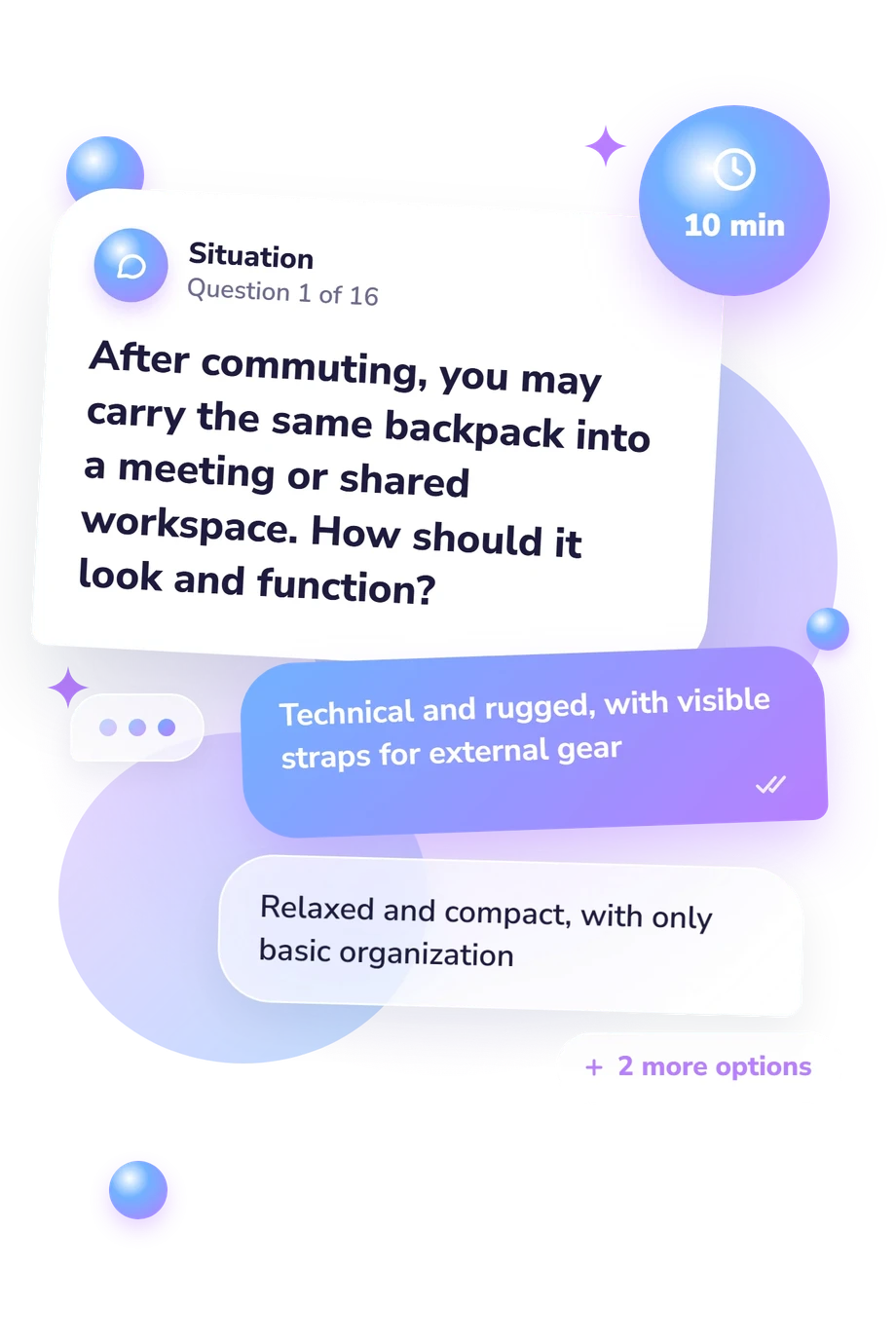
- Technical and rugged, with visible straps for external gear
- Relaxed and compact, with only basic organization
- Clean and structured, with work items kept orderly inside
- Travel-oriented, with maximum packing volume as the main goal
- With accessible space for layers, water, and weather protection
- With most space devoted to a padded laptop compartment
- With clothing compressed into a travel-style main compartment
- With a basic main section and one pocket for small essentials
- A supportive harness that keeps water, layers, and gear stable
- A polished structure that protects office electronics
- A wide suitcase-style opening for folded clothes
- A light, casual shape for a few everyday belongings
Backpack Quiz - Description and methodology of the test
People choosing a bag for commuting, study, errands, travel, or outdoor use can use the backpack quiz to clarify which priorities fit their routines. It helps when several styles seem plausible and a structured comparison is more useful than judging appearance alone. Someone deciding what backpack to get can use it to turn carrying needs into a readable profile. The result points to the format most compatible with your habits.
What This Assessment Explores
It separates work, everyday, trail, and travel priorities for people comparing protection, access, capacity, support, weather readiness, and portability.
Across the scenarios, four practical backpack profiles help identify which backpack type matches the reader's routine. The displayed outcomes are:
- Commuter Tech Backpack (0-12) measures work and device priorities: Different Priority (0-4), Occasional Commuter Fit (5-8), Strong Commuter Fit (9-12).
- Everyday Daypack (0-12) measures light, flexible daily carrying: Specialized Needs (0-4), Flexible Match (5-8), Strong Everyday Fit (9-12).
- Outdoor Adventure Pack (0-12) measures trail support and gear readiness: Urban/Travel Priority (0-4), Occasional Outdoor Match (5-8), Strong Outdoor Fit (9-12).
- Travel Backpack (0-12) measures multi-day capacity and transit access: Day-Use Priority (0-4), Short-Trip Match (5-8), Strong Travel Fit (9-12).
The highest score is the closest fit; scores within one point indicate a blend.
Methodology and Design Context
Each item presents a scenario with four answer choices about access, organization, support, capacity, or weather features. The choices contrast practical needs, while the questionnaire compares the four profile scores; it does not state how individual responses are converted into points.
The scoring is comparative; the highest result shows the leading affinity, while near-tied outcomes suggest a mixed use case.
Legg, Barr and Hedderley (2003) offer contextual design literature on subjective backpack perceptions in field conditions, while Lee, Li and Chow (2021) review support, fit, access, compartments, and load management. These sources support the practical themes in the scenarios, not validation of this questionnaire, which is not presented as an adaptation of either work.
For someone wondering what backpack they should get for classes or study, the result can clarify daily fit without making this an age-specific assessment. Self-report depends on honest answers and current routines, which may shift with a new laptop, schedule, trip, or sport. Use the result before checking a model's comfort, dimensions, and load.
- Legg, Stephen J., Aiala Barr, and David I. Hedderley. “Subjective perceptual methods for comparing backpacks in the field.” Ergonomics, 46(9), 2003, 935-955. 10.1080/0014013031000107577
- Lee, Joe Ching Nang, Simon Siu Wai Li, and Daniel Hung Kay Chow. “School backpack design: A systematic review and a summary of design items.” International Journal of Industrial Ergonomics, 84, 2021, 103166. 10.1016/j.ergon.2021.103166
Updated: