
Hand Muscles Quiz
How the Scales are Structured
Who Usually Takes This Test?
See How You Compare
Below is a preview of how scores are typically distributed across each scale.
Example Questions From the Test
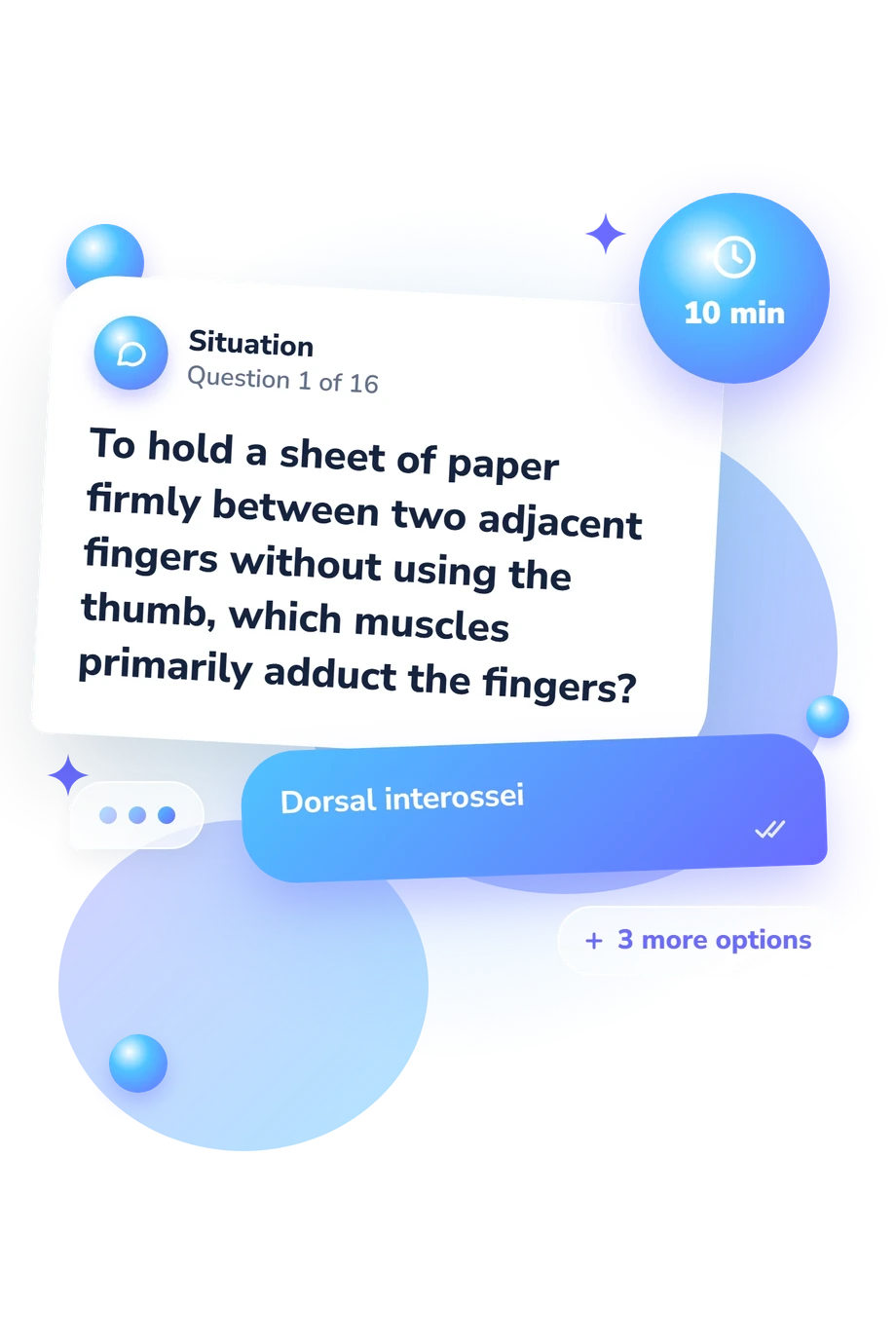
- Dorsal interossei
- Palmar interossei
- Flexor digitorum superficialis
- Extensor digitorum
- Opponens digiti minimi
- Flexor digiti minimi brevis
- Abductor digiti minimi
- Palmar interosseous of the little finger
- Palmar interossei
- Dorsal interossei
- Thenar muscles
- Lumbricals
Hand Muscles Quiz - Description and methodology of the test
For students, educators, and anatomy learners, this assessment offers a focused way to connect hand and wrist structures with the movements they produce. The hand muscles quiz is useful when you want to find gaps in actions, attachments, nerve supply, and functional relationships rather than memorize isolated names. Used as a hand anatomy quiz, it gives revision a practical direction and helps you choose what to study next.
What This Assessment Explores
Questions focus on anatomy that must be applied, not only recalled. They ask you to distinguish intrinsic from extrinsic muscles, identify actions at the wrist and finger joints, trace tendon attachments, and connect movements with median or ulnar nerve supply. Scenarios include finger abduction and adduction, thumb opposition and abduction, radial deviation, independent extension, and the coordinated action of the lumbricals. As a quiz about the muscles of the hand, it is relevant to anatomy students, clinical learners, and anyone revising functional relationships.
The main learning areas represented by the questions are:
- Intrinsic muscles explain finger spreading, closing, and coordinated digital control.
- Extrinsic muscles show how forearm tendons create wrist and finger movement.
- Thumb and hypothenar muscles clarify opposition, abduction, and little-finger positioning.
- Attachments and nerve supply connect anatomical details with functional or lesion-based reasoning.
Methodology and Evidence Base
Each item presents an anatomical prompt with four answer choices. Selecting the best structure, action, attachment, or nerve relationship tests recognition and application. Themes include intrinsic and extrinsic muscles, insertions, combined actions, tendon borders, and nerve lesions.
The result uses Hand Muscles Knowledge, scored from 0-16; the answer-weighting rule is not stated, so interpretation should stay with the displayed total and bands. Those bands are Foundations to build (0-6), Developing knowledge (7-12), and Strong knowledge (13-16), indicating increasing ability to connect anatomy with functional scenarios.
Anatomically, the content is conceptually consistent with von Schroeder and Botte (2001), Jacobson and colleagues (1992), and Dalley and Agur’s reference. These sources support the questionnaire's anatomical content-intrinsic architecture, actions, attachments, tendon relationships, and functional anatomy-but they provide no norms or validation for this online questionnaire. As a hand muscle assessment, it is an educational knowledge check: recent study, wording interpretation, and familiarity with anatomy can affect performance, while the score does not assess physical strength, injury, or nerve function.
- Herbert P. von Schroeder and Michael J. Botte. The dorsal aponeurosis, intrinsic, hypothenar, and thenar musculature of the hand. Clinical Orthopaedics and Related Research. 2001;(383):97-107. 10.1097/00003086-200102000-00012
- Mark D. Jacobson, Rajnik Raab, Babak M. Fazeli, Reid A. Abrams, Michael J. Botte, and Richard L. Lieber. Architectural design of the human intrinsic hand muscles. The Journal of Hand Surgery. 1992;17(5):804-809. 10.1016/0363-5023(92)90446-V
- Arthur F. Dalley II and Anne M. R. Agur. Moore's Clinically Oriented Anatomy. 9th ed. Philadelphia: Wolters Kluwer; 2023.
Updated: