
Hatchet Quiz
How the Scales are Structured
Who Usually Takes This Test?
See How You Compare
Below is a preview of how scores are typically distributed across each scale.
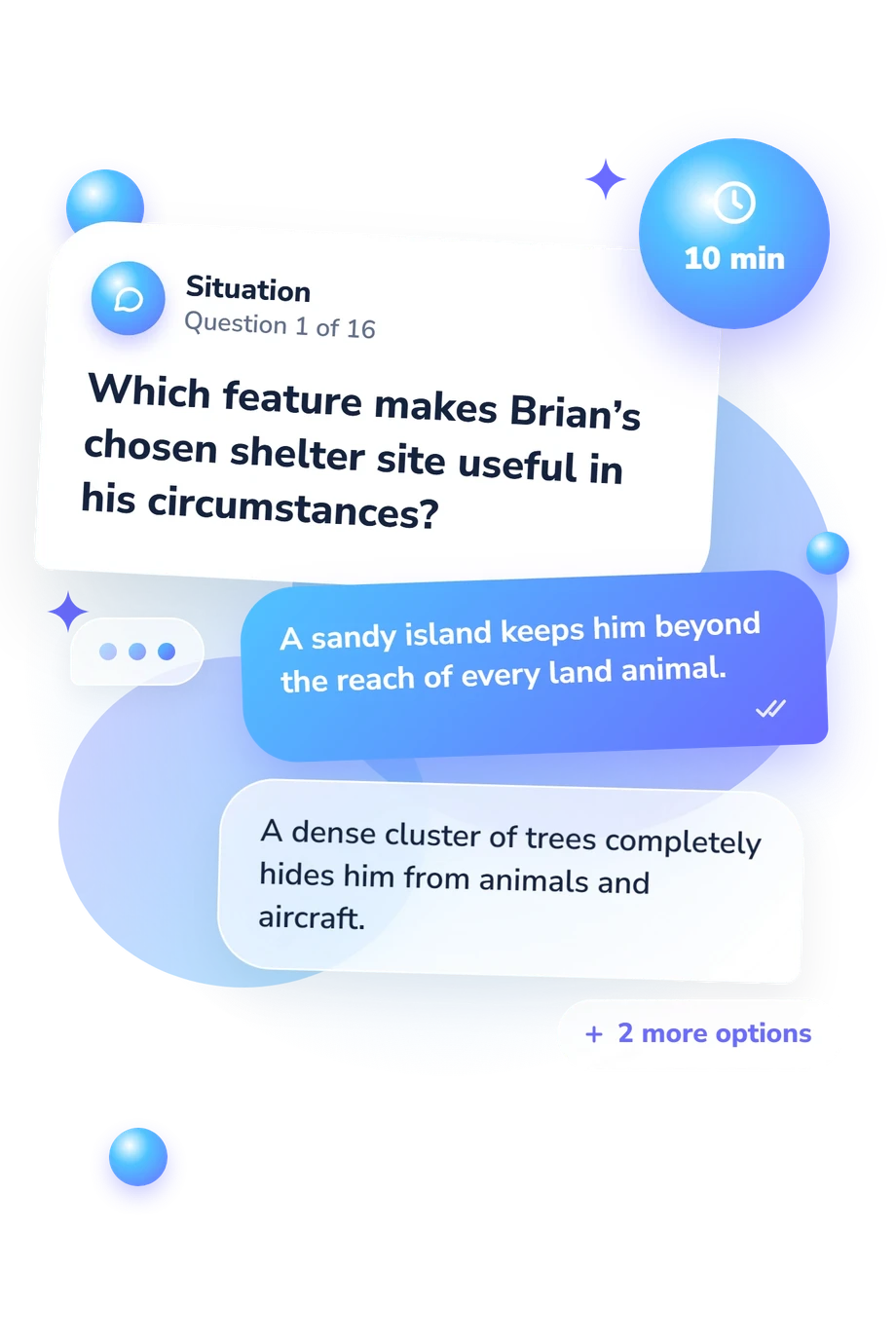
Example Questions From the Test
- Gary Paulsen
- Jean Craighead George
- Will Hobbs
- Wilson Rawls
- The plane strikes a flock of birds.
- The pilot suffers a heart attack.
- The pilot becomes disoriented in a storm.
- The controls fail after the radio stops working.
- He is going to visit his father in northern Canada.
- He is joining his mother for a wilderness vacation.
- He is moving permanently to live with a relative in Alaska.
- He is attending a summer survival program near the oil fields.
Hatchet Quiz - Description and methodology of the test
Readers wanting to decide whether their familiarity with Gary Paulsen’s novel is strong enough for discussion or study can use this hatchet quiz. It suits readers who know or have studied Hatchet and want more than plot recall. The hatchet online quiz also shows how Brian’s choices connect practical survival with character growth. Its result indicates an overall level of knowledge and comprehension, including connections between events, character, and theme.
What This Assessment Explores
Questions cover Brian’s survival experience and the events that shape him. They ask readers to connect objects, decisions, dangers, and emotional pressures with the novel’s larger themes.
The questions cover these themes and contribute to one overall result:
- Plot and turning points show what happens and why the search plane, tornado, and rescue matter.
- Survival reasoning shows how observation, experimentation, restraint, and adaptation guide Brian’s choices.
- Character and themes connect family conflict, isolation, self-reliance, and growing judgment.
- Hatchet Knowledge spans 0-16: Foundation to Build (0-6) signals review of major events; Developing Understanding (7-12) reflects solid comprehension with subtler links to revisit; Strong Understanding (13-16) indicates detailed knowledge connected to character and theme.
Readers who know or have studied the story can use this quiz on Hatchet to review recall and interpretation.
Methodology and Evidence Base
Each question presents four answer choices and asks for the best response. The items mix factual recall with cause-and-effect, symbolism, and interpretation of Brian’s behavior. The questionnaire reports one overall result with the displayed bands, rather than separate results for the themes represented by its questions.
The format tests Hatchet comprehension rather than general language ability.
The questions address Paulsen’s novel, while Unwin and Palmer connect it with integrated learning and Dewan places it within children’s survival fiction. Those literary sources provide contextual discussion with which the quiz is conceptually consistent; they do not create, adapt, standardize, or validate this online questionnaire.
The result describes performance on this item set rather than a norm-referenced population standing; no standardization or reliability information is claimed for the questionnaire. Memory, classroom discussion, wording, and guessing can affect performance, while selected-response items cannot capture every subtle literary insight. Use the result to decide what to revisit in Hatchet.
- Paulsen, Gary. Hatchet. Bradbury Press, 1987.
- Unwin, Cynthia G., and Brian Palmer. "Survival as a Bridge to At-Risk Readers: Applications of Gary Paulsen's Hatchet to an Integrated Curriculum." The ALAN Review, vol. 26, no. 3, 1999, pp. 9-12. 10.21061/alan.v27i1.a.3.
- Dewan, Pauline. "Survival of the Fittest: The Evolution of the Children's Survival Novel." Children and Libraries, vol. 18, no. 4, 2020, pp. 21-25. 10.5860/cal.18.4.21.
Updated: