
How Do People See Me Quiz
How the Scales are Structured
Who Usually Takes This Test?
See How You Compare
Below is a preview of how scores are typically distributed across each scale.
Example Questions From the Test
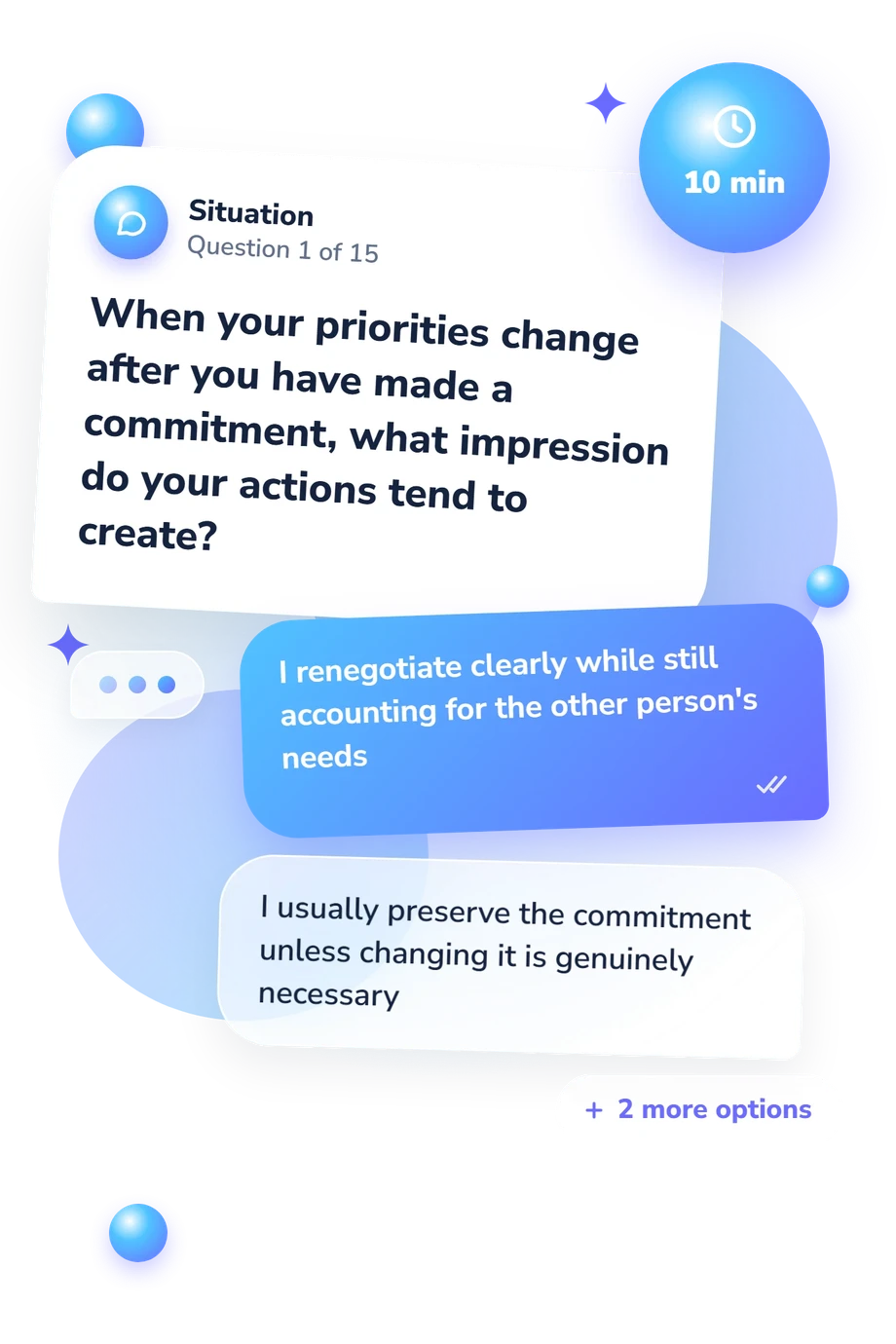
- I renegotiate clearly while still accounting for the other person's needs
- I usually preserve the commitment unless changing it is genuinely necessary
- I prefer to adjust plans freely as new priorities emerge
- I explain the change, though sometimes only after reorganizing my own plans
- State what I would enjoy and offer a specific alternative
- Mention a preference but stay open to the emerging choice
- Go along with the group unless someone directly asks me
- Indicate that the suggestions are not ideal without pushing another option
- I place it with my event belongings or set a reminder immediately
- I make a mental note and usually remember when preparing
- I rely on remembering it when the event comes up naturally
- I write it down later if I think I might forget
How Do People See Me Quiz - Description and methodology of the test
For readers who want to understand the impression they may create in everyday interactions, this questionnaire offers a focused self-reflection exercise. The How Do People See Me Quiz links familiar social situations with patterns in warmth, dependability, and visible expression. In practical terms, this is a how do others see you quiz, helping people consider which signals may feel natural, situational, or less noticeable to others.
What This Assessment Explores
Questions examine everyday choices and social cues, not hidden intentions or fixed personality labels. Situations cover approach, follow-through, inclusion, disagreement, emotional signaling, boundaries, and visible preferences. Viewed as a how do others perceive me quiz, the questionnaire asks how responses may be read in context. Results describe cues you believe you display, not opinions held by every observer.
The dimensions are:
- Approachability and Warmth (0-15) reflects how readily friendliness is noticed: Reserved first impression (0-5), Selectively approachable (6-10), or Readily approachable (11-15).
- Dependability and Steadiness (0-15) reflects consistency: Flexible impression (0-5), Situationally steady (6-10), or Strongly dependable (11-15).
- Visible Self-Expression (0-15) reflects how clearly preferences and feelings come across: Quietly expressed (0-5), Contextual expression (6-10), or Clearly expressed (11-15).
No band is inherently better; context and culture influence perception, and the profile reflects your pattern.
Methodology and Evidence Base
Each question presents a familiar social situation with four response options describing different ways of acting or signaling. Choose the option closest to your usual pattern; there is no correct answer. The questionnaire reports separate results for the three dimensions, with each displayed band indicating the direction of that profile rather than combining it into one global label.
Meta-insight (Carlson et al., 2011) provides the closest conceptual anchor because it examines how accurately people understand the impressions they make. Carlson, Furr, and Vazire (2010) distinguish awareness of a first impression from agreement with observers. This questionnaire is conceptually consistent with those studies, not an adaptation or standardized version of them.
Fiske et al. (2002) places warmth among central interpersonal judgments, while Ambady and Rosenthal (1992) show that brief expressive behavior can influence interpersonal impressions. As a how others see you quiz, this questionnaire translates those ideas into everyday self-report choices. Mood, context, culture, self-awareness, and response bias can shape answers, so its bands are best used as reflection prompts rather than population norms for the exact items.
- Carlson, Erika N., Simine Vazire, and R. Michael Furr. (2011). “Meta-Insight: Do People Really Know How Others See Them?” Journal of Personality and Social Psychology, 101(4), 831-846. 10.1037/a0024297
- Carlson, Erika N., R. Michael Furr, and Simine Vazire. (2010). “Do We Know the First Impressions We Make? Evidence for Idiographic Meta-Accuracy and Calibration of First Impressions.” Social Psychological and Personality Science, 1(1), 94-98. 10.1177/1948550609356028
- Fiske, Susan T., Amy J. C. Cuddy, Peter Glick, and Jun Xu. (2002). “A Model of (Often Mixed) Stereotype Content: Competence and Warmth Respectively Follow From Perceived Status and Competition.” Journal of Personality and Social Psychology, 82(6), 878-902. 10.1037/0022-3514.82.6.878
- Ambady, Nalini, and Robert Rosenthal. (1992). “Thin Slices of Expressive Behavior as Predictors of Interpersonal Consequences: A Meta-Analysis.” Psychological Bulletin, 111(2), 256-274. 10.1037/0033-2909.111.2.256
Updated: