
Ladyboy Quiz
How the Scales are Structured
Who Usually Takes This Test?
See How You Compare
Below is a preview of how scores are typically distributed across each scale.
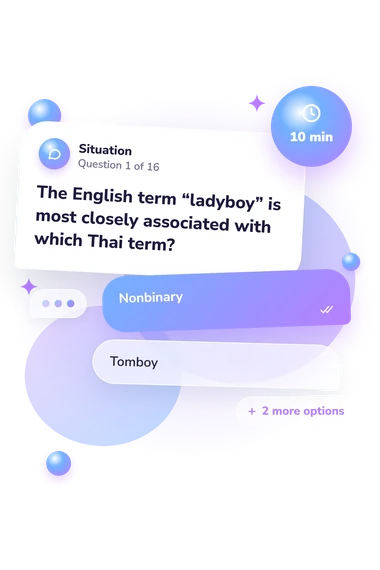
Example Questions From the Test
- Nonbinary
- Tomboy
- Cisgender
- Kathoey
- Automatically replace it with “gay man” because readers know that term
- Automatically replace it with “transgender woman” because both terms are identical
- Remove the identity reference because cultural terms cannot be translated
- Preserve the person’s self-description and explain the cultural context if clarification is needed
- When the person uses or welcomes the term for themself
- Whenever someone appears feminine and was assigned male at birth
- Whenever the person is from Thailand and wears feminine clothing
- Only when the term appears in an English-language profile
Ladyboy Quiz - Description and methodology of the test
Readers who want to understand Thai gender terminology without relying on assumptions can use this assessment as a guided introduction. The ladyboy quiz is suited to travelers, writers, educators, and anyone trying to communicate more respectfully across cultural contexts. Its scenarios address how terms such as kathoey and ladyboy are used in Thailand, alongside questions about identity language, boundaries, consent, and stereotypes.
What This Assessment Explores
Rather than asking respondents to identify themselves, this assessment checks whether they can distinguish cultural terminology from Western categories and avoid inferring identity from appearance, work, clothing, or medical history. It also covers self-description, pronoun respect, privacy, consent, and the difference between gender identity and sexual orientation. The result describes contextual knowledge, not anyone’s gender or sexuality.
The result reflects four connected areas:
- Terminology and translation show whether you preserve chosen language and explain cultural meaning without forcing a false synonym.
- Diversity and identity show whether you recognize varied expressions and life experiences associated with kathoey.
- Respectful interaction shows whether you avoid assumptions about names, pronouns, bodies, and medical history.
- Consent and boundaries show whether you understand mutual expectations and withdrawal of agreement.
A higher result indicates stronger stereotype-aware understanding; a lower result highlights topics for reflection. The result supports contextual learning rather than personal classification.
Methodology and Evidence Base
Each item presents a situation or statement with four answer options. Selecting the most accurate response makes this a scenario-based educational assessment of applied knowledge, not personal disclosure. The Ladyboy Knowledge scale runs from 0-16 and measures understanding of kathoey, identity terminology, respectful interaction, diversity, consent, and stereotype-aware communication. Results are Building Foundations (0-6), Developing Context (7-12), or Strong Contextual Knowledge (13-16).
The score is an educational profile. Individual answer weights are not specified, so no finer-grained score interpretation should be inferred. It is an educational questionnaire without stated standardized norms, reliability estimates, or clinical cutoffs.
Its themes are conceptually consistent with Winter (2006), which describes variation in Thai transgender identities and transitions. Ocha and Earth (2013) helps separate occupation from assumptions about identity, while Saisuwan (2016) explains why language and cultural context matter when terms are translated. These sources support thematic interpretation, not provenance or validation of this questionnaire.
When answering this knowledge questionnaire, performance can reflect prior exposure, wording comprehension, and current understanding. The result can guide learning, but respectful communication still depends on listening to each person’s boundaries.
- Winter, Sam. "Thai Transgenders in Focus: Demographics, Transitions and Identities." International Journal of Transgenderism 9, no. 1 (2006): 15-27. 10.1300/J485v09n01_03
- Ocha, Witchayanee, and Barbara Earth. "Identity Diversification among Transgender Sex Workers in Thailand’s Sex Tourism Industry." Sexualities 16, nos. 1-2 (2013): 195-216. 10.1177/1363460712471117
- Saisuwan, Pavadee. "Kathoey and the Linguistic Construction of Gender Identity in Thailand." In Language, Sexuality, and Power: Studies in Intersectional Sociolinguistics, edited by Erez Levon and Ronald Beline Mendes, 189-214. Oxford University Press, 2016. 10.1093/acprof:oso/9780190210366.003.0010