
Angle Relationships Quiz
How the Scales are Structured
Who Usually Takes This Test?
See How You Compare
Below is a preview of how scores are typically distributed across each scale.
Example Questions From the Test
- 16°
- 48°
- 60°
- 80°
- 90°
- 80°
- 70°
- 110°
- 106°
- 74°
- 148°
- 286°
Angle Relationships Quiz - Description and methodology of the test
Students revising geometry and teachers checking fluency can use this assessment to connect definitions, diagrams, angle measures, and equations. The angle relationships quiz shows whether overall performance falls in a foundational, developing, or strong knowledge band. Reviewing individual questions and the rules behind them may help identify topics for further practice. For a learner wanting an angle relationships mini quiz before review, the result provides a snapshot of current understanding.
What This Assessment Explores
This assessment examines how learners identify and apply relationships created by intersecting lines, parallel lines, transversals, triangles, and angles around a point. Across the set, angle relationships practice questions cover vocabulary, positional reasoning, angle sums, converse theorems, and short equations. The result reflects recognition and application, making it useful for students consolidating geometry and teachers choosing review topics.
The questions cover these topics, followed by one overall scale:
- Definitions and vocabulary ask you to distinguish adjacent, vertical, complementary, and supplementary angles.
- Parallel lines and transversals ask you to identify corresponding, alternate interior, alternate exterior, and same-side interior relationships.
- Equations and angle sums ask you to translate relationships into algebra and calculate an unknown measure.
- Angle Relationships Knowledge (0-16) awards one point per correct answer and places overall performance in Foundations to Build (0-6), Developing Knowledge (7-12), or Strong Knowledge (13-16).
Methodology and Evidence Base
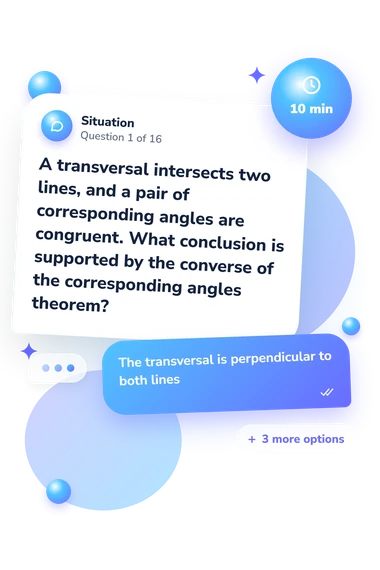
Each item presents a geometry situation with four answer choices. Tasks cover definitions, angle positions, 90° or 180° sums, converse reasoning, and equations. This fixed-response check judges each selection against the relevant geometric rule, so performance reflects the number of correct responses.
Kirk et al. (2023) provide content context for lines, transversals, triangles, and angle measures. The content aligns with HSG-CO.C.9-10 in the Common Core standards and Euclid’s treatment of lines and angles. Okumus and Simsek (2021) is relevant to linguistic signifiers learners use when interpreting angles formed by two lines and a transversal. These sources provide content context; they do not empirically validate or standardize this questionnaire, which is conceptually consistent with them rather than an adaptation of any one.
Several items concern parallel lines and transversals, while the overall score covers all angle-relationship topics. No normative sample or standardization is reported for this questionnaire, and online responding can be affected by wording, attention, or recent classroom exposure. Reviewing a rule behind a missed answer is more useful than treating a band as a fixed measure of mathematical ability.
- Kirk, Donna, Barbara Boschmans, Brian Beaudrie, Matthew Cathey, Valeree Falduto, Maureen Gerlofs, Quin Hearn, and Ian Walters. Contemporary Mathematics. Houston, TX: OpenStax, 2023. Chapter 10, Geometry.
- Common Core State Standards Initiative. Common Core State Standards for Mathematics. Washington, DC: National Governors Association Center for Best Practices and Council of Chief State School Officers, 2010. HSG-CO.C.9-10.
- Euclid. The Thirteen Books of Euclid's Elements, translated with introduction and commentary by Thomas Little Heath. 2nd ed., 3 vols. Cambridge: Cambridge University Press, 1925.
- Okumus, Samet, and Zulfiye Zeybek Simsek. Prospective mathematics teachers' use of linguistic signifiers in the context of angles formed by two lines cut by a transversal. Journal of Mathematical Behavior 63 (2021): 100890. 10.1016/j.jmathb.2021.100890