
Which Reindeer Are You Quiz
How the Scales are Structured
Who Usually Takes This Test?
See How You Compare
Below is a preview of how scores are typically distributed across each scale.
Example Questions From the Test
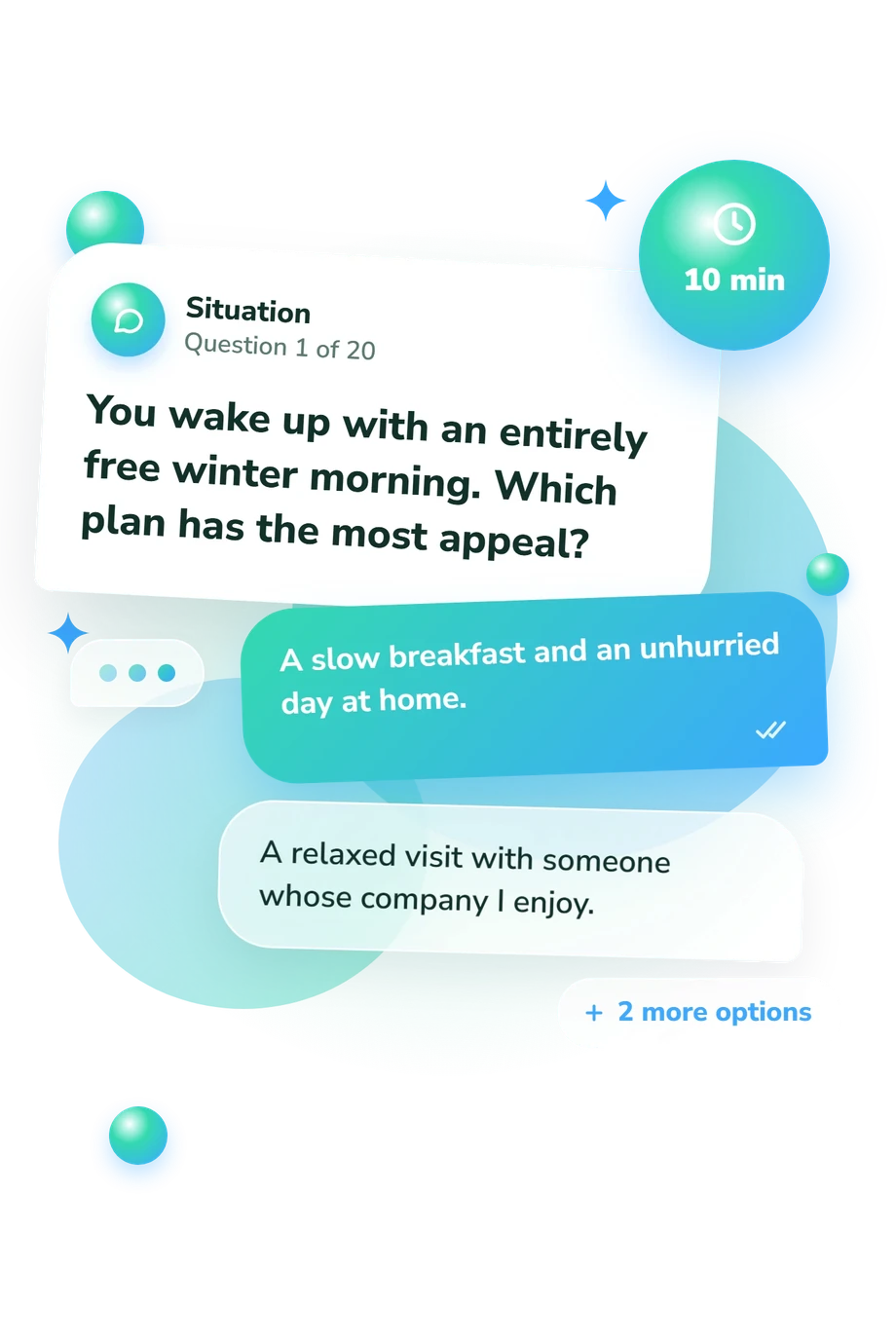
- A slow breakfast and an unhurried day at home.
- A relaxed visit with someone whose company I enjoy.
- A planned activity that gives the morning a clear purpose.
- An energetic outing that makes the day feel like an adventure.
- Enjoying the reassuring familiarity without changing much.
- Helping organize the pieces that others have already chosen.
- Adding a fresh detail that gives the tradition new energy.
- Turning it into an occasion people will talk about afterward.
- Which option would be more meaningful or enjoyable for me now.
- Whether the original plan can reasonably be rearranged.
- How much the person is relying on the commitment I made.
- Preserving their trust by showing up exactly as promised.
Which Reindeer Are You Quiz - Description and methodology of the test
People who want a light, imaginative way to reflect on how they support others, handle uncertainty, and contribute to groups may enjoy the Which Reindeer Are You Quiz. It suits curious people seeking a descriptive profile rather than a fixed label. Using Santa's reindeer as playful archetypes, the quiz offers a shared language for conversations about roles, choices, and collaboration.
What This Assessment Explores
Instead of assigning one fixed mascot, this reindeer personality quiz shows five affinities:
- Cupid & Donner - The Hearthkeeper (0-12) reflects affinity for warmth, loyalty, reassurance, and dependable contribution: Independent Contributor (0-4), Steady Companion (5-8), Devoted Hearthkeeper (9-12).
- Dancer & Prancer - The Spark (0-12) reflects affinity for expression, playfulness, social sparkle, and creating memorable moments: Quiet Presence (0-4), Situational Performer (5-8), Radiant Spark (9-12).
- Dasher & Blitzen - The Trailblazer (0-12) reflects affinity for pace, decisive action, and energizing forward motion: Deliberate Navigator (0-4), Selective Accelerator (5-8), Spirited Trailblazer (9-12).
- Rudolph - The Guiding Original (0-12) reflects affinity for visible individuality, purpose-driven courage, inclusion, and guiding others through uncertainty: Harmonious Teammate (0-4), Emerging Beacon (5-8), Guiding Original (9-12).
- Vixen & Comet - The Pathfinder (0-12) reflects affinity for curiosity, improvisation, clever problem-solving, and exploring alternate routes: Proven-Route Thinker (0-4), Practical Explorer (5-8), Inventive Pathfinder (9-12).
Methodology and Evidence Base
Each item presents a familiar situation with four response choices; you select the reaction that feels most natural. Items touch social support, celebration, commitments, uncertainty, individuality, and problem-solving. There is no correct answer or ability score.
Responses feed five separate dimensions rather than one winner. Because point assignments are not specified, the displayed bands are descriptive profile categories rather than population cutoffs. Results within one point may form a blended profile, so the pattern matters more than a single label.
OLIW offers only a limited conceptual comparison: its multidimensional playfulness model (Proyer, 2017) and short-form work by Proyer, Brauer, and Wolf (2020) relate to playful and expressive themes, not the source or validation of these five custom scales. This online reindeer personality test is a self-report profile, not a named adaptation of OLIW.
Current mood, context, response style, and self-awareness may influence results. Read the profile as a reflection prompt rather than a fixed conclusion.
- Proyer, René T. (2017). A new structural model for the study of adult playfulness: Assessment and exploration of an understudied individual differences variable. Personality and Individual Differences, 108, 113-122. 10.1016/j.paid.2016.12.011
- Proyer, René T., Brauer, Kay, and Wolf, Annegret (2020). Assessing other-directed, lighthearted, intellectual, and whimsical playfulness in adults: Development and initial validation of a short form of the OLIW using self- and peer-ratings. European Journal of Psychological Assessment, 36(4), 624-634. 10.1027/1015-5759/a000531
- McCrae, Robert R., and Costa, Paul T. (1997). Personality trait structure as a human universal. American Psychologist, 52(5), 509-516. 10.1037/0003-066X.52.5.509
Updated: