
Interval Quiz
How the Scales are Structured
Who Usually Takes This Test?
See How You Compare
Below is a preview of how scores are typically distributed across each scale.
Example Questions From the Test
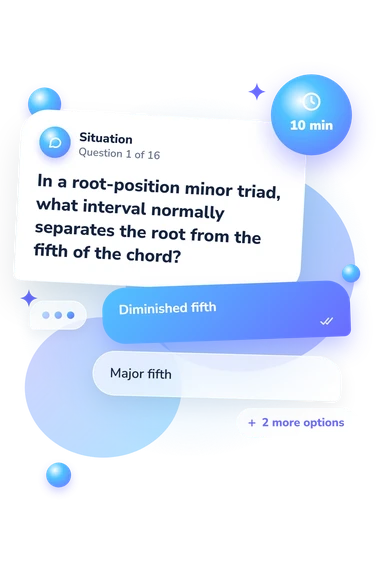
- Diminished fifth
- Major fifth
- Minor sixth
- Perfect fifth
- Major ninth
- Perfect eleventh
- Major tenth
- Minor tenth
- Minor third
- Major third
- Augmented second
- Perfect fourth
Interval Quiz - Description and methodology of the test
Music learners who want to check written theory can use this interval quiz to turn familiar rules into focused review of naming and applying distances between notes. Students and self-directed musicians use this interval theory quiz to practise written interval theory while working on harmony, staff reading, or basic transposition. Results show which rules deserve another pass without treating one score as a complete picture of musicianship.
What This Assessment Explores
Written interval theory is the focus: the questions ask you to name distances between notes and apply rules in notation-based situations. They suit learners reviewing harmony, staff reading, transposition, and chord construction. As an interval theory test, the assessment helps locate gaps in written knowledge rather than estimate listening or performance skill.
These themes show the reasoning behind the result:
- Interval number identifies the letter-name span, such as a third or fifth.
- Interval quality distinguishes perfect, major, minor, augmented, and diminished forms.
- Semitone and spelling rules connect written names with pitch distance, including enharmonic cases.
- Compound and inverted forms show whether rules transfer to wider or reversed intervals.
The result reports Music Interval Knowledge (0-16): Emerging foundation (0-6), Developing command (7-12), or Strong command (13-16). The result reflects written theory, not aural identification or overall musicianship.
Methodology and Scientific Basis
Each item presents a musical prompt with four answer choices. They cover interval names, semitone counts, compound forms, inversions, transposition, and enharmonic spelling. The format tests recall and application rather than general musical confidence.
The displayed band summarizes written interval knowledge across the questionnaire. It guides review by showing the overall level reached, but it does not identify which individual topics or items were missed. This written interval assessment covers written interval theory rather than the full range of musical competence.
Barrett et al. (2020) provide context for connecting music-theory learning with practical musical participation, but it is not a validation study of this questionnaire. Kostka, Payne, and Almén, together with Benward and Saker, supply the tonal-theory framework for interval number, quality, semitone distance, inversion, and compound forms. The questionnaire is conceptually consistent with those sources, not an adaptation of them.
Use the result to revisit interval number, quality, semitone distance, spelling, inversion, and compound forms through notation exercises.
- Barrett, Michael, Roy Page-Shipp, Caroline van Niekerk, and Johan Ferreira. "Learning music theory en passant: a study in an internationally recognised South African University student choir." British Journal of Music Education, 37(2), 155-168, 2020. 10.1017/S0265051719000238
- Kostka, Stefan M., Dorothy Payne, and Byron Almén. Tonal Harmony: With an Introduction to Post-Tonal Music. 8th ed. New York: McGraw-Hill Education, 2018.
- Benward, Bruce, and Marilyn Nadine Saker. Music in Theory and Practice, Volume 1. 9th ed. New York: McGraw-Hill, 2014.