
Harrison Bergeron Quiz
How the Scales are Structured
Who Usually Takes This Test?
See How You Compare
Below is a preview of how scores are typically distributed across each scale.
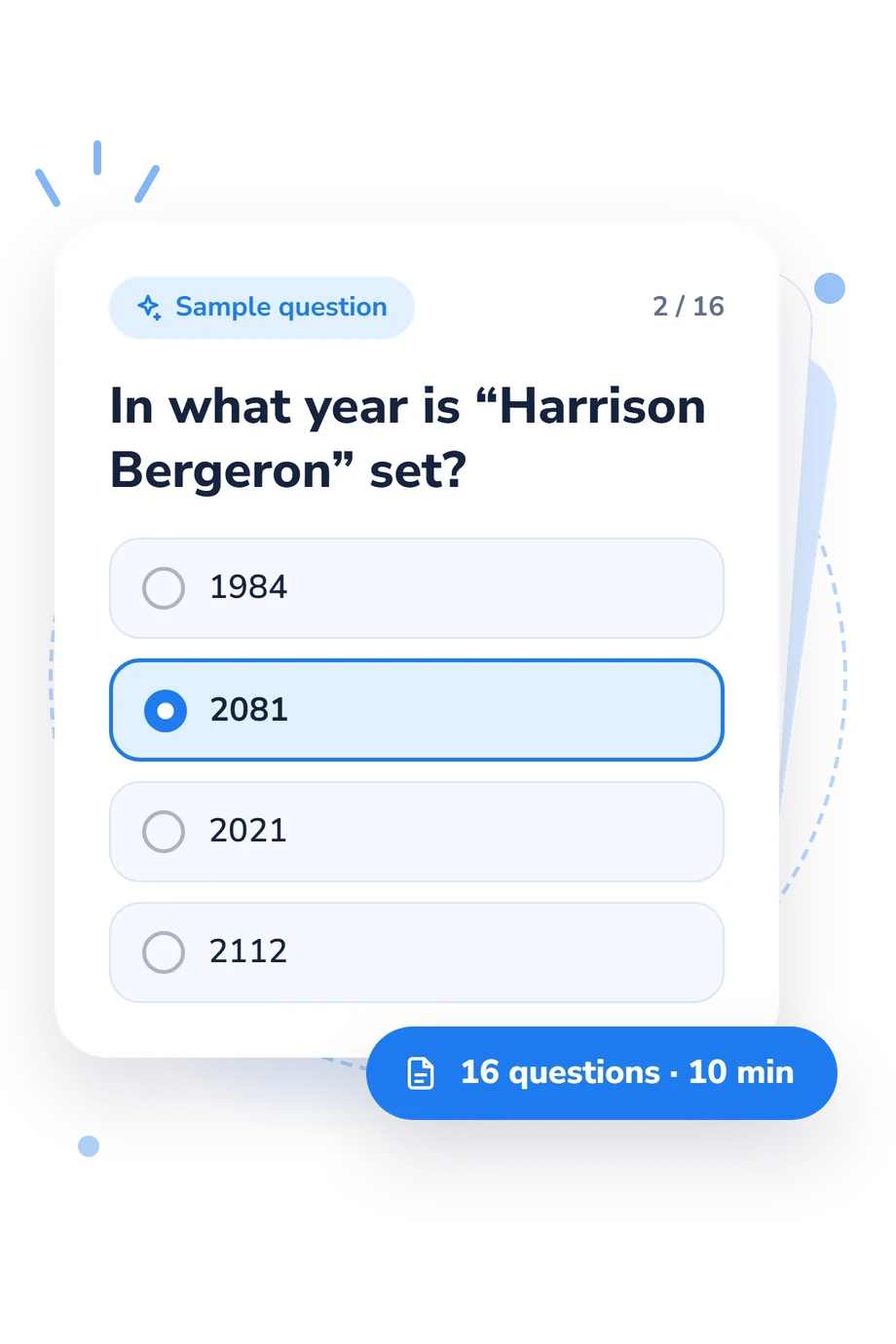
Example Questions From the Test
- 1984
- 2081
- 2021
- 2112
- The studio loses power during a storm.
- George turns off the television after hearing a noise.
- Harrison enters the studio and takes control of the broadcast.
- Hazel calls the Handicapper General to protest.
- Hazel Bergeron
- Diana Moon Glampers
- The television announcer
- George Bergeron
Harrison Bergeron Quiz - Description and methodology of the test
Readers returning to Kurt Vonnegut’s short story can use the Harrison Bergeron Quiz to test memory and interpretation. It suits students, book-club members, and independent readers who want to connect plot details with satire, character choices, and the warning about enforced sameness. Its quiz questions on Harrison Bergeron link events with their meaning, while the result shows which parts of the text merit closer rereading.
What This Assessment Explores
The assessment measures plot, characters, setting, the handicap system, irony, and themes. It suits readers who want to move beyond recall and consider why Vonnegut links equality with restriction and force. As a literary quiz about Harrison Bergeron, it connects events with what they reveal about obedience and resistance.
The result areas are:
- Plot and sequence show whether you place the escape, broadcast, dance, and ending accurately.
- Characters and actions reveal how figures respond to authority, resistance, and confusion.
- Handicaps and social control indicate how well you understand the restraints imposed by law.
- Irony and themes show whether you connect equality, entertainment, violence, and forgetting.
The Harrison Bergeron Knowledge scale runs 0-16: Foundation 0-6 signals partial understanding; Developing 7-12 shows command of central events with details to sharpen; Strong 13-16 shows command of detail, irony, and themes.
Methodology and Evidence Base
Each item presents a question with four answer choices, combining factual recall-year, characters, actions, and sequence-with interpretation of irony, symbolism, equality, media, memory, and the ending. Correct responses follow the story; interpretive items ask for the reading best supported by its text. The score summarizes performance here rather than establishing population norms or general literary ability.
When a response is missed, quiz answers for Harrison Bergeron can show whether it reflects a forgotten detail or a different interpretation, making rereading more targeted. The result does not measure broad reading ability or prove that one interpretation is the only defensible one.
Harrison Bergeron (Vonnegut, 1961) supplies the textual basis for details and events. Hattenhauer (1998) supports a political reading of enforced equality and authoritarian power; Reed (2015) addresses distraction and impaired memory; Joodaki and Mahdiany (2013) discuss equality versus freedom. These sources provide context, but this questionnaire is not a standardized adaptation of any one of them.
Because no published reliability study or norm group is claimed, the result is a focused reading check. Familiarity, attention, and reasoning on interpretive items can affect performance, and rereading may change the outcome.
- Vonnegut, Kurt. “Harrison Bergeron.” The Magazine of Fantasy and Science Fiction, vol. 21, no. 4, October 1961, pp. 5-10.
- Hattenhauer, Darryl. “The Politics of Kurt Vonnegut’s ‘Harrison Bergeron.’” Studies in Short Fiction, vol. 35, no. 4, 1998, pp. 387-392.
- Reed, Benjamin. “Technologies of Instant Amnesia: Teaching Kurt Vonnegut’s ‘Harrison Bergeron’ to the Millennial Generation.” Teaching American Literature: A Journal of Theory and Practice, vol. 8, no. 1, 2015, pp. 45-69.
- Joodaki, Abdol Hossein, and Hamideh Mahdiany. “Equality versus Freedom in ‘Harrison Bergeron’ by Kurt Vonnegut: A Study of Dystopian Setting.” International Journal of Applied Linguistics and English Literature, vol. 2, no. 4, 2013, pp. 70-73. 10.7575/aiac.ijalel.v.2n.4p.70
Updated: