
Travel Personality Quiz
How the Scales are Structured
Who Usually Takes This Test?
See How You Compare
Below is a preview of how scores are typically distributed across each scale.
Example Questions From the Test
- Return to a place I already know I enjoy
- Take a relaxed walk near my accommodation
- Visit an attraction recommended by someone I trust
- Head toward an unfamiliar district or trail and see what unfolds
- A destination that feels easy and reliably enjoyable
- A comfortable destination with one or two unfamiliar features
- A place offering several experiences I have never tried
- A place whose unfamiliarity is the main reason to go
- Full days with many activities and little unused time
- Mostly active days with an occasional slow period
- One or two main activities each day with time to unwind
- Open, spacious days shaped around rest and an unhurried rhythm
Travel Personality Quiz - Description and methodology of the test
Travelers who want to understand which travel conditions they tend to find energizing, tiring, engaging, or restorative can use the Travel Personality Quiz to examine their preferred balance of novelty, culture, recovery, and connection. The assessment suits trip planners, people reflecting on past experiences, and travelers comparing their preferences with a destination's offerings; its travel preference profile supports practical trip choices. Results turn those preferences into a readable profile.
What This Assessment Explores
Travel choices appear here as a pattern, not a fixed identity. The items compare what travelers seek in destinations, pace, cultural contact, novelty, and company. The questionnaire describes relative preferences or affinities rather than assigning a fixed travel identity; the profile can guide vacation planning.
The four dimensions and their displayed result bands are:
- Bold Explorer (0-12) shows attraction to unfamiliar routes and spontaneity: Familiarity Forward 0-4, Flexible Adventurer 5-8, Bold Explorer 9-12.
- Cultural Immerser (0-12) shows how central local life is: Light-Touch Visitor 0-4, Curious Observer 5-8, Cultural Immerser 9-12.
- Restorative Voyager (0-12) shows the pull of comfort and recovery: Momentum Seeker 0-4, Balanced Recharger 5-8, Restorative Voyager 9-12.
- Social Connector (0-12) shows enjoyment of shared experiences: Independent Traveler 0-4, Selective Connector 5-8, Social Connector 9-12.
Methodology and Scientific Basis
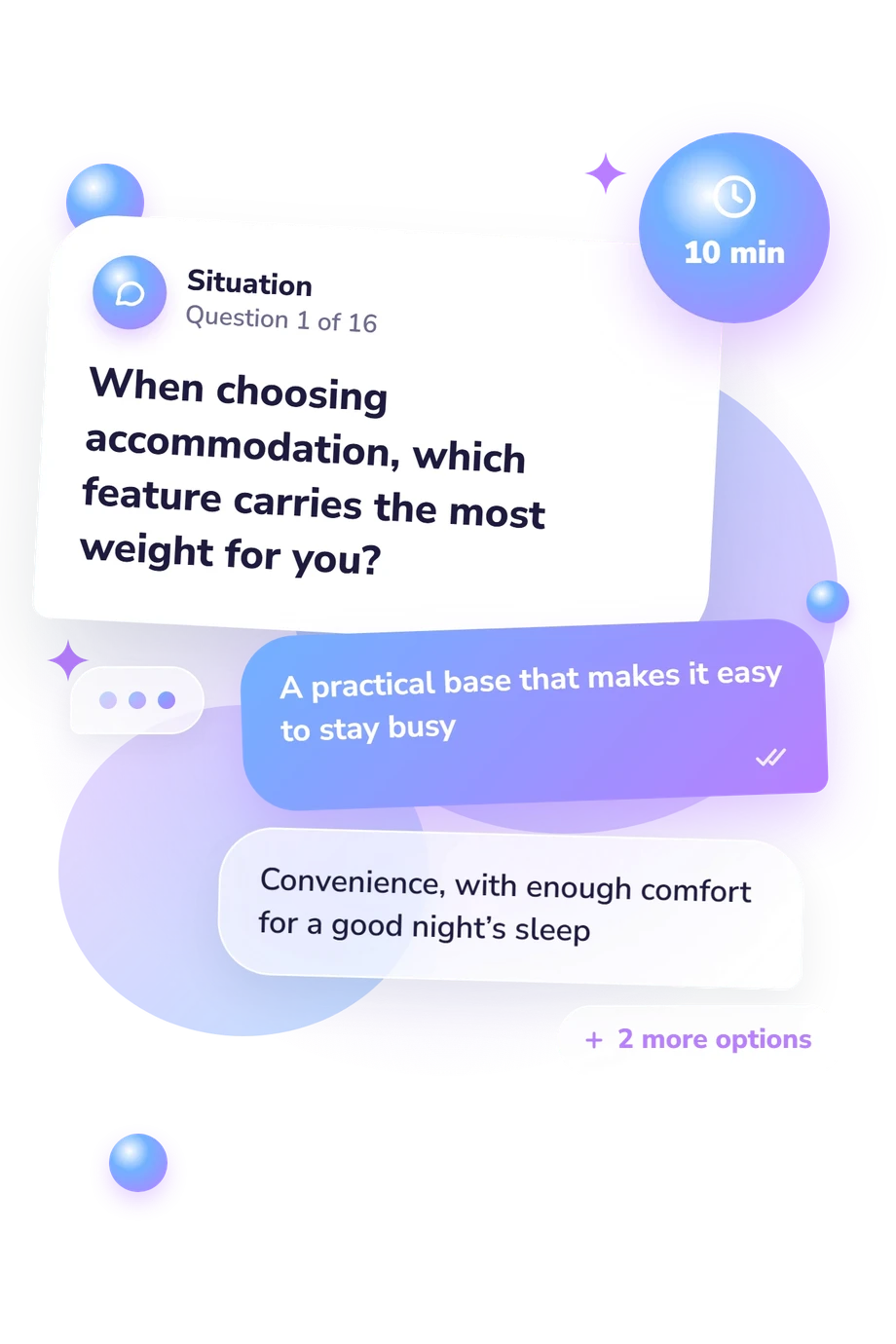
Each item presents a travel situation with four response options, so there is no correct answer. The choices cover accommodation, pace, disruptions, cultural learning, solo time, and social contact, sampling everyday decisions rather than one isolated reaction.
Scoring is descriptive: the result displays four affinity profiles and compares their scores rather than combining them into one global rating. Profiles with scores within one point of the highest can produce a blended interpretation, reflecting preferences that are similarly strong.
Pearce and Lee (2005) provide the closest conceptual comparison, connecting tourist preferences with changing patterns of novelty and experience. Fodness (1994) treats tourist motivation as multidimensional; Ryan and Glendon (1998) connect tourism choices with leisure motives; and Lee and Crompton (1992) offer a relevant framework for novelty seeking.
This self-reflection questionnaire is conceptually consistent with those studies, not an adaptation or validation of a published instrument. Tourist motivation research supplies context, while the result remains descriptive of travel preferences rather than a single underlying motive or fixed identity. Current context, memory, and self-presentation can shape answers, so read it alongside travel experience.
- Pearce, Philip L., and Uk-Il Lee. "Developing the Travel Career Approach to Tourist Motivation." Journal of Travel Research 43, no. 3 (2005): 226-237. DOI 10.1177/0047287504272020
- Fodness, Dale. "Measuring Tourist Motivation." Annals of Tourism Research 21, no. 3 (1994): 555-581. DOI 10.1016/0160-7383(94)90120-1
- Ryan, Chris, and Ian Glendon. "Application of Leisure Motivation Scale to Tourism." Annals of Tourism Research 25, no. 1 (1998): 169-184. DOI 10.1016/S0160-7383(97)00066-2
- Lee, Tae-Hee, and John L. Crompton. "Measuring Novelty Seeking in Tourism." Annals of Tourism Research 19, no. 4 (1992): 732-751. DOI 10.1016/0160-7383(92)90064-V
Updated: