
Forensic Science Quiz
How the Scales are Structured
Who Usually Takes This Test?
See How You Compare
Below is a preview of how scores are typically distributed across each scale.
Example Questions From the Test
- To help verify that the forensic copy accurately represents the source data
- To decrypt every protected file on the drive
- To identify the person who last used the computer
- To determine whether all files are legally admissible
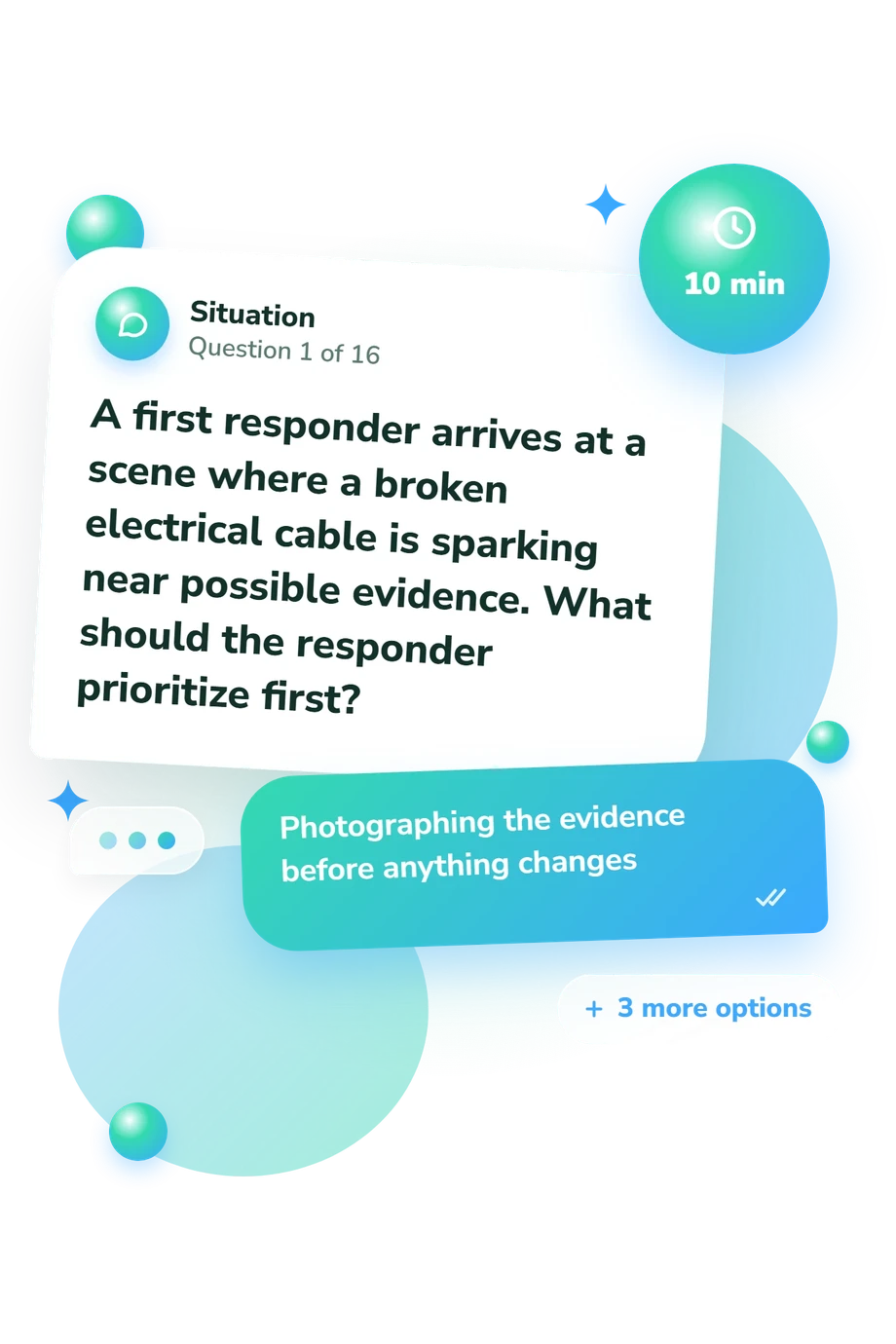
- Photographing the evidence before anything changes
- Collecting fragile evidence before specialists arrive
- Addressing immediate safety hazards and controlling access
- Interviewing every witness inside the scene
- The principle of superposition
- The exclusionary rule
- Locard’s exchange principle
- The corpus delicti rule
Forensic Science Quiz - Description and methodology of the test
Designed for students, trainees, and curious readers who want to test applied reasoning, this forensic science quiz presents short investigative situations instead of isolated definitions. It can help you examine how well you apply knowledge of evidence preservation, laboratory interpretation, digital traces, and limits on conclusions. The forensics quiz can help identify concepts to review and sharpen careful interpretation of evidence.
What This Assessment Explores
The scenarios ask whether you can apply core principles when evidence is incomplete, fragile, or open to competing interpretations. Readers learning or revising forensic reasoning can use questions on forensic science in this quiz to practise application rather than recall.
The result summarizes one educational scale, Forensic Science Knowledge (0-16). Foundation to Build (0-6) signals concepts needing review; Developing Knowledge (7-12) reflects core principles with room to strengthen application; Strong Knowledge (13-16) reflects a well-rounded grasp of forensic reasoning, evidence handling, and important limits. This score does not establish professional competence or certify conclusions about a real case.
The scenarios cover these practical dimensions:
- Scene safety and continuity show whether you protect people and document handling.
- Laboratory interpretation shows whether you separate possibilities from identifications.
- Digital evidence shows whether you understand imaging, hashes, deletion, and metadata.
- Comparison and inference show whether you recognize class characteristics, bias, and uncertainty.
Methodology and Scientific Basis
Each item gives a brief case and several answer choices. The forensic quiz questions test preservation, continuity, comparison, interpretation, and context, while distractors may overstate what a method can establish.
Selected responses are summarized as one educational knowledge result and assigned to the displayed bands. The displayed result is an educational score intended to identify learning priorities, not a professional pass standard. It focuses on evidence handling, analytical limits, and digital traces that merit further study.
Houck and Siegel’s forensic-science textbook is the closest conceptual reference for evidence handling, laboratory reasoning, and limits of interpretation; this questionnaire is conceptually consistent with that work, not an adaptation of it, and its scenarios address those themes through scene safety, digital traces, comparison, and biological evidence. The National Research Council’s forensic-science report, NIST’s digital-forensics guidance, and Dror’s work on contextual bias support the emphasis on scientific limits, digital evidence, and contextual bias.
Performance can reflect prior study, guessing, attention, and how a scenario is read, so the result is best used to plan further study.
- Houck, Max M., and Jay A. Siegel. Fundamentals of Forensic Science, 3rd ed. Academic Press, 2015. ISBN 9780128000373.
- National Research Council. Strengthening Forensic Science in the United States: A Path Forward. National Academies Press, 2009. 10.17226/12589.
- Kent, Karen, Suzanne Chevalier, Tim Grance, and Hung Dang. Guide to Integrating Forensic Techniques into Incident Response. NIST Special Publication 800-86. National Institute of Standards and Technology, 2006. 10.6028/NIST.SP.800-86.
- Dror, Itiel E. “Cognitive neuroscience in forensic science: understanding and utilizing the human element.” Philosophical Transactions of the Royal Society B: Biological Sciences 370, no. 1674 (2015): 20140255. 10.1098/rstb.2014.0255.
Updated: