
Are You a Vampire Quiz
How the Scales are Structured
Who Usually Takes This Test?
See How You Compare
Below is a preview of how scores are typically distributed across each scale.
Example Questions From the Test
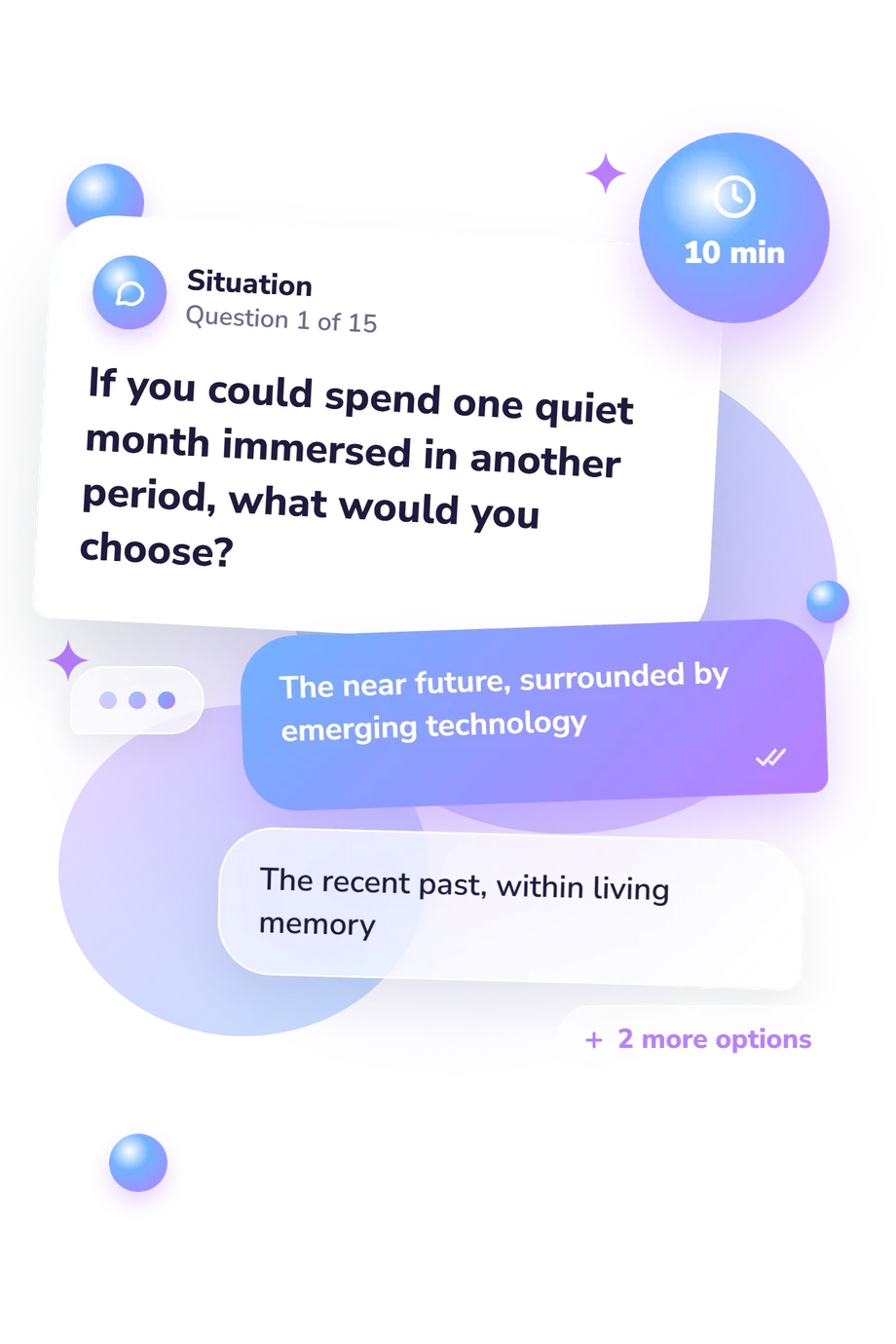
- The near future, surrounded by emerging technology
- The recent past, within living memory
- A historical era I have read about in detail
- A distant century of castles, rituals, and forgotten customs
- A sleek new venue with experimental dishes
- A relaxed contemporary restaurant in a lively neighborhood
- A historic dining room with traditional details
- A candlelit hall that seems untouched by time
- Answer openly if the question seems friendly
- Share a simple version without going very deep
- Offer a carefully chosen detail and redirect the conversation
- Keep the answer elusive until the person has earned my trust
Are You a Vampire Quiz - Description and methodology of the test
Designed for readers who enjoy symbolic personality tools, the Are You a Vampire Quiz turns vampire imagery into questions about selective, private social presence, daily rhythm, and attraction to history, ritual, and old-world atmosphere. It suits anyone using this quiz to explore how to know if you are a vampire in a symbolic sense, reflecting on social style, routines, and personal atmosphere; the result maps these tendencies across three themes.
What This Assessment Explores
Rather than measure belief in vampires, the questionnaire uses the theme as a lens for interpersonal style, preferred hours, and attraction to history, ritual, and permanence. As a vampire personality quiz, it suits readers seeking a vivid profile of social approach and atmosphere preferences. The three dimensions are:
- Mysterious Intensity (0-15) measures selective, private, deeply focused interpersonal style; Open Presence (0-5), Quiet Magnetism (6-10), and Enigmatic Force (11-15) show its bands.
- Nocturnal Nature (0-15) measures how strongly energy and routines gravitate toward night; Sunlit Spirit (0-5), Twilight Drifter (6-10), and Creature of the Night (11-15) show its bands.
- Timeless Sensibility (0-15) reflects attraction to history, ritual, and permanence; Modern Pulse (0-5), Keeper of Echoes (6-10), and Timeless Soul (11-15) show its bands.
Read separately, the three dimensions can produce different combinations of social style, nighttime orientation, and historical sensibility.
Methodology and Evidence Base
Each item presents a familiar situation with four ordered choices. Responses progress from open, daytime, modern, or lightly engaged reactions toward private, nocturnal, enduring, or intense ones. The selected option lets the profile capture patterns in social behavior, energy, attention, and taste.
Scoring is dimensional: the result reports separate scale scores in the displayed bands, but the questionnaire does not specify how many points each response contributes or provide a standardized point scheme. The playful premise frames a vampire personality test around whether someone might have a vampire-like style, then translates that idea into self-report tendencies.
Bram Stoker's Dracula supplies cultural context for the vampire persona, not evidence for these psychological dimensions; this questionnaire is not an adaptation of the novel. The questionnaire is conceptually parallel to Horne and Ostberg's work on morningness-eveningness and Batcho's research on nostalgia, but neither establishes validity, norms, or standardized scoring for this online tool.
Current mood, memory, self-presentation, and response bias can influence answers, so the profile is best read as a snapshot of present preferences and self-perception.
- Hardy, Callum. "From Dracula to Cullen: The Average Vampire." Saints Academic Review, vol. III, 2025-2026, pp. 16-31.
- Horne, James A., and Olov Ostberg. "A self-assessment questionnaire to determine morningness-eveningness in human circadian rhythms." International Journal of Chronobiology, vol. 4, no. 2, 1976, pp. 97-110.
- Batcho, Krystine Irene. "Nostalgia: A psychological perspective." Perceptual and Motor Skills, vol. 80, no. 1, 1995, pp. 131-143. 10.2466/pms.1995.80.1.131
Updated: