
What Bronzer Should I Use Quiz
How the Scales are Structured
Who Usually Takes This Test?
See How You Compare
Below is a preview of how scores are typically distributed across each scale.
Example Questions From the Test
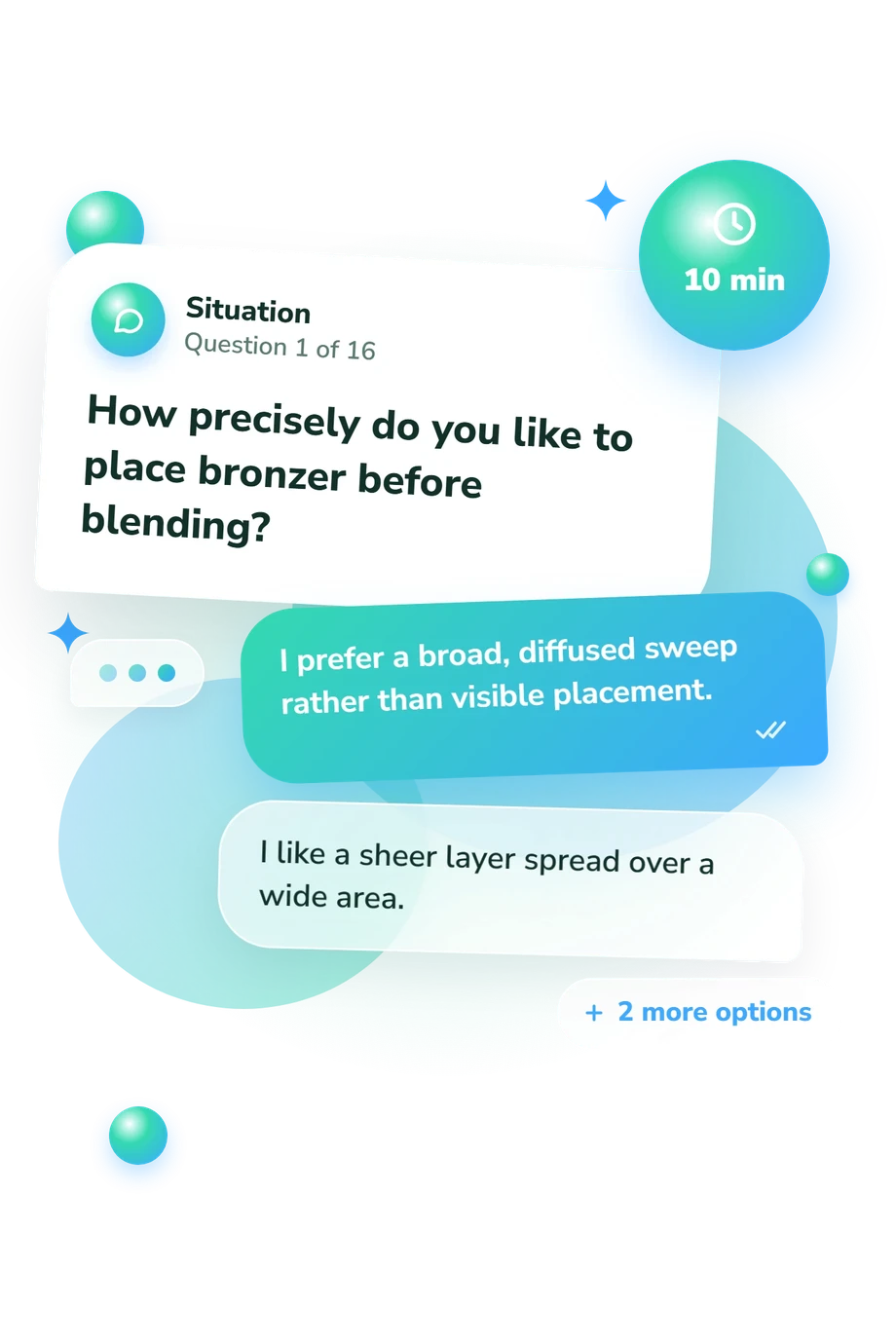
- I prefer a broad, diffused sweep rather than visible placement.
- I like a sheer layer spread over a wide area.
- I tap color onto approximate zones, then shape the edges.
- I want to mark exact points or short lines before blending.
- A compact and a full-size fluffy brush.
- A pot of cream with a sponge or tapping brush.
- A small liquid bottle and a mixing surface.
- A twist-up stick that can be applied directly and buffed out.
- Soft brush diffusion that does not create sharp starting points.
- A dab of cream that I can pat outward gradually.
- A tiny fluid amount that spreads into a translucent veil.
- A narrow product edge that places color exactly where intended.
What Bronzer Should I Use Quiz - Description and methodology of the test
Choosing a bronzer can be difficult when a product looks appealing but its application feels awkward. The What Bronzer Should I Use Quiz helps readers interpret their placement, blending, and finish preferences. Its bronzer recommendation reflects how someone wears makeup, not just how a formula looks in a swatch. It is for readers who want a more deliberate decision before buying a product.
What This Assessment Explores
The questionnaire links your makeup habits with four bronzer formats. Its scenarios cover placement, blending, portability, fluidity, finish, layering, base preparation, and touch-ups.
The result is a comparative profile. This bronzer quiz shows which application styles feel most natural. The displayed scales describe these matches:
- Cream Bronzer (0-12) measures pliable, skin-like preference: Low cream fit (0-4), Flexible cream option (5-8), or Strong cream affinity (9-12).
- Liquid Bronzer (0-12) measures comfort with drops and thin layers: Low liquid match (0-4), Selective liquid match (5-8), or Strong liquid affinity (9-12).
- Powder Bronzer (0-12) measures brush-applied, buildable preference: Different workflow (0-4), Situational match (5-8), or Strong powder affinity (9-12).
- Stick Bronzer (0-12) measures direct, portable placement: Different style (0-4), Useful option (5-8), or Strong affinity (9-12).
Methodology and Evidence Base
Each item presents a situation involving bronzer application and offers four response choices covering control, speed, finish, placement, and blending. Examples distinguish a broad brush sweep from tapped cream, measured liquid, or direct stick application. This makes bronzer selection a preference-matching task, not a test of technical skill.
Responses produce four format-specific scores. Since the displayed method gives no point-by-point weighting formula, interpret them comparatively: a higher score means closer alignment with that format's workflow. Results within one point of the highest score form a blended recommendation.
Cheon et al. (2025) connect cosmetic texture preference with neural indicators, offering context for why a formula's feel can influence choice. Courrèges et al. (2021) link touch and smell with cream perception, while Spence and Zhang (2024) discuss multisensory cosmetic interaction. Together, these papers provide contextual research on cosmetic texture and perception, rather than validation of the questionnaire's format-specific scores.
Context also matters: the best bronzer formula may vary with familiarity and occasion. Because responses are self-reported and context-sensitive, the displayed bands are preference categories rather than clinical norms.
- Cheon, H.-R., Kwon, G., Kim, Y., Kim, H., Lee, H. K., Shin, J. H., Yu, J., and Hwang, H.-J. (2025). Electroencephalography-based neural indicators of texture preference for cosmetic formulations. Frontiers in Neuroscience, 19, 1620806. 10.3389/fnins.2025.1620806
- Courrèges, S., Aboulaasri, R., Bhatara, A., and Bardel, M.-H. (2021). Crossmodal Interactions Between Olfaction and Touch Affecting Well-Being and Perception of Cosmetic Creams. Frontiers in Psychology, 12, 703531. 10.3389/fpsyg.2021.703531
- Spence, C., and Zhang, T. (2024). Multisensory contributions to skin-cosmetic product interactions. International Journal of Cosmetic Science, 46(6), 833-849. 10.1111/ics.12975
Updated: