
Spider Quiz
How the Scales are Structured
Who Usually Takes This Test?
See How You Compare
Below is a preview of how scores are typically distributed across each scale.
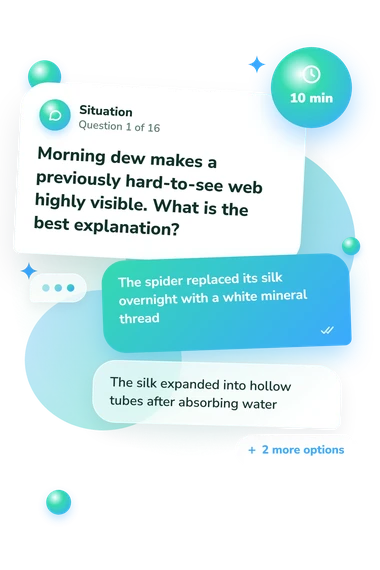
Example Questions From the Test
- Producing nectar for other arthropods
- Pollinating nearly all flowering plants
- Breaking down rock into mineral soil
- Preying on insects and other small animals
- They grind the entire prey animal with chewing jaws
- They release digestive fluids and draw in the liquefied tissues
- They swallow the prey whole and digest it in the stomach
- They scrape off pieces with a toothed tongue
- It is a young spider that has not grown its final pair of legs
- It is a harvestman because harvestmen have antennae
- It is a spider adapted to living among insects
- It is an insect rather than a spider
Spider Quiz - Description and methodology of the test
Curious learners who want to apply spider facts to everyday scenarios can use this spider quiz as a focused introduction to the subject. It helps readers distinguish common biological misconceptions from evidence about silk, molting, breathing, prey capture, and body structure. This spider knowledge test turns familiar observations into short reasoning tasks rather than asking for specialist terminology.
What This Assessment Explores
The questions assess understanding of spider anatomy, behavior, ecology, feeding, reproduction, defense, and life processes. They also ask readers to distinguish spiders from similar arthropods and connect observable clues, such as a web pattern or body structure, with the best biological explanation. The assessment suits curious learners who want an accessible foundation rather than a specialist examination.
The main themes are:
- Anatomy and classification cover body regions, legs, pedipalps, spinnerets, breathing organs, and differences from insects or harvestmen.
- Behaviour and survival cover web vibration, ballooning, autotomy, molting, prey capture, and defense.
- Ecology and life processes connect spiders with predation, silk use, habitats, and development.
- Identification asks readers to apply visible clues to the most likely biological explanation.
Moving beyond memorized labels, this spider identification quiz asks readers to reason from anatomy, behavior, and ecological context.
Methodology and Scientific Basis
Each item gives a factual or scenario-based prompt with four answer choices. Some questions test definitions; others require the reader to infer a process from evidence such as silk, body structure, or behavior. The result is reported on one Spider Knowledge scale from 0-16: Emerging 0-6, Developing 7-12, and Strong 13-16.
Foelix provides the factual reference for the questionnaire's anatomy, physiology, behavior, and life-history content. Prokop and Tunnicliffe (2008) offer related evidence about spider myths and attitudes; their study concerns attitudes rather than knowledge measurement, so this questionnaire is not an adaptation of it. Harmer and colleagues support interpreting webs through biomechanics, ecology, and behavior. These sources support the subject matter, but none validates this specific questionnaire or supplies its scoring model.
The score is a snapshot of performance on these questions, so prior study, guessing, attention, and answer wording can affect it. This spider biology quiz can therefore guide further reading by showing which parts of the subject deserve more attention.
- Prokop, Pavol, and Sue Dale Tunnicliffe. “Disgusting” Animals: Primary School Children’s Attitudes and Myths of Bats and Spiders. Eurasia Journal of Mathematics, Science and Technology Education, 4(2), 87-97 (2008). DOI 10.12973/ejmste/75309.
- Foelix, Rainer F. Biology of Spiders. 3rd ed. New York: Oxford University Press, 2011. ISBN 978-0-19-973482-5.
- Harmer, Aaron M. T., Todd A. Blackledge, Joshua S. Madin, and Marie E. Herberstein. High-performance spider webs: integrating biomechanics, ecology and behaviour. Journal of the Royal Society Interface, 8(57), 457-471 (2011). DOI 10.1098/rsif.2010.0454.