
Dr. Berg Body Type Quiz
How the Scales are Structured
Who Usually Takes This Test?
See How You Compare
Below is a preview of how scores are typically distributed across each scale.
Example Questions From the Test
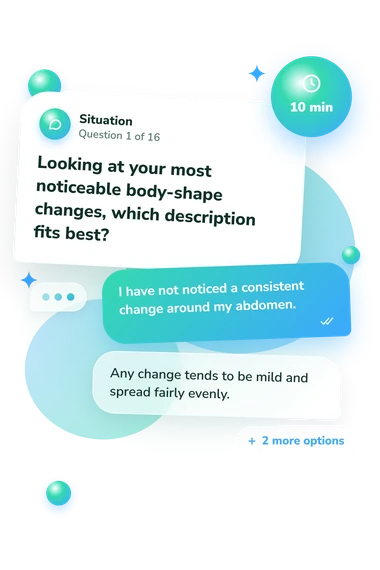
- I have not noticed a consistent change around my abdomen.
- Any change tends to be mild and spread fairly evenly.
- Change is often more noticeable through my upper waist and abdomen.
- A rounded or protruding abdomen while my limbs change comparatively little is the dominant pattern.
- No consistent dryness, coarseness, or diffuse hair change.
- Occasional dryness or shedding that resolves or has an obvious situational cause.
- Recurring dry skin, coarse texture, or broadly increased shedding.
- A persistent combination of marked dryness and diffuse hair or texture changes.
- Comfortable at roughly the same temperature as everyone else.
- A little chilly now and then, especially when inactive.
- Noticeably colder than others on a regular basis.
- Persistently cold, often needing extra layers when others do not.
Dr. Berg Body Type Quiz - Description and methodology of the test
People curious about how recurring body-shape, digestive, stress-related, temperature, or cycle-linked experiences fit Dr Berg’s model can use this Dr Berg body type quiz as a structured reflection. The Dr Berg Quiz shows which of four framework profiles most closely matches the situations described in the answers, helping the reader organize observations without treating a pattern as a medical explanation.
What This Assessment Explores
Questions cover body shape, abdominal fullness, rich meals, stress, sleep, cravings, temperature, energy, hair, skin, and cycles. In this Dr Berg evaluation quiz, higher affinity means resemblance, not abnormal organ function.
Scales:
- Adrenal Body Type Affinity (0-12): Limited affinity (0-4) means little resemblance; Moderate affinity (5-8) means several stress, sleep, craving, or waist features; Strong affinity (9-12) means a prominent match.
- Liver Body Type Affinity (0-12): Limited affinity (0-4) means few upper-abdominal or meal-related features; Moderate affinity (5-8) means some alignment; Strong affinity (9-12) means a prominent match.
- Ovary Body Type Affinity (0-12): Limited affinity (0-4) means few lower-body or cycle-linked features; Moderate affinity (5-8) means several; Strong affinity (9-12) means a prominent match.
- Thyroid Body Type Affinity (0-12): Limited affinity (0-4) means few generalized-change or cold/low-energy features; Moderate affinity (5-8) means several; Strong affinity (9-12) means a prominent match.
Methodology and Scientific Basis
Each item uses four ordered response choices, moving from no clear pattern toward stronger, more persistent experiences. Respondents compare their situations with descriptions rather than rate a medically defined symptom severity. Related prompts produce four displayed affinity totals, but no validated point conversion for individual choices is established.
Scores should be interpreted comparatively within this questionnaire. The bands are unvalidated reflective summaries: they do not measure cortisol, liver health, ovarian function, or thyroid function. Stress, sleep, diet, life stage, medication, and self-perception may influence responses.
The named model is the Berg body-type framework (2017). The online questionnaire is conceptually consistent with that framework, but its scoring is not a standardized reproduction of a published Berg measure. Juppi et al. (2022) provides context on regional adiposity changes during menopause, while Abraham et al. (2013) examines cortisol, obesity, and metabolic syndrome; neither study validates these online scores.
As a Dr Berg body type assessment, the tool helps organize self-observation and identify topics for broader health discussion. Persistent or concerning symptoms should be evaluated according to the symptoms themselves, not the affinity label.
- Berg, Eric. Dr. Berg's New Body Type Guide: Get Healthy, Lose Weight & Feel Great. New York: KB Publishing, 2017. ISBN 978-0-9826016-3-1.
- Juppi, Hanna-Kaarina, Sarianna Sipilä, Vasco Fachada, Matti Hyvärinen, Neil J. Cronin, Pauliina Aukee, Jari E. Karppinen, Harri Selänne, Urho M. Kujala, Vuokko Kovanen, Sira Karvinen, and Eija K. Laakkonen. (2022). Total and regional body adiposity increases during menopause-evidence from a follow-up study. Aging Cell, 21(6), e13621. 10.1111/acel.13621.
- Abraham, S. B., Domenica Rubino, N. Sinaii, S. Ramsey, and L. K. Nieman. (2013). Cortisol, obesity, and the metabolic syndrome: A cross-sectional study of obese subjects and review of the literature. Obesity, 21(1), E105-E117. 10.1002/oby.20083.