
Franchise Quiz
How the Scales are Structured
Who Usually Takes This Test?
See How You Compare
Below is a preview of how scores are typically distributed across each scale.
Example Questions From the Test
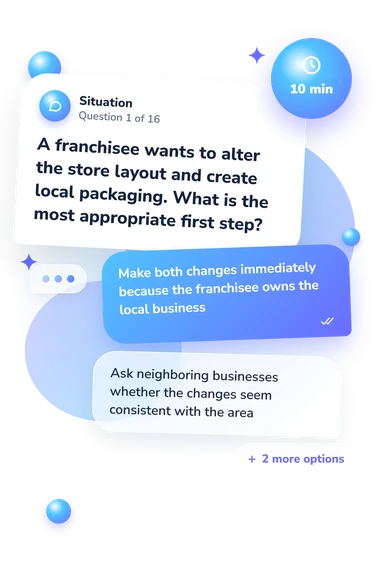
- Make both changes immediately because the franchisee owns the local business
- Ask neighboring businesses whether the changes seem consistent with the area
- Register the new packaging as a separate brand before informing the franchisor
- Check the agreement and operating standards, then seek any required franchisor approval
- The franchisor licenses its brand and system; the franchisee operates a business under that system.
- The franchisor owns every outlet, while the franchisee manages one as an employee.
- The franchisor supplies financing, while the franchisee supplies only labor.
- The franchisor controls the local market, while the franchisee owns the brand trademarks.
- The estimated total initial investment, including required opening expenses and working capital
- The initial franchise fee by itself
- The franchisor’s total company revenue
- The number of pages in each franchise agreement
Franchise Quiz - Description and methodology of the test
Prospective franchisees, small-business buyers, and investors can use this assessment to examine how they think through practical decisions surrounding a franchise opportunity. The franchise quiz is intended for readers who want a structured check before comparing systems, reviewing documents, or speaking with advisers. Readers can take a franchise assessment to organize questions about ownership demands, financial commitments, and contractual responsibilities before discussing a potential investment.
What This Assessment Measures
The assessment examines franchise literacy through scenarios about agreements, disclosure, royalties, working capital, territory, support, transfers, and unit comparisons. It suits readers evaluating an opportunity or organizing franchise due diligence questions. The result indicates the level of franchise knowledge reflected in the responses.
The assessment groups its subject matter into four themes:
- Contract terms show recognition of approval, renewal, transfer, and operating-standard requirements.
- Financial reasoning shows links among investment, royalties, costs, margins, and working capital.
- Due diligence shows whether documented information and franchisee conversations are valued.
- Operating fit shows awareness of owner involvement, support, territory, and comparable unit economics.
One reported scale, Franchise Knowledge, runs from 0-16: Foundation Building 0-6, Developing Knowledge 7-12, and Strong Knowledge 13-16. These bands describe familiarity with the tested concepts, not the likely profitability of a particular franchise.
Methodology and Evidence Base
Each item presents a business scenario with answer choices. Alternatives test recognition and application: a respondent may identify a contract provision, choose a financial comparison, or distinguish a documented obligation from a sales promise. This format emphasizes practical judgment over abstract agreement.
The result is a single educational total mapped to the displayed bands. It describes the level of franchise knowledge reflected in responses; the bands are educational descriptors of that knowledge. Scenario answers show how contract, financial, and operating implications were handled, while the result does not predict a particular franchise's profitability.
Disclosure-related questions are conceptually consistent with Wright and Winzar's 2014 study of franchise-system investment disclosure. Emerson's 2021 analysis adds a transparency perspective, while the Federal Trade Commission's 2007 franchising rule provides regulatory context for disclosure requirements and prohibitions. Together, these sources clarify the emphasis; this questionnaire is not an adaptation of any one.
Its online format makes this an online multiple-choice knowledge assessment; performance may reflect prior experience, attention, and interpretation, so the result should be considered alongside document review, comparable financial evidence, and jurisdiction-specific advice when evaluating an opportunity.
- Wright, Owen, and Hume Winzar. “Franchise system investment disclosure: signaling value to prospective franchisees.” Asia Pacific Journal of Marketing and Logistics, 26(3), 365-377, 2014. 10.1108/APJML-10-2013-0124
- Emerson, Robert W. “Transparency in Franchising.” Columbia Business Law Review, 2021(1), 172-242, 2021. 10.52214/cblr.v2021i1.8478
- Federal Trade Commission. “Disclosure Requirements and Prohibitions Concerning Franchising and Business Opportunities.” 16 CFR Parts 436 and 437, Final Rule, 2007.