
Microbiology Lab Quiz
How the Scales are Structured
Who Usually Takes This Test?
See How You Compare
Below is a preview of how scores are typically distributed across each scale.
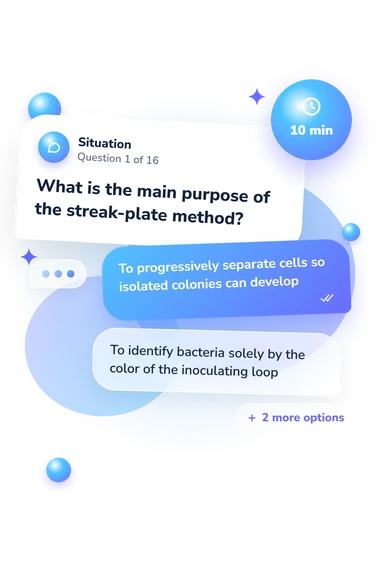
Example Questions From the Test
- To progressively separate cells so isolated colonies can develop
- To identify bacteria solely by the color of the inoculating loop
- To sterilize the agar surface during inoculation
- To ensure every organism grows equally well on the medium
- Safranin, iodine, decolorizer, crystal violet
- Crystal violet, decolorizer, iodine, safranin
- Iodine, crystal violet, safranin, decolorizer
- Crystal violet, iodine, decolorizer, safranin
- Cooling makes the loop hold a larger volume of culture.
- A hot loop could kill cells in the sample being transferred.
- A cool loop prevents oxygen from entering the culture tube.
- Cooling converts the loop surface from selective to differential.
Microbiology Lab Quiz - Description and methodology of the test
For students and early-career laboratory learners, the Microbiology Lab Quiz 1 offers a focused way to check whether core procedures make sense before practical work. The format is useful when terminology must guide a bench decision. Its result from this microbiology lab quiz offers one overall educational indication of laboratory knowledge based on selected laboratory scenarios and principles.
What This Assessment Explores
The questionnaire checks whether learners can reason through routine laboratory decisions, not only recall terminology. The microbiology lab quiz questions cover culture isolation, contamination control, staining, microscopy, dilution calculations, media classification, sterilization, and biosafety. It suits students reviewing introductory laboratory work before supervised practice.
The displayed result is the Microbiology Lab Knowledge scale, 0-16. It provides one overall result representing educational knowledge of laboratory methods and reasoning. Bands are Foundations to Build (0-6), Developing Knowledge (7-12), and Strong Knowledge (13-16). This educational score reflects quiz performance and does not certify hands-on competence.
The questions cover these areas:
- Culture and isolation shows whether growth, controls, and colony selection are interpreted correctly.
- Staining and microscopy reflects visualization methods and reagent choices.
- Quantitative reasoning connects dilution steps and colony counts with concentration estimates.
- Sterilization and biosafety captures containment, autoclave action, and disinfection limits.
Methodology and Scientific Basis
Each item presents a short laboratory situation, observation, calculation, or procedure with four answer choices. Selecting the best action or interpretation tests applied understanding alongside terminology. As a microbiology laboratory quiz, it connects contamination, methods, growth, and safety decisions.
The questionnaire reports one result on the displayed knowledge scale. It has no topic subscores or observed-performance component. As a self-report, multiple-choice exercise, performance may reflect recent study, familiarity with examples, current context, and careful reading as well as laboratory understanding.
The content is conceptually consistent with Muzaheed and colleagues’ study of microbiology laboratory knowledge, attitudes, and practices, but this questionnaire is not an adaptation of that study. Its focus on conceptual reasoning also aligns with the Microbiology Concept Inventory developed by Paustian and colleagues. Sharp and Elder distinguish written knowledge from observed laboratory competence.
Interpret the result as a review guide: it can indicate where further study may help, while current study context, familiarity with examples, and careful reading can influence a multiple-choice response.
- Muzaheed M, El-Masry OS, Rabaan AA, Alzahrani F, Alomar A, Farooqi FA. Comparative cross-sectional assessment of knowledge, attitude and practice among university students and employees towards the use of the microbiology laboratory equipment. F1000Research. 2021;10:117. 10.12688/f1000research.49923.2
- Paustian TD, Briggs AG, Brennan RE, Boury N, Buchner J, Harris S, Horak REA, Hughes LE, Katz-Amburn DS, Massimelli MJ, McDonald AH, Primm TP, Smith AC, Stevens AM, Yung SB. Development, Validation, and Application of the Microbiology Concept Inventory. Journal of Microbiology & Biology Education. 2017;18(3). 10.1128/jmbe.v18i3.1320
- Sharp SE, Elder BL. Competency Assessment in the Clinical Microbiology Laboratory. Clinical Microbiology Reviews. 2004;17(3):681-694. 10.1128/CMR.17.3.681-694.2004
Updated: