
What Song Am I Quiz
How the Scales are Structured
Who Usually Takes This Test?
See How You Compare
Below is a preview of how scores are typically distributed across each scale.
Example Questions From the Test
- Strongly disagree
- Disagree
- Agree
- Strongly agree
- Strongly disagree
- Disagree
- Agree
- Strongly agree
- Strongly disagree
- Disagree
- Agree
- Strongly agree
What Song Am I Quiz - Description and methodology of the test
For anyone curious about the musical identity that fits their everyday vibe, this assessment turns three measured dimensions into a recognizable result rather than a fixed label. The what song am i quiz suits people who enjoy reflective self-observation. Its result offers a song identity profile that leaves room for nuance, while remaining a context-sensitive snapshot rather than a definitive statement about personality.
What This Assessment Explores
The questionnaire's three dimensions shape a song personality profile from emotional color, pace, and the social source of everyday energy rather than musical knowledge. Responses touch on lingering feelings, bittersweet reflection, spontaneous activity, and social recovery, making it suitable for anyone seeking a reflective description of everyday style.
The three displayed dimensions are:
- Emotional Tone (0-30) captures dominant feeling: Sunny & Playful (0-10) reflects carefree positivity, Balanced & Grounded (11-20) marks a middle range, and Deep & Reflective (21-30) reflects intense or bittersweet feeling.
- Energy Level (0-30) measures typical drive: Mellow (0-10) is calmer, Steady (11-20) is moderate, and High-Octane (21-30) is more action-oriented.
- Social Recharge (0-30) assesses restoration: Solo Reset (0-10) favors quiet, Balanced Recharge (11-20) combines both routes, and Social Fuel (21-30) favors shared stimulation.
Together, the scores describe a tendency without treating one style as better.
Methodology and Evidence Base
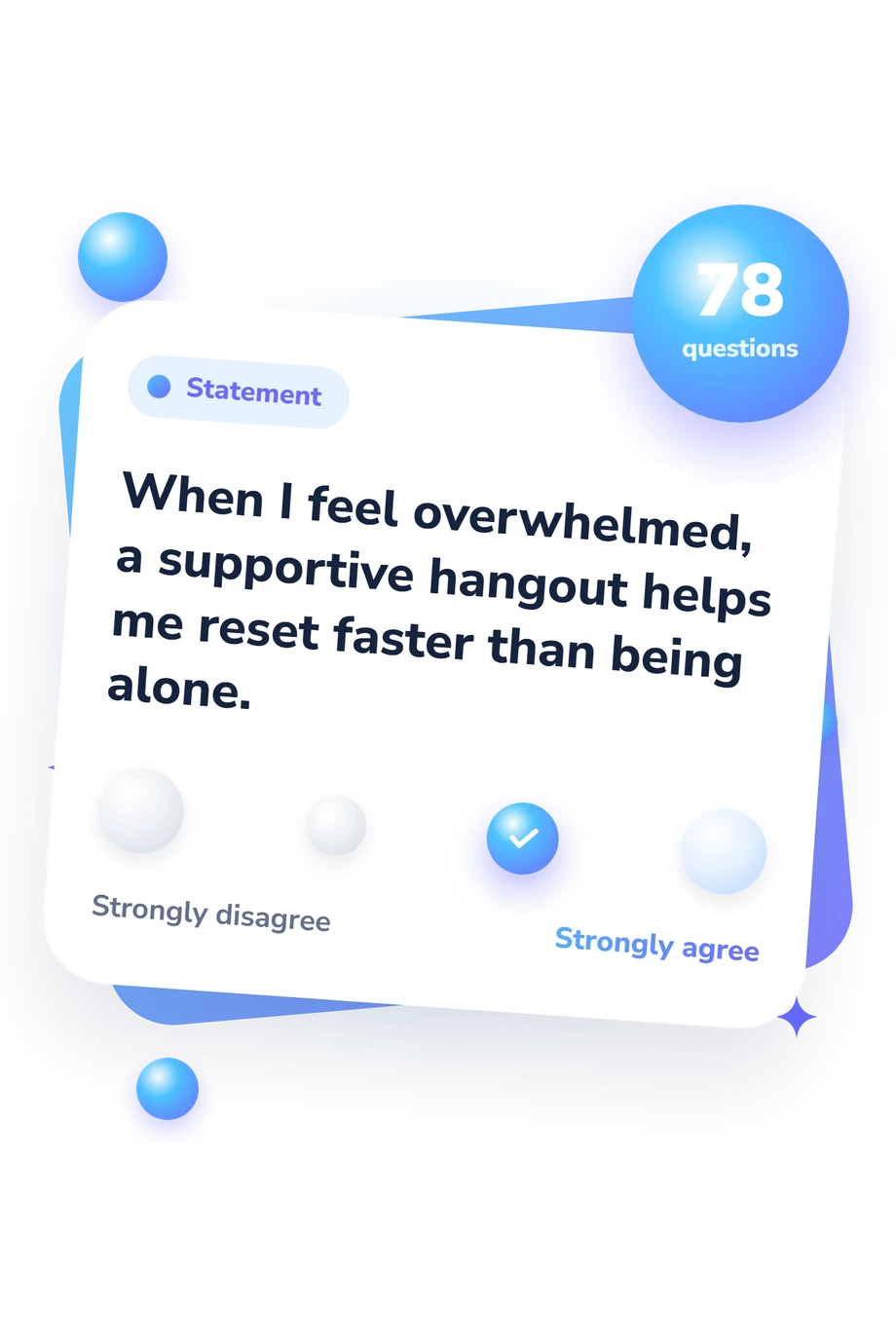
The shown statements use a four-point agreement format: Strongly disagree, Disagree, Agree, or Strongly agree. The sample asks about ordinary experiences, including lingering emotions, spontaneous activity, and whether social contact restores energy. The musical personality profile displays the three scale ranges and descriptive bands; the contribution of each response is not specified, so no particular point value should be assumed.
Greenberg et al. (2016) connect musical attribute dimensions with personality-related patterns; that work is a conceptual parallel, not the source, adaptation, or validation of this questionnaire. Rentfrow et al. (2011) offers a five-factor model for organizing musical preferences, and Schäfer et al. (2013) discusses music's roles in emotion, identity, and social connection. These papers help situate the musical framing conceptually, but they do not define the displayed dimensions, item structure, scoring, or song-result mapping.
The cited studies do not establish standardization or validation for this exact questionnaire. Because answers rely on self-report, current mood, memory, social context, and self-awareness can shape the result. Treat it as a snapshot that can prompt reflection, rather than a fixed description of personality.
- Greenberg, David M., Michal Kosinski, David J. Stillwell, Brian L. Monteiro, Daniel J. Levitin, and Peter J. Rentfrow. “The Song Is You: Preferences for Musical Attribute Dimensions Reflect Personality.” Social Psychological and Personality Science, vol. 7, no. 6, 2016, pp. 597-605. 10.1177/1948550616641473
- Schäfer, Thomas, Peter Sedlmeier, Christine Städtler, and David Huron. “The Psychological Functions of Music Listening.” Frontiers in Psychology, vol. 4, article 511, 2013. 10.3389/fpsyg.2013.00511
- Rentfrow, Peter J., Lewis R. Goldberg, and Daniel J. Levitin. “The Structure of Musical Preferences: A Five-Factor Model.” Journal of Personality and Social Psychology, vol. 100, no. 6, 2011, pp. 1139-1157. 10.1037/a0022406
Updated: