
What Race Am I Attracted To Quiz
How the Scales are Structured
Who Usually Takes This Test?
See How You Compare
Below is a preview of how scores are typically distributed across each scale.
Example Questions From the Test
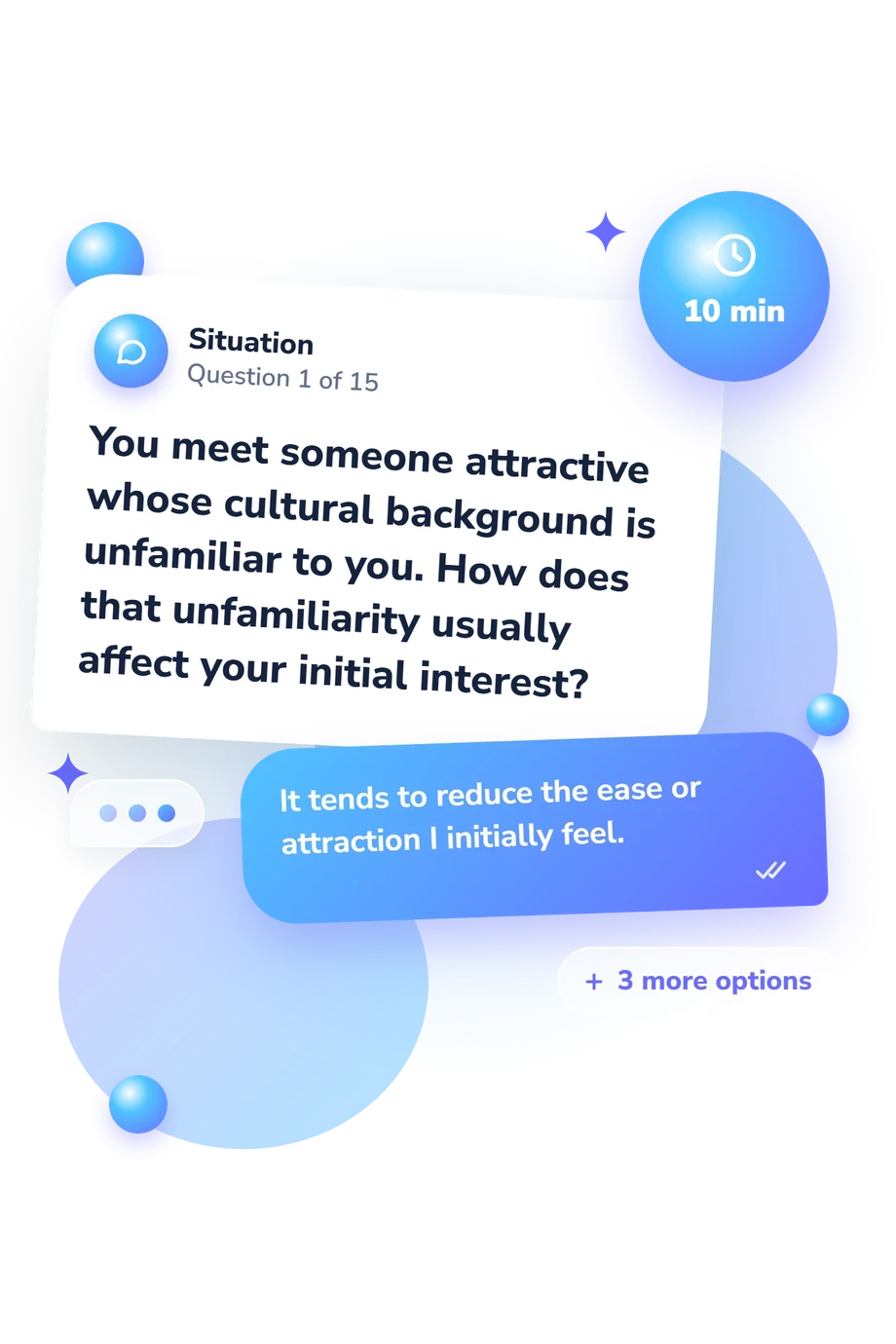
- It tends to reduce the ease or attraction I initially feel.
- It gives me slight pause, though interest can develop naturally.
- It is noticeable but has little effect on my attraction.
- It generally does not affect my initial interest.
- They come from several racial groups, though one appears somewhat more often.
- They span many racial identities without a pattern I can clearly identify.
- They are mostly from one racial group, with occasional exceptions.
- They cluster very consistently around one racial group.
- Somewhat unusual, because my history has a noticeable pattern.
- Not unusual; my attractions have never clustered much by race.
- Very unusual, because it falls well outside my usual pattern.
- Only mildly notable; I have a tendency but plenty of exceptions.
What Race Am I Attracted To Quiz - Description and methodology of the test
For anyone deciding whether this assessment fits their self-reflection, it offers a structured way to examine how racial concentration, cultural familiarity, and individual qualities each shape attraction. The What Race Am I Attracted To Quiz helps readers distinguish these influences while allowing for exceptions, context, and change. It is a quiz about what ethnicity I am attracted to, but it does not reduce attraction to one category.
What This Assessment Explores
Attraction is examined through racial concentration, cultural familiarity, and individual qualities. The items cover crushes, first impressions, chemistry, cultural references, and social settings. Personal reflection can show which influence stands out. The dimensions are:
- Attraction Pattern Concentration runs 0-15: Broadly distributed (0-5) means racial identities vary; Some recurring pattern (6-10) means a tendency has exceptions; Strong concentration (11-15) means attractions cluster.
- Cultural Familiarity Influence runs 0-15: Limited influence (0-5) means familiarity rarely directs attraction; Contextual influence (6-10) means shared references sometimes matter; Strong influence (11-15) means cultural recognition helps attraction form.
- Individual-First Attraction runs 0-15: Type-led (0-5) means a familiar type organizes interest; Mixed focus (6-10) means type and qualities both matter; Individual-led (11-15) means qualities usually outweigh racial category.
The bands describe reflective tendencies, rather than turning this result into a quiz about what race my type is or prescribing whom to date.
Methodology and Scientific Basis
Each item presents four response options; the respondent selects the one that best fits. The options sample different emphases or pattern levels, not simple degrees. Responses combine into three dimensions, but the questionnaire does not specify how many points each option contributes. The bands summarize a profile, not a reconstructable formula.
Fisman et al. (2008) is the closest conceptual reference for racial preferences in dating. Brooks and Neville (2017) connect interracial attraction with familiarity, ideology, and similarity; Burke et al. (2013) offers a perspective on own-race preference in attractiveness; Auelua-Toomey and Roberts (2024) consider preferences and social hierarchy. These studies examine topics conceptually consistent with this questionnaire, but it is not an adaptation or validation of them.
This questionnaire functions as a quiz asking what ethnicity you are attracted to, and self-report may reveal patterns connected with cultural familiarity and exposure. Memories, current relationships, and expectations may shape answers, while self-awareness affects how accurately they are described. The displayed bands are profile categories, not population norms, so the result is best read as a personal summary.
- Fisman, Raymond, Sheena S. Iyengar, Emir Kamenica, and Itamar Simonson. (2008). Racial Preferences in Dating. The Review of Economic Studies, 75(1), 117-132. 10.1111/j.1467-937X.2007.00465.x
- Brooks, James E., and Helen A. Neville. (2017). Interracial attraction among college men: The influence of ideologies, familiarity, and similarity. Journal of Social and Personal Relationships, 34(2), 166-183. 10.1177/0265407515627508
- Burke, Darren, Caroline Nolan, William Gordon Hayward, Robert Russell, and Danielle Sulikowski. (2013). Is There an Own-Race Preference in Attractiveness? Evolutionary Psychology, 11(4), 855-872. 10.1177/147470491301100410
- Auelua-Toomey, Sakaria Laisene, and Steven Othello Roberts. (2024). Romantic racism: How racial preferences (and beliefs about racial preferences) reinforce hierarchy in U.S. interracial relationships. Cultural Diversity and Ethnic Minority Psychology, 30(3), 532-552. 10.1037/cdp0000592
Updated: