
What One Piece Character Are You Quiz
How the Scales are Structured
Who Usually Takes This Test?
See How You Compare
Below is a preview of how scores are typically distributed across each scale.
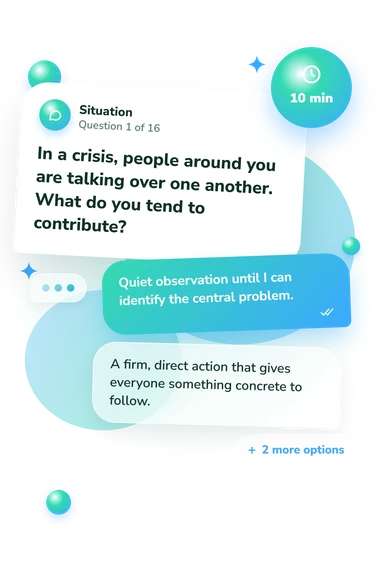
Example Questions From the Test
- Quiet observation until I can identify the central problem.
- A firm, direct action that gives everyone something concrete to follow.
- A quick comparison of options before the group commits.
- Space for people to settle before any major decision is made.
- Create the best meal I can from what is available and make them feel welcomed.
- Offer a comforting dish and adjust the evening to include them.
- Share whatever is already prepared without changing much.
- Help them find an easy food option while preserving my original plans.
- Whether their enthusiasm feels genuine enough to justify a chance.
- Whether other people I trust seem comfortable with the proposal.
- Which missing details could materially change the value of the deal.
- Whether I can test a limited version before making a full commitment.
What One Piece Character Are You Quiz - Description and methodology of the test
Fans who want to connect everyday choices with the Straw Hat crew can use the What One Piece Character Are You Quiz as a playful character-affinity exercise. Readers can use the Which One Piece Character Are You Quiz to examine courage, planning, persistence, and care rather than plot knowledge. The result identifies the strongest character affinity and can also reveal a blend when close scores cluster at the top.
What This Assessment Explores
Rather than testing plot knowledge, the What One Piece Character Am I Quiz maps everyday decisions onto four character-linked tendencies. It compares freedom, strategy, discipline, and care across the character scales, showing what One Piece character you are most like.
The displayed scales describe these dimensions:
- Monkey D. Luffy (0-12) reflects freedom, instinctive courage, loyalty, and enthusiasm; its bands are Deliberate Voyager (0-4), Adventure-Curious (5-8), and Free-Spirited Captain (9-12).
- Nami (0-12) reflects strategic thinking, awareness, resource management, and flexibility; its bands are Open-Handed Explorer (0-4), Adaptive Planner (5-8), and Resourceful Navigator (9-12).
- Roronoa Zoro (0-12) reflects discipline, endurance, directness, and commitment; its bands are Flexible Path (0-4), Steady Challenger (5-8), and Resolute Swordsman (9-12).
- Sanji (0-12) reflects hospitality, generosity, flair, and protective care; its bands are Reserved Contributor (0-4), Warm Supporter (5-8), and Devoted Host (9-12).
Methodology and Scientific Basis
Each item presents a familiar situation with four response options. The scenarios ask how someone reacts to crises, guests, uncertain proposals, setbacks, promises, long-term practice, changing conditions, limited resources, and another person’s difficulty. Choosing the option that feels most characteristic creates a behavioral profile rather than an agreement rating or plot-knowledge score.
Scoring is comparative. The highest character-scale score is the strongest affinity, while any other score within one point of it contributes to a blended result. The displayed bands describe increasing resemblance within each scale; they are descriptive categories, not population norms or clinical cutoffs.
Conceptually, it aligns with Huang and Fung's narrative-character identification research, Cohen's audience-character identification work, and Huang, Fung, and Sun's audience-character similarity study. Eiichiro Oda's One Piece supplies canonical context. It is not adapted from those measures, but is an online character-affinity format.
Read the Which One Piece Character Am I Quiz result as a relative pattern within its displayed character scales, indicating which One Piece character you might resemble most. Mood, recent experiences, self-awareness, and current values can shape self-report, so the profile should not be treated as a diagnosis.
- Huang, Kate Y., and Helene H. Fung. (2024). Measuring identification with narrative characters: the development and validation of a new scale. Current Psychology, 43, 24835-24849. 10.1007/s12144-024-06191-2
- Huang, Kate Y., Helene H. Fung, and Peifeng Sun. (2024). The effect of audience-character similarity on identification with narrative characters: A meta-analysis. Current Psychology, 43(8), 7026-7043. 10.1007/s12144-023-04842-4
- Cohen, Jonathan. (2001). Defining identification: A theoretical look at the identification of audiences with media characters. Mass Communication and Society, 4(3), 245-264. 10.1207/S15327825MCS0403_01
- Oda, Eiichiro. (2018). One Piece Color Walk Compendium: East Blue to Skypiea. VIZ Media LLC. ISBN 978-1-4215-9850-5