
What Killer Am I Quiz
How the Scales are Structured
Who Usually Takes This Test?
See How You Compare
Below is a preview of how scores are typically distributed across each scale.
Example Questions From the Test
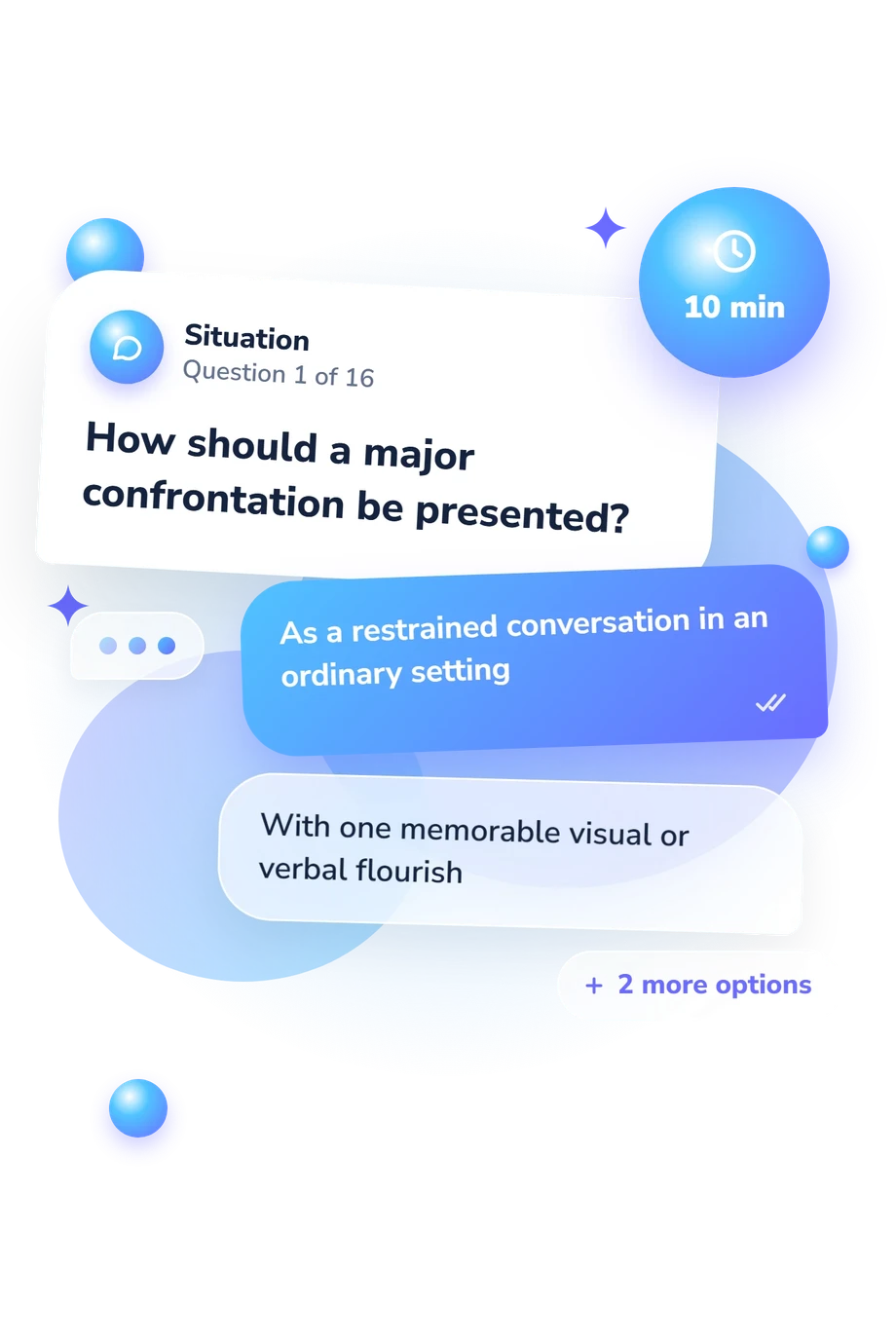
- As a restrained conversation in an ordinary setting
- With one memorable visual or verbal flourish
- As a carefully arranged encounter with a strong dramatic motif
- As a full set piece in which setting, timing, and dialogue create spectacle
- No deliberate device; the connection emerges through ordinary evidence
- A small repeated detail that becomes meaningful later
- A recognizable motif appearing at several major turning points
- An elaborate symbolic scene designed to demand interpretation
- A public rivalry in which both sides openly challenge each other
- A quiet setting where absence and unseen observation create tension
- A shifting investigation with occasional glimpses of the hidden figure
- A character-focused mystery with limited emphasis on concealment
What Killer Am I Quiz - Description and methodology of the test
Readers who enjoy crime fiction, write antagonists, or analyse story mechanics can use the What Killer Am I Quiz to map the qualities that hold their attention. Genre-minded readers can treat its profile as a what killer are you quiz, where imagined confrontations, clues, reveals, and reversals shape the result. The result explains why certain villains or plot structures feel memorable while keeping the focus on fictional taste.
What the Questionnaire Measures
Questions cover confrontations, atmosphere, dialogue, motifs, reveals, clues, planning, reversals, and endings. They measure fictional taste rather than real-world conduct, showing which fictional villain preferences shape the profile. Together, the four displayed dimensions create a mixed profile rather than one fixed type.
The scales show:
- Elusive Shadow (0-12) measures preference for direct conflict, mystery, or anonymity: Visible Conflict 0-4; Mystery Interest 5-8; Shadow Affinity 9-12.
- Methodical Mastermind (0-12) measures attraction to improvisation, strategy, or interlocking plans: Improvisational Taste 0-4; Strategic Interest 5-8; Mastermind Affinity 9-12.
- Theatrical Signature (0-12) measures appeal of restraint, motifs, or staged drama: Understated taste 0-4; Symbolic interest 5-8; Theatrical affinity 9-12.
- Volatile Disruptor (0-12) measures enjoyment of stable patterns, anchored unpredictability, or reversals: Structured-chaos taste 0-4; Anchored unpredictability 5-8; Disruptor affinity 9-12.
Methodology and Scientific Basis
Each item presents a fictional story situation with four response options. The choices cover direct, concealed, calculated, theatrical, and disruptive preferences; the result displays four scale scores with named bands. How individual responses contribute to each score is undocumented, so the bands are descriptive rather than normative and have no clinical cutoff.
The Villain Positivity Scale, developed by Kjeldgaard-Christiansen and colleagues, is a conceptual reference for this questionnaire’s interest in fictional-villain appeal. The online profile is separate, not an adaptation of that measure. Work by Black and colleagues is conceptually consistent with its attention to moral reactions and imaginative resistance around dark characters. Research by Brewer and Lichtenstein, and by Jose and Brewer, is conceptually consistent with its attention to story structure, suspense, character identification, and resolution. The questionnaire has no documented standardization or validation, so its bands are descriptive levels of fictional preference.
Although the format may feel like a fictional antagonist quiz, the result describes preferred fictional construction rather than a stable personality type. Mood, genre familiarity, writing interests, and imagined scenes may influence self-report, so read the profile as focused reflection on narrative taste.
- Kjeldgaard-Christiansen, Jens, Anne Fiskaali, Henrik Høgh-Olesen, John A. Johnson, Murray Smith, and Mathias Clasen. "Do Dark Personalities Prefer Dark Characters? A Personality Psychological Approach to Positive Engagement with Fictional Villainy." Poetics 85 (2021): 101511. 10.1016/j.poetic.2020.101511
- Black, Jessica E., Yomna Helmy, Olivia Robson, and Jennifer L. Barnes. "Who Can Resist a Villain? Morality, Machiavellianism, Imaginative Resistance and Liking for Dark Fictional Characters." Poetics 74 (2019): 101344. 10.1016/j.poetic.2018.12.005
- Brewer, William F., and Edward H. Lichtenstein. "Stories Are to Entertain: A Structural-Affect Theory of Stories." Journal of Pragmatics 6, no. 5-6 (1982): 473-486. 10.1016/0378-2166(82)90021-2
- Jose, Paul E., and William F. Brewer. "Development of Story Liking: Character Identification, Suspense, and Outcome Resolution." Developmental Psychology 20, no. 5 (1984): 911-924. 10.1037/0012-1649.20.5.911
Updated: