
What Is My Wolf Name Quiz
How the Scales are Structured
Who Usually Takes This Test?
See How You Compare
Below is a preview of how scores are typically distributed across each scale.
Example Questions From the Test
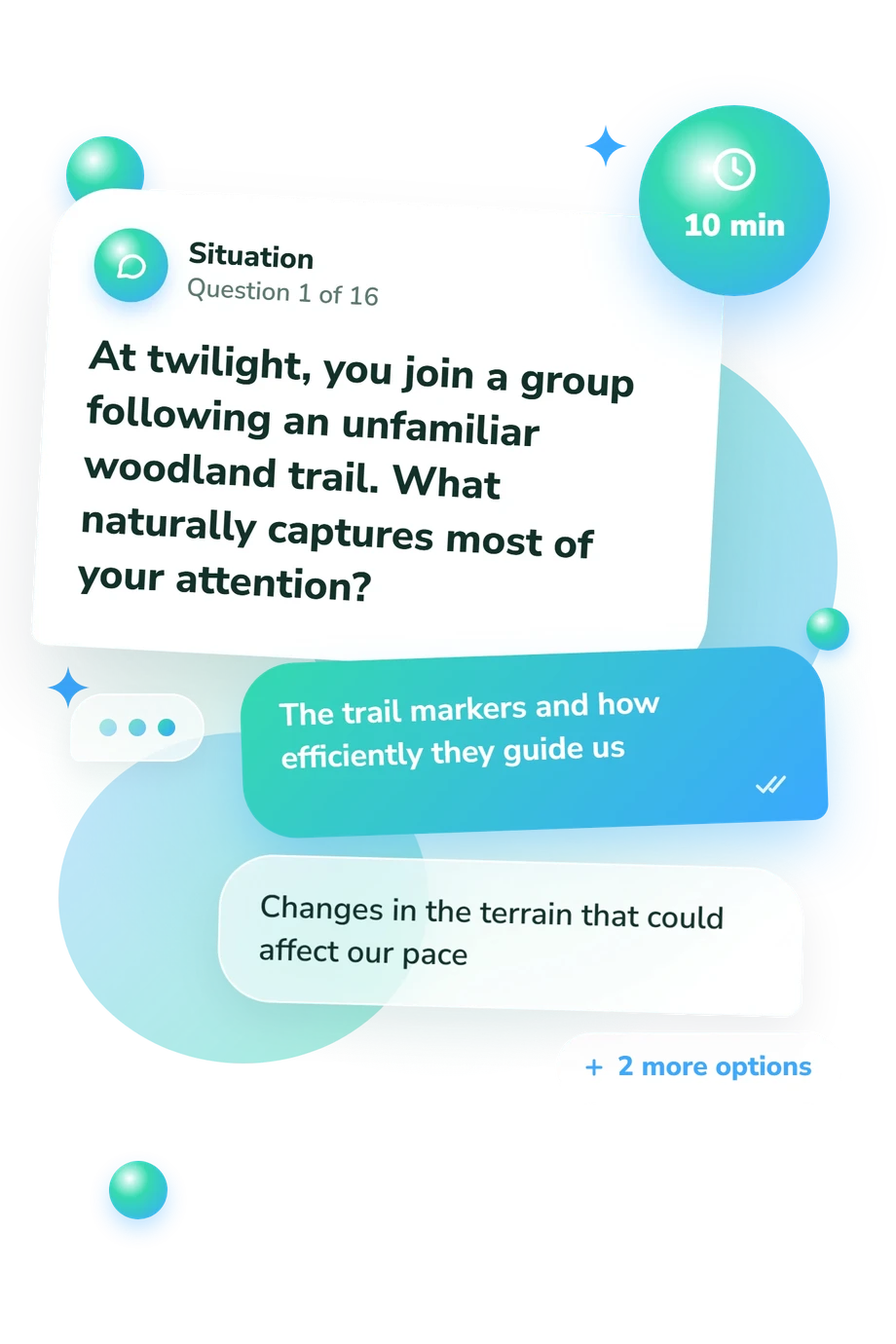
- The trail markers and how efficiently they guide us
- Changes in the terrain that could affect our pace
- Small shifts in my companions' moods
- Distant sounds, moving shadows, and the first stars
- I suggest a familiar outing that feels easier to plan
- I ask who else is going before I decide
- I check the essential details, then probably accept
- I feel the spark of adventure and say yes quickly
- A fast, energetic distraction that changes the mood
- A long conversation with someone I trust
- Private time to organize my thoughts and surroundings
- Slow, unstructured time outdoors with room to breathe
What Is My Wolf Name Quiz - Description and methodology of the test
For readers deciding whether a short symbolic exercise fits their curiosity about identity, relationships, and adventure, this questionnaire provides a focused set of choices about how they respond to people, places, and uncertainty. The what is my wolf name quiz can help you decide which kind of result feels most relevant to your current preferences. That makes this wolf name quiz a suitable starting point for reflection.
What This Assessment Explores
The questionnaire suits anyone curious about how environments, decisions, social responses, and energy patterns shape a wolf-inspired profile. Framed as a quiz about discovering what your wolf name might be, it organizes those choices around warmth, intuition, independence, and adventurous movement. The strongest affinity gives the clearest symbolic match, while close scores can produce a blended result.
These displayed scales define the four symbolic patterns:
- Emberheart (0-12) reflects warm loyalty and group connection: Gentle Spark (0-4), Steady Flame (5-8), and Strong Affinity (9-12).
- Moonwhisper (0-12) reflects quiet intuition and subtle atmosphere: Faint Echo (0-4), Lunar Pull (5-8), and Strong Affinity (9-12).
- Pineshadow (0-12) reflects grounded patience and independent calm: Passing Shade (0-4), Rooted Presence (5-8), and Strong Affinity (9-12).
- Stormfang (0-12) reflects decisive energy and appetite for movement: Distant Thunder (0-4), Rising Wind (5-8), and Strong Affinity (9-12).
Methodology and Evidence Base
Each item presents a brief situation with four contrasting response options. The choices cover attention, recovery, disagreement, decisions, exploration, and group contribution, so selecting the most natural answer reveals preferences rather than performance.
For this wolf name generator quiz, each profile receives a displayed score from 0-12. Scores within one point of the highest indicate a blended result, so the comparison can show a close fit rather than forcing a single name.
The questionnaire uses a symbolic self-reflection format rather than a named published instrument or theoretical model. Wolf imagery turns recurring choices about social warmth, quiet observation, independence, and bold action into accessible names that can help organize a personal impression.
Because responses are self-reported, current mood, circumstances, and self-awareness can influence which options feel natural, so read comparative scores as a reflection prompt for noticing preferences rather than a definitive account of personality.
- Oliver P. John, Eileen M. Donahue, and Robert L. Kentle. Big Five Inventory-Versions 4a and 54. Technical report. Berkeley, CA: University of California, Berkeley, Institute of Personality and Social Research, 1991. 10.1037/t07550-000
- Robert R. McCrae and Paul T. Costa Jr. An Introduction to the Five-Factor Model and Its Applications. Journal of Personality, 60(2), 175-215, 1992. 10.1111/j.1467-6494.1992.tb00970.x
- Samuel D. Gosling, Peter J. Rentfrow, and William B. Swann Jr. A Very Brief Measure of the Big-Five Personality Domains. Journal of Research in Personality, 37(6), 504-528, 2003. 10.1016/S0092-6566(03)00046-1
Updated: