
What Is My Ninja Name Quiz
How the Scales are Structured
Who Usually Takes This Test?
See How You Compare
Below is a preview of how scores are typically distributed across each scale.
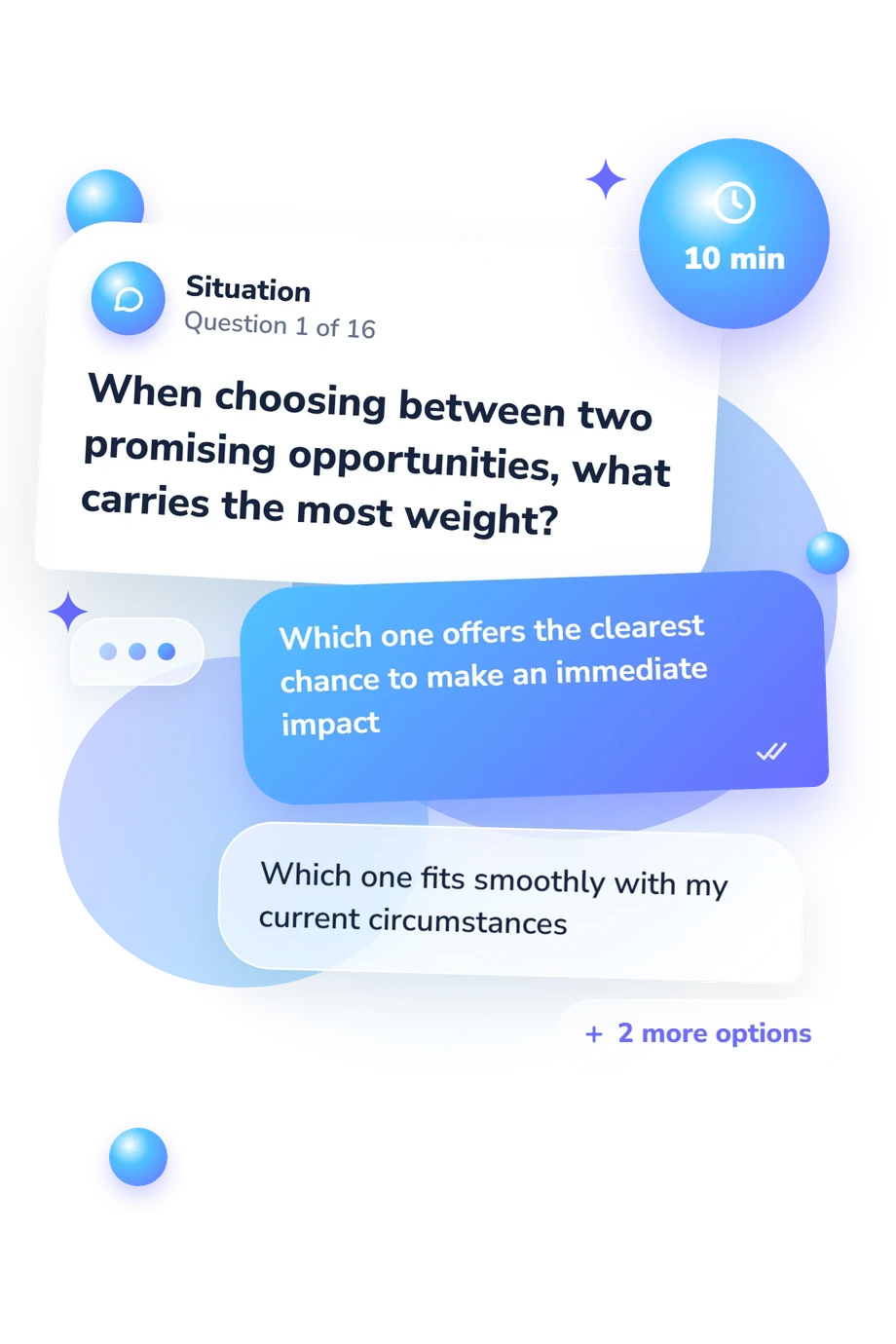
Example Questions From the Test
- Study the surroundings for a less obvious passage
- Keep everyone focused while checking the safest practical option
- Volunteer to test a promising new route and keep morale high
- Compare the terrain with earlier clues to predict what lies ahead
- Bring energy to the group and encourage an immediate start
- Ask everyone to agree on a clear objective
- Watch how the group works before choosing where to contribute
- Identify the main obstacles and sketch a possible plan
- Quietly adjust my part so the presentation stays balanced
- Add extra energy to carry the group past the awkward moment
- Make a discreet improvisation that redirects attention
- Note why it happened so the pattern can be prevented later
What Is My Ninja Name Quiz - Description and methodology of the test
Curious visitors who enjoy symbolic self-reflection can use the What Is My Ninja Name Quiz to examine how they approach pressure, uncertainty, teamwork, and action. It suits anyone who wants a playful ninja name profile of decision-making habits and a clearer view of familiar strengths and less obvious tendencies. This quiz can help make those patterns easier to notice in everyday choices.
What This Assessment Explores
As a quiz about what your ninja name is, it explores four ways of meeting challenges. Choices involving opportunities, conflict, obstacles, teamwork, learning, social settings, and sudden changes reveal whether you lead visibly, investigate deeply, adjust quietly, or act with measured control. Your highest score marks the strongest affinity; scores within one point create a blended profile.
The result dimensions are:
- Ember Tiger (0-12) captures bold initiative and protective action: Measured Spark (0-4), Ready Flame (5-8), and Ember Tiger Affinity (9-12).
- Moon Raven (0-12) reflects curiosity, patterns, and foresight: Practical Focus (0-4), Searching Mind (5-8), and Moon Raven Affinity (9-12).
- Shadow Fox (0-12) reflects discretion, adaptability, and low-profile influence: Open Presence (0-4), Quietly Adaptable (5-8), and Shadow Fox Affinity (9-12).
- Storm Crane (0-12) represents composure, precision, balance, and timing: Flexible Rhythm (0-4), Centered Technique (5-8), and Storm Crane Affinity (9-12).
Methodology and Scientific Basis
Each item presents a social, practical, or uncertain situation with four response options representing different priorities or approaches. Selecting the response that feels closest makes the format comparative rather than an agreement scale, so the profile reflects your self-view and imagined context.
The scoring assigns selected responses across four displayed dimensions. The highest score is the strongest affinity, and scores within one point create a blended result. The named bands describe how strongly each style appears in this questionnaire.
Its comparative format uses preferences rather than agreement with statements, making the result a playful ninja personality profile. The method is conceptually consistent with forced-choice personality assessment discussed by Heggestad et al. (2006), where similarly appealing alternatives can limit indiscriminate endorsement.
Brown and Maydeu-Olivares (2013) explain that item-response theory can address some ipsative-data problems in forced-choice designs. The questionnaire does not report IRT scoring, normative data, or formal standardization and validation, and its relative self-report result can be shaped by mood, self-image, imagined context, and response bias, so read it as a prompt for reflection.
- Heggestad, Eric D., Morgan Morrison, Charlie L. Reeve, and Rodney A. McCloy. "Forced-choice assessments of personality for selection: Evaluating issues of normative assessment and faking resistance." Journal of Applied Psychology 91, no. 1 (2006): 9-24. 10.1037/0021-9010.91.1.9
- Brown, Anna, and Alberto Maydeu-Olivares. "How IRT can solve problems of ipsative data in forced-choice questionnaires." Psychological Methods 18, no. 1 (2013): 36-52. 10.1037/a0030641
Updated: