
Vikings Quiz
How the Scales are Structured
Who Usually Takes This Test?
See How You Compare
Below is a preview of how scores are typically distributed across each scale.
Example Questions From the Test
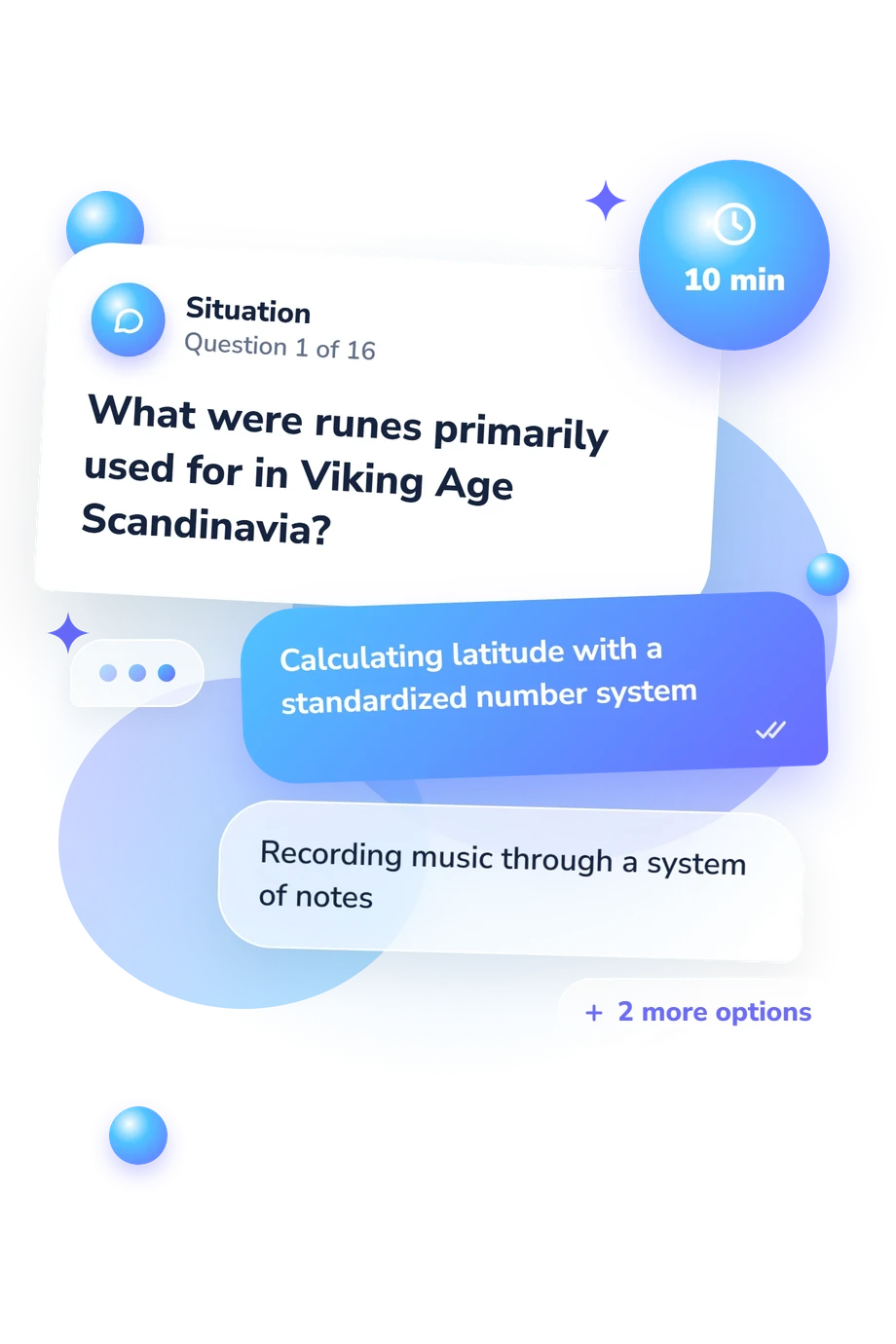
- Calculating latitude with a standardized number system
- Recording music through a system of notes
- Writing names, messages, memorials, and other inscriptions
- Marking ownership exclusively on imported coins
- Sutton Hoo
- Jelling
- Lindisfarne
- L’Anse aux Meadows
- A sextant, magnetic compass, and printed atlas
- Coastal landmarks together with observations of the sun and stars
- A mechanical clock synchronized with a port timetable
- A single released bird used as the crew’s only guide
Vikings Quiz - Description and methodology of the test
Readers curious about how Viking Age societies worked can use this Vikings Quiz to test their understanding of historical evidence and interpretation. The questions make this a Viking history quiz for anyone who wants to examine how evidence supports conclusions about the period. Its purpose is to turn broad interest into a structured check of knowledge about people, places, practices, and historical change.
What This Assessment Explores
Questions about runes, graves, settlements, ships, exchange, social roles, law, conversion, and literary portrayals define the content, not separate result scales. They ask readers to connect material evidence with travel, society, belief, and historical interpretation.
Across the questionnaire, four-option Viking quiz questions ask respondents to choose the answer best supported by historical context. The choices distinguish evidence-based conclusions from tempting generalizations.
The themes include:
- Material evidence shows how inscriptions, graves, settlements, and imported objects support cautious interpretations.
- Travel and technology reveal how ships, navigation, waterways, and exchange networks shape movement.
- Society, belief, and change cover status, work, law, conversion, religious coexistence, identity, and differences between literary portrayal and archaeological evidence.
The result uses a 0-16 scale: Foundations to build (0-6), Developing knowledge (7-12), or Strong knowledge (13-16). These bands summarize quiz performance, not professional historical expertise.
Methodology and Evidence Base
Each item presents a historical question with four answer choices, asking the respondent to select the best-supported option rather than rate agreement or personal experience. The displayed total records performance across the selected questions.
With content-based multiple choice, the questionnaire functions as a Viking Age quiz rather than a psychological self-report method. Its themes are conceptually consistent with Viking World, while Sigurdsson and Richards add complementary historical framing. These works support the subject matter, but the online questionnaire is not a direct adaptation of any one of them.
Interpretation is strongest when a result is read as a snapshot of current knowledge. Prior study, familiarity with popular portrayals, and uncertainty between plausible distractors can affect performance. The score therefore indicates performance on these selected items, while further reading can deepen the historical connections they test.
- Brink, Stefan, and Neil Price, editors. The Viking World. Routledge, 2008. 10.4324/9780203412770
- Sigurdsson, Jón Viðar. Scandinavia in the Age of Vikings. Translated by Thea Kveiland. Cornell University Press, 2022. 10.7591/cornell/9781501760471.001.0001
- Richards, Julian D. The Vikings: A Very Short Introduction. Oxford University Press, 2005. 10.1093/actrade/9780192806079.001.0001
Updated: