
Verb Consistency Quiz
How the Scales are Structured
Who Usually Takes This Test?
See How You Compare
Below is a preview of how scores are typically distributed across each scale.
Example Questions From the Test
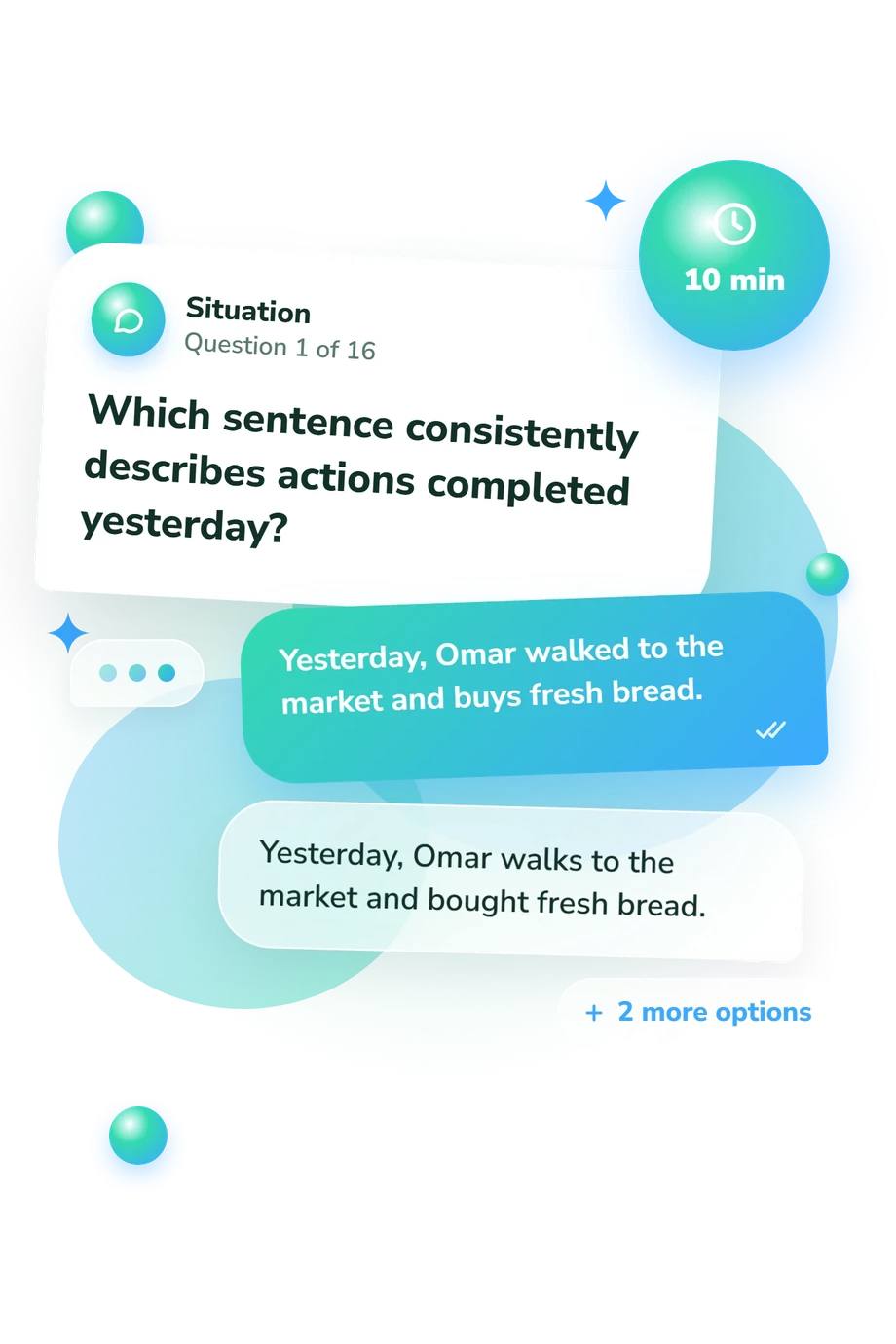
- Yesterday, Omar walked to the market and buys fresh bread.
- Yesterday, Omar walks to the market and bought fresh bread.
- Yesterday, Omar walked to the market and bought fresh bread.
- Yesterday, Omar had walked to the market and buys fresh bread.
- If Jordan had charged the battery, the car would have started.
- If Jordan had charged the battery, the car will start.
- If Jordan would have charged the battery, the car started.
- If Jordan charged the battery, the car would have started.
- I was cooking dinner when the phone rings, so I answered it.
- I cook dinner when the phone rang, so I answer it.
- I had cooked dinner when the phone rings, so I answered it.
- I was cooking dinner when the phone rang, so I answered it.
Verb Consistency Quiz - Description and methodology of the test
People who want a clearer picture of their English grammar can use the verb consistency quiz to examine how reliably they identify verb forms that fit a stated time frame and grammatical structure. Tense relationships are one content area alongside parallel construction in this verb tense consistency quiz, which suits learners, writers, editors, and teachers reviewing core usage. The overall result suggests review topics without separating strengths and weaknesses.
What This Assessment Explores
The questions test stable grammatical frames across past and present time, completed and continuing events, hypothetical conditions, habits, instructions, future clauses, and parallel forms after plans to, enjoys, and can.
These themes suggest review topics; the displayed result is an overall knowledge score, not a profile of separate strengths and weaknesses. Four areas are:
- Time alignment shows whether forms match time signals.
- Event sequence shows whether earlier and later actions receive appropriate tense relationships.
- Parallel construction shows whether coordinated verbs share a consistent form.
- Clause patterns show whether conditionals, commands, and modal or time clauses fit their meaning.
On the Verb Consistency Knowledge scale, stronger performance means recognizing forms that fit the stated time frame and grammatical structure. The scale is 0-16: Foundations to build (0-6), Developing control (7-12), Strong knowledge (13-16). This verb consistency test highlights review priorities.
Methodology and Scientific Basis
Each item presents a sentence or context with four answer choices. The respondent selects the version that preserves the intended time frame, event sequence, parallel form, or clause pattern. This is sentence-level grammatical recognition, not free-form writing. The displayed result is a single total on the scale, interpreted through its three result bands rather than separate scores for each topic.
Its framework is conceptually consistent with descriptive and learner-oriented English grammar, including distinctions involving tense, aspect, clause relationships, and coordination. These grammatical sources provide conceptual context for those distinctions, not evidence of the questionnaire's reliability, validity, norms, or authorship.
As an English verb tense practice tool, it is a focused online self-assessment. No standardization or norm reference is stated for its single score. Results may reflect familiarity with classroom conventions, attention on the day, and how the respondent interprets sentence-level choices. Use the outcome to select review topics, not as a complete estimate of writing ability or overall English proficiency.
- Huddleston, Rodney, and Geoffrey K. Pullum. The Cambridge Grammar of the English Language. Cambridge University Press, 2002. 10.1017/9781316423530.
- Biber, Douglas, Stig Johansson, Geoffrey Leech, Susan Conrad, and Edward Finegan. Longman Grammar of Spoken and Written English. Longman, 1999.
- Celce-Murcia, Marianne, Diane Larsen-Freeman, and Howard Williams. The Grammar Book: An ESL/EFL Teacher's Course. 2nd ed. Heinle & Heinle, 1999.
Updated: