
Call Sign Quiz
How the Scales are Structured
Who Usually Takes This Test?
See How You Compare
Below is a preview of how scores are typically distributed across each scale.
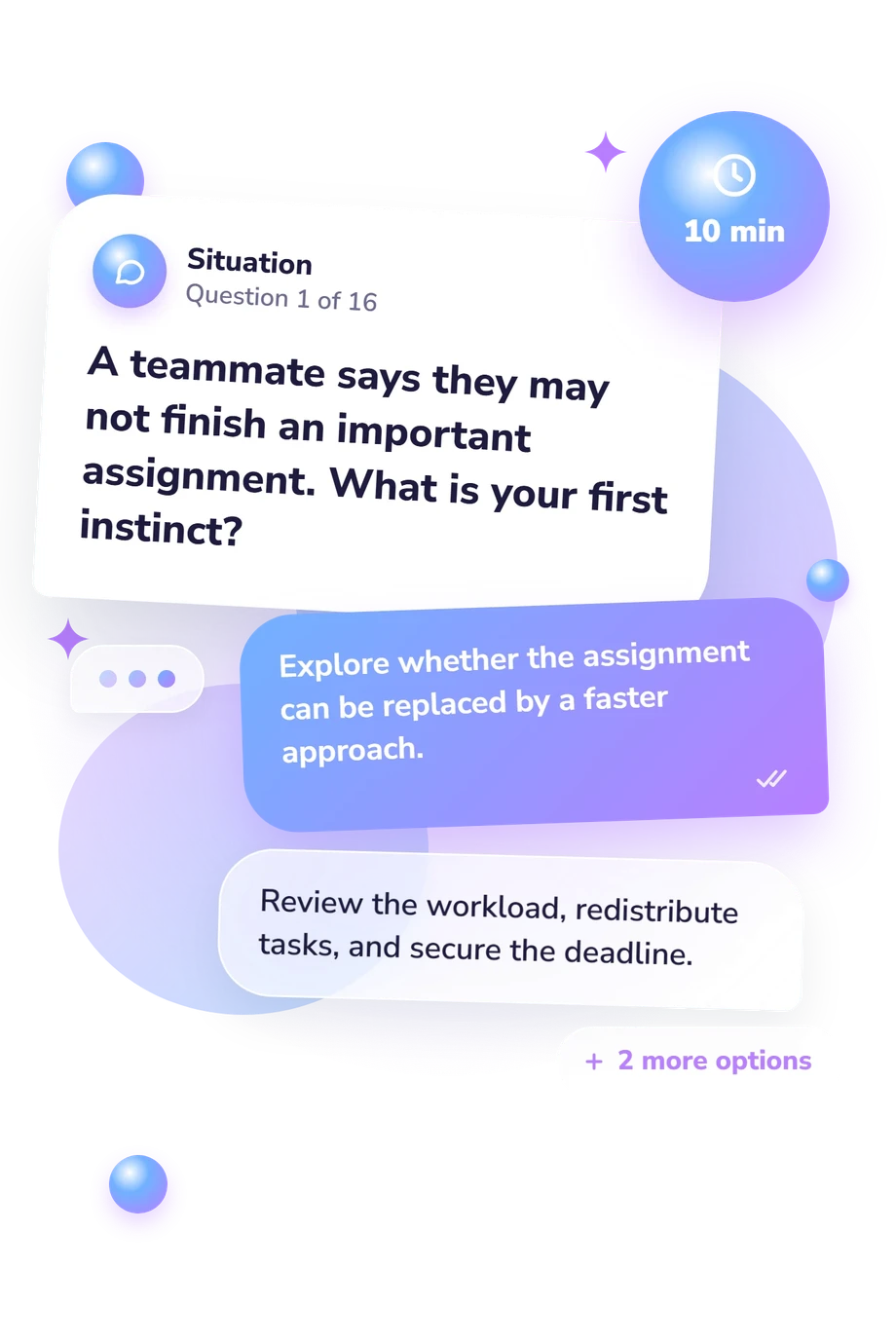
Example Questions From the Test
- A steady rhythm with milestones decided in advance.
- Short bursts of intense progress with room to change direction.
- A flexible schedule that includes occasional spontaneous sprints.
- Quiet stretches focused on getting each detail right.
- Studying the clues alone before revealing a precise theory.
- Tracking confirmed information so the group stays grounded.
- Keeping everyone talking until connections emerge.
- Testing unusual combinations as soon as they occur to me.
- A private space where I can investigate without interruption.
- A structured setting with clear expectations and checkpoints.
- A lively space where ideas move quickly between people.
- A small group where conversation and solo focus alternate.
Call Sign Quiz - Description and methodology of the test
Readers considering how they approach decisions, responsibilities, or interactions can use this team role assessment to reflect on patterns that may help them choose a role, prepare for collaboration, or understand a reaction to change. The call sign quiz offers a profile of preferred ways of contributing, while leaving room to notice how context affects what feels natural.
What This Assessment Explores
Across teamwork, projects, planning, and change, this callsign quiz examines preferences. Atlas covers preparation and responsibility; Beacon, connection and communication; Comet, momentum and improvisation; Ghost, independent focus, observation, and precision. Together, they describe contribution preferences, not formal roles.
They mean:
- Atlas (0-12) measures reliability, preparation, responsibility: Light Load (0-4) favors flexibility; Reliable Support (5-8) adds structure; Full Atlas (9-12) steadies situations.
- Beacon (0-12) reflects connection, communication, and encouragement: Independent Signal (0-4) stays self-directed; Guiding Glow (5-8) connects selectively; Full Beacon (9-12) includes others.
- Comet (0-12) measures momentum, experimentation, and bold improvisation: Deliberate Orbit (0-4) favors deliberation; Adaptive Spark (5-8) balances change; Full Comet (9-12) embraces bold action.
- Ghost (0-12) reflects independent focus, observation, and precision: Open Signal (0-4) engages visibly; Quiet Insight (5-8) alternates; Full Ghost (9-12) favors autonomy and overlooked details.
Scores within one point indicate a blended affinity.
Methodology and Scientific Basis
Items present situations involving projects, groups, planning, changing conditions, and independent work, with four response options. They also touch personal pace, concentration, recognition, and responsibility. Choosing the response that feels most natural makes the exercise a situational self-report, not a knowledge test.
Conceptually, its scenario format shares with the Team Role Test by Mumford and colleagues the use of work situations to examine role-related judgment; this online questionnaire is not an adaptation of that instrument. Olaru and colleagues offer a conceptual parallel concerning situational-judgment approaches, while Lievens offers a framework for personality-situation interplay. These parallels do not validate the online questionnaire.
Scoring displays four scores that are compared across the profile; the response format does not specify how individual answers are assigned points. Results within one point of one another indicate a blended affinity. As a work style questionnaire, it has no published population norms, so current context, self-awareness, and response style may influence its profile. Use it to reflect on how you contribute when planning, communicating, working independently, or adapting to change.
- Mumford, T. V., Van Iddekinge, C. H., Morgeson, F. P., & Campion, M. A. (2008). The Team Role Test: Development and Validation of a Team Role Knowledge Situational Judgment Test. Journal of Applied Psychology, 93(2), 250-267. 10.1037/0021-9010.93.2.250
- Olaru, G., Burrus, J., MacCann, C., Zaromb, F. M., Wilhelm, O., & Roberts, R. D. (2019). Situational Judgment Tests as a Method for Measuring Personality: Development and Validity Evidence for a Test of Dependability. PLOS ONE, 14(2), e0211884. 10.1371/journal.pone.0211884
- Lievens, F. (2017). Assessing Personality-Situation Interplay in Personnel Selection: Toward More Integration into Personality Research. European Journal of Personality, 31(5), 424-440. 10.1002/per.2111
Updated: