
Car Model Quiz
How the Scales are Structured
Who Usually Takes This Test?
See How You Compare
Below is a preview of how scores are typically distributed across each scale.
Example Questions From the Test
- Santa Fe
- Kona
- Palisade
- Tucson
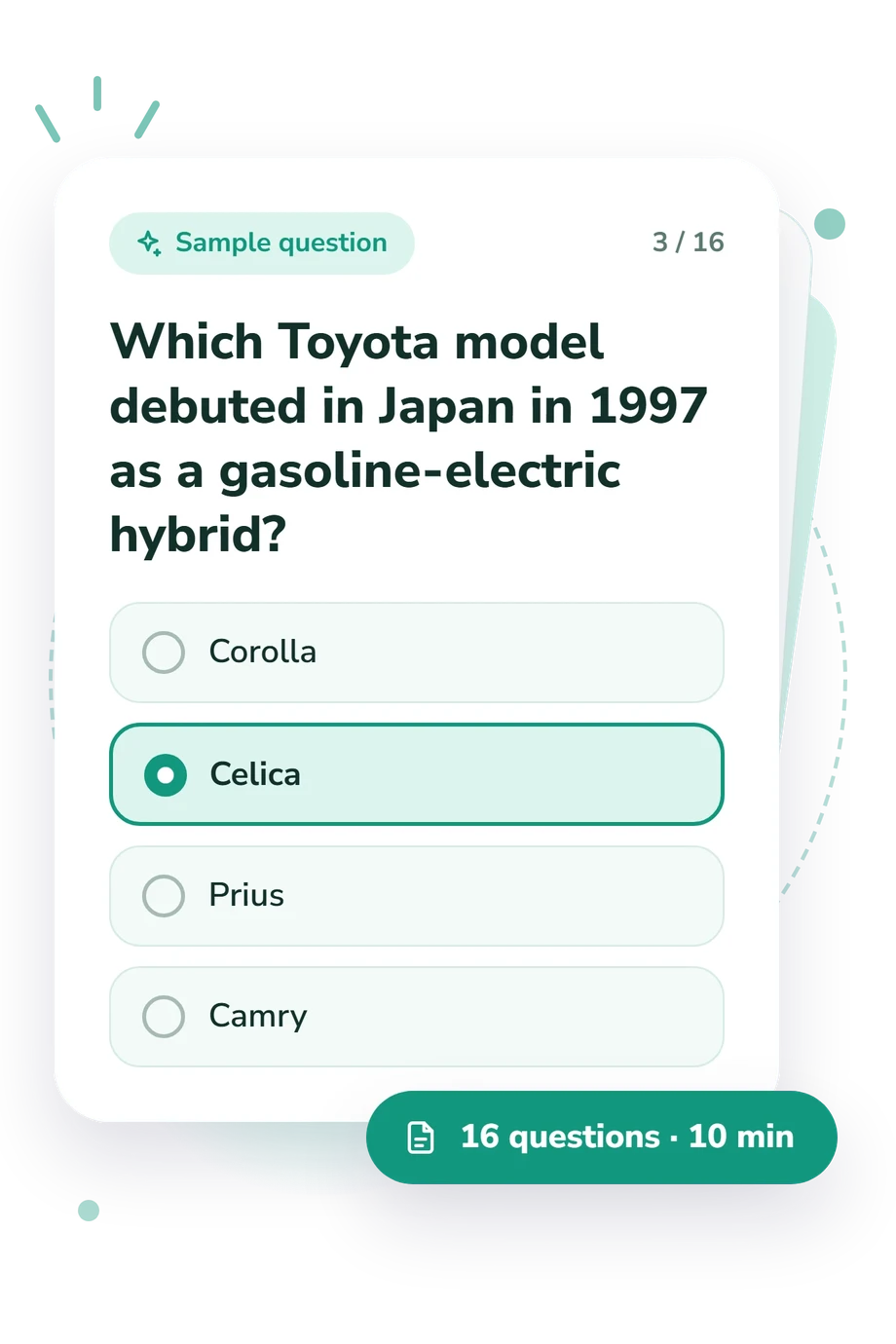
- Corolla
- Celica
- Prius
- Camry
- Ariya
- Leaf
- Qashqai
- Juke
Car Model Quiz - Description and methodology of the test
Designed for curious drivers, enthusiasts, and learners, this car model quiz examines how readily you distinguish individual vehicles from the clues that set them apart. It focuses on recognition rather than driving ability, maintenance knowledge, or ownership experience. By pairing each manufacturer with specific models, this car make and model quiz gives a broad snapshot of performance across its model-recognition clues.
What This Assessment Explores
Questions link model names with manufacturer history, body style, powertrain, platform, and market position. The quiz spans several types of car, but each prompt asks for a specific model, not a broad category. It suits learners and enthusiasts checking recognition of familiar and historic vehicles.
The recurring clue groups are:
- Naming and brand links show whether you connect a model with its manufacturer or name.
- Historical and heritage cues show how launch era, military roots, or category history support identification.
- Design signatures reveal whether silhouettes, doors, body materials, and visual icons separate models.
- Engineering and positioning clues show how powertrain, drivetrain, platform, size, and market role aid recognition.
The displayed scale is Car Model Knowledge (0-16). Foundations (0-6) reflects recognition of major names with possible confusion; Developing (7-12) reflects broad knowledge with gaps; Strong (13-16) reflects consistent use of manufacturer, heritage, positioning, and engineering clues.
Methodology and Evidence Base
Each item gives a short scenario or clue with four model choices. The task tests recognition: the respondent selects the vehicle matching a manufacturer link, historical fact, design signature, engineering feature, or market position. Performance is reported as one aggregate score.
A-Z of Cars (Sedgwick & Gillies, 2010) supplies historical context for makes, eras, and model identities. Hennessy, Hester, and DK Publishing add visual context. The questionnaire is conceptually consistent with these works, not an adaptation of either book.
Harel and Bentin (2013) is relevant because its car-expertise research examines subordinate categorization: distinguishing members within a visual category. This supports the emphasis on model-level recognition, but it does not validate this online questionnaire or provide norms for its score. The result is a structured snapshot of vehicle model identification, not a standardized measure of total automotive expertise.
Performance can vary with regional exposure, brand familiarity, memory, and clue interpretation. A strong result reflects success on these items; an unfamiliar model can lower the score even when wider automotive knowledge is substantial.
- Sedgwick, Michael, and Mark Gillies. A-Z of Cars 1945-1970. Herridge & Sons Ltd., 2010. ISBN 9781906133269.
- Harel, Assaf, and Shlomo Bentin. Are All Types of Expertise Created Equal? Car Experts Use Different Spatial Frequency Scales for Subordinate Categorization of Cars and Faces. PLOS ONE, 8(6), e67024, 2013. 10.1371/journal.pone.0067024.
- Hennessy, Kathryn, Beth Landis Hester, and DK Publishing. Car: The Definitive Visual History of the Automobile. DK Publishing, 2011. ISBN 9780756671679.
Updated: