
Declaration of Independence Quiz
How the Scales are Structured
Who Usually Takes This Test?
See How You Compare
Below is a preview of how scores are typically distributed across each scale.
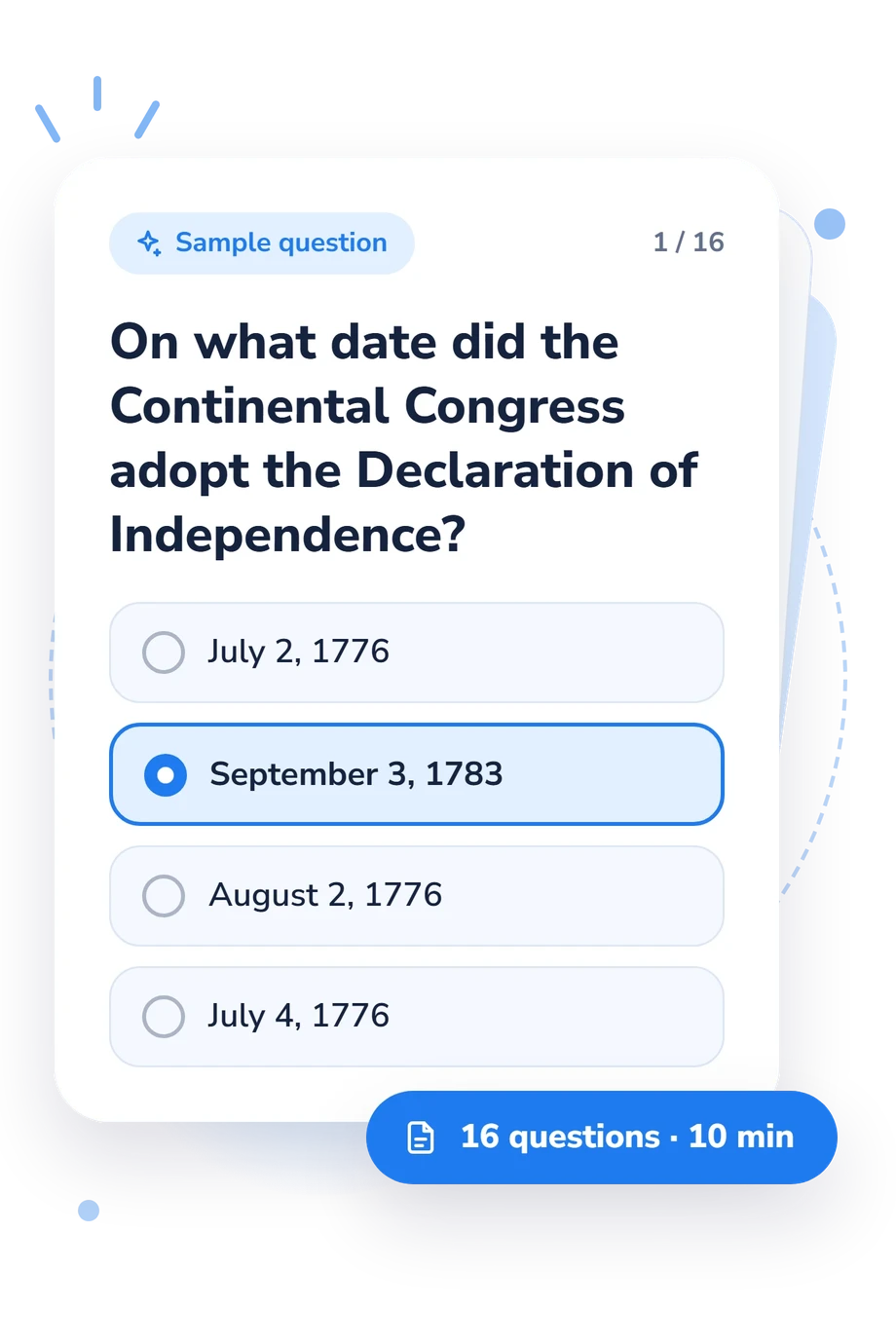
Example Questions From the Test
- July 2, 1776
- September 3, 1783
- August 2, 1776
- July 4, 1776
- Speech, worship, and assembly
- Life, liberty, and the pursuit of happiness
- Peace, prosperity, and equality
- Property, representation, and trial by jury
- Samuel Adams
- John Hancock
- John Jay
- Patrick Henry
Declaration of Independence Quiz - Description and methodology of the test
For students, lifelong learners, and anyone revisiting early American history, this declaration of independence quiz checks how well the document’s purpose, arguments, and historical setting fit together. It also works as a history quiz about the Declaration of Independence for readers who want to connect dates, people, political ideas, and textual choices rather than memorize isolated facts. The result points toward useful topics for review.
What This Assessment Explores
These items test whether readers can connect the Declaration’s language with the events and ideas surrounding adoption. They distinguish the July 2 independence vote, July 4 adoption, and later signing; identify Jefferson and Hancock; interpret grievances; and explain why the document announced and justified separation instead of creating a federal government.
Beyond chronology, questions in this quiz on the Declaration of Independence examine natural rights, consent of the governed, repeated grievance wording, and the contradiction between equality language and slavery in 1776. The result uses Declaration of Independence Knowledge: 0-16, with these bands:
- Foundations to build (0-6) indicates recognition of ideas while pointing to review.
- Developing knowledge (7-12) shows many major facts and themes with contextual gaps.
- Strong knowledge (13-16) reflects command of the document’s language, purpose, history, and implications.
The bands describe the knowledge level shown on this educational questionnaire.
Methodology and Evidence Base
Each item presents four answer choices and combines factual recall with interpretation. Topics include dates, authorship, grievances, natural-rights language, adoption versus signing, and purpose. For review, answers for this quiz on the Declaration of Independence can be checked against the questionnaire’s answer key, while the displayed score totals correct responses on the single knowledge scale; it is not a personality profile.
Conceptually, the questionnaire aligns with Declaration of Independence (1776), the primary text for its language, grievances, and independence claim. Hoffer and Hoffer (2026) clarify the congressional procedure behind the July 2 vote, July 4 adoption, and subsequent signing. Jefferson’s papers support the drafting context and Jefferson’s role. These sources provide historical grounding; the online questionnaire is not an adaptation of a standardized test, and no external norms are supplied.
Interpret the result as a study guide rather than a measure of overall historical ability. Performance may reflect prior coursework, familiarity with eighteenth-century language, guessing, current attention, and careful reading of each option. Missed items can identify distinctions to revisit in the document and its historical context.
- Continental Congress. Declaration of Independence. 1776. National Archives, Records of the Continental and Confederation Congresses and the Constitutional Convention, Record Group 360.
- Hoffer, Peter Charles, and Williamjames Hull Hoffer. "The Process of Writing and Procedures for Adopting the Declaration." In The Cambridge Companion to the Declaration of Independence, edited by Mark A. Graber and Michael Zuckert, 35-45. Cambridge University Press, 2026. 10.1017/9781009692632.004
- Jefferson, Thomas. The Papers of Thomas Jefferson, Volume 1: 1760 to 1776. Edited by Julian P. Boyd, Lyman H. Butterfield, and Mina R. Bryan. Princeton University Press, 1950. 10.2307/j.ctv346qw7
Updated: