
What Style House Do I Have Quiz
How the Scales are Structured
Who Usually Takes This Test?
See How You Compare
Below is a preview of how scores are typically distributed across each scale.
Example Questions From the Test
- Tall narrow windows, projecting bays, and details such as stained glass, ornate trim, or ceiling medallions appear repeatedly
- Several vertically proportioned windows and surviving decorative wood or glass details suggest a period design
- Most features are replaced, though one bay, transom, stained-glass panel, or ornate trim element remains
- Broad picture windows, plain openings, and minimal interior trim dominate
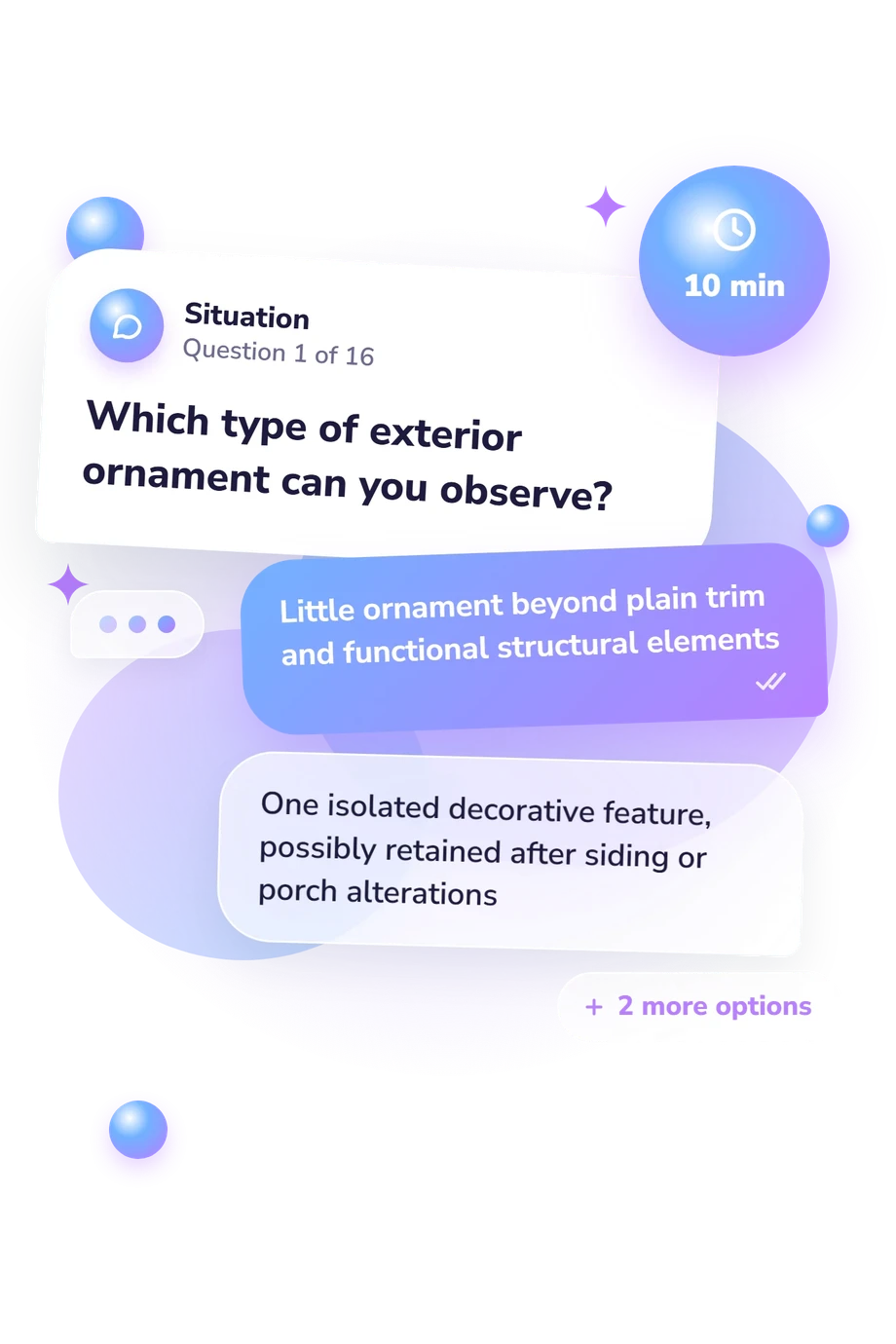
- Little ornament beyond plain trim and functional structural elements
- One isolated decorative feature, possibly retained after siding or porch alterations
- Several decorative brackets, patterned shingles, turned posts, or carved trim elements
- Layered ornament such as spindlework, gingerbread trim, patterned surfaces, brackets, and decorative porch details
- The composition is strongly asymmetrical, with windows and entry placed according to varied room shapes
- There is a loose sense of balance, although additions or renovations interrupt it
- The openings are mostly balanced around a near-central entrance
- A central front door anchors a clearly symmetrical arrangement of evenly spaced windows
What Style House Do I Have Quiz - Description and methodology of the test
Homeowners, renovators, and design-curious readers can use this assessment to turn visible features into a clearer architectural profile. The What Style House Do I Have Quiz is especially useful when original details sit beside additions, replacements, or remodeling. Framed around the question of what architectural style is my house, it supports reflection before decorating, researching, or planning changes.
What This Assessment Explores
Style is read through relationships rather than isolated decoration. The questions consider symmetry, roofs, windows, entries, materials, ornament, interior planning, built-ins, and yard connections. Remodeling can leave a home with partial evidence of several traditions, so the result describes affinity rather than a definitive historical classification.
Readers asking what is my architectural style can use the comparison to identify the strongest visual match. The four scales are:
- Colonial (0-12) measures classical geometry and detail: Limited evidence 0-4; Colonial influence 5-8; Strong Colonial affinity 9-12.
- Craftsman (0-12) measures visible structure and workmanship: Limited evidence 0-4; Craftsman influence 5-8; Strong affinity 9-12.
- Mid-Century Modern (0-12) measures horizontal, open, indoor-outdoor design: Limited evidence 0-4; Mid-century influence 5-8; Strong affinity 9-12.
- Victorian (0-12) measures complex massing and ornament: Limited evidence 0-4; Victorian influence 5-8; Strong Victorian affinity 9-12.
Methodology and Scientific Basis
Each item offers four descriptive choices built around observable contrasts: aligned or irregular openings, broad eaves or dramatic rooflines, restrained or layered ornament, and open or compartmentalized interiors. Choosing the closest description compares recurring feature patterns across the four outcomes.
For anyone wondering what type of house do I have, the profile acts as a visual inventory. Each style receives an outcome score, but the displayed method does not say how many points an individual answer contributes. The highest score is the strongest affinity; scores within one point form a blended result.
The architectural vocabulary is conceptually consistent with the McAlester house-style guide (1984), which attends to massing, roofs, openings, materials, and ornament. Weeks and Grimmer (1995) and Weeks and Jandl (1996) similarly emphasize character-defining features and the difference between identifying character and prescribing treatment. This questionnaire is consistent with those sources, not an adaptation or standardized administration of them.
These bands are descriptive catalogue categories, not population norms. Renovation, missing evidence, viewing conditions, and familiarity with architectural terms can affect self-report, making the profile a starting point for observation and further research.
- Virginia McAlester and Arcie Lee McAlester. A Field Guide to American Houses. New York: Alfred A. Knopf, 1984. ISBN 9780394510323.
- Kay D. Weeks and Anne E. Grimmer. The Secretary of the Interior's Standards for the Treatment of Historic Properties with Guidelines for Preserving, Rehabilitating, Restoring & Reconstructing Historic Buildings. Washington, DC: U.S. Department of the Interior, National Park Service, 1995.
- Kay D. Weeks and Harold W. Jandl. The Secretary of the Interior's Standards for the Treatment of Historic Properties: A Philosophical and Ethical Framework for Making Treatment Decisions. ASTM Special Technical Publication 1258, 1996, pp. 7-22. 10.1520/STP15422S.
Updated: