
Am I Hispanic Quiz
How the Scales are Structured
Who Usually Takes This Test?
See How You Compare
Below is a preview of how scores are typically distributed across each scale.
Example Questions From the Test
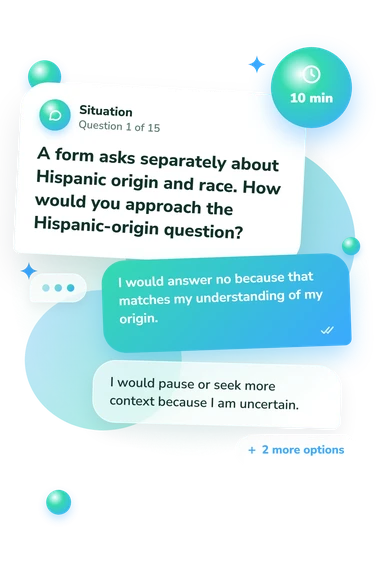
- I would answer no because that matches my understanding of my origin.
- I would pause or seek more context because I am uncertain.
- I would usually answer yes, while also wanting to specify my background.
- I would confidently answer yes and treat race as a separate question.
- I do not know of such a connection in my ancestry.
- There may be a connection, but the details are uncertain or distant.
- There is a known connection through part of my family.
- There is a clear connection through close family or multiple family lines.
- I would probably encounter it as an unfamiliar cultural practice.
- I might recognize it from general exposure but not from personal experience.
- I would recognize it from some family or community experiences.
- I would readily connect it with recurring experiences in my family or community.
Am I Hispanic Quiz - Description and methodology of the test
For readers sorting through ancestry, self-description, and cultural experience, the Am I Hispanic Quiz helps them consider identity without reducing it to appearance, surname, birthplace, or language ability. The am i latino or hispanic quiz format suits people whose connection feels clear, mixed, developing, or uncertain. The questionnaire distinguishes ancestry, identity, and lived cultural connection, so the three can be considered separately rather than collapsed into one label.
What This Assessment Explores
Three dimensions separate family history, self-description, and cultural participation. Results keep family origin, identity context, and lived cultural connection distinct, so each dimension can be read on its own rather than forcing every experience into one label or turning the profile into a how hispanic are you quiz score. The result is a profile, not a ruling on authenticity. Spanish fluency is not required, and national, regional, racial, or mixed identities may remain important. The scales are:
- Family Heritage and Origin (0-15) reflects known Hispanic family links: Limited/Unclear Connection (0-5), Some Connection (6-10), or Strong Documented Connection (11-15).
- Identity and Community Context (0-15) reflects self-description and social experience: Not currently identified (0-5), Exploring or contextual (6-10), or Established identification (11-15).
- Lived Cultural Connection (0-15) reflects participation and familiarity: Little lived connection (0-5), Developing or selective (6-10), or Sustained connection (11-15).
Methodology and Evidence Base
Each item offers four ordered self-report responses, moving from little or uncertain connection toward clearer or more sustained connection. The questions group into the three dimensions, and each dimension receives its own score; the displayed results keep these dimensions distinct and should not be treated as an authenticity verdict.
The framework is conceptually consistent with MMCISL (Felix-Ortiz et al., 1994), a multidimensional cultural-identity measure, and with later validation work by Dillon et al. (2009) on related scales. This questionnaire is not presented as a direct adaptation or standardized administration of either study. Its separation of Hispanic origin from race also reflects federal classification standards issued in 1997.
The profile can show where a respondent has clear information or uncertainty, how community contact figures in, and whether an am i latino quiz framing fits their self-description, without assuming that one area determines the others.
These bands are descriptive labels, not population norms or clinical cutoffs. Memory, self-awareness, current context, and incomplete records can shape self-report, so the result is best read as a structured snapshot of the respondent’s present understanding.
- Felix-Ortiz, M., Newcomb, M. D., & Myers, H. (1994). A Multidimensional Measure of Cultural Identity for Latino and Latina Adolescents. Hispanic Journal of Behavioral Sciences, 16(2), 99-115. 10.1177/07399863940162001
- Dillon, F. R., Félix-Ortiz, M., Rice, C., De La Rosa, M., Rojas, P., & Duan, R. (2009). Validating the Multidimensional Measure of Cultural Identity Scales for Latinos among Latina mothers and daughters. Cultural Diversity and Ethnic Minority Psychology, 15(2), 191-201. 10.1037/a0015321
- Office of Management and Budget. (1997). Revisions to the Standards for the Classification of Federal Data on Race and Ethnicity. Federal Register, 62(210), 58782-58790.