
What Putter Is Best for Me Quiz
How the Scales are Structured
Who Usually Takes This Test?
See How You Compare
Below is a preview of how scores are typically distributed across each scale.
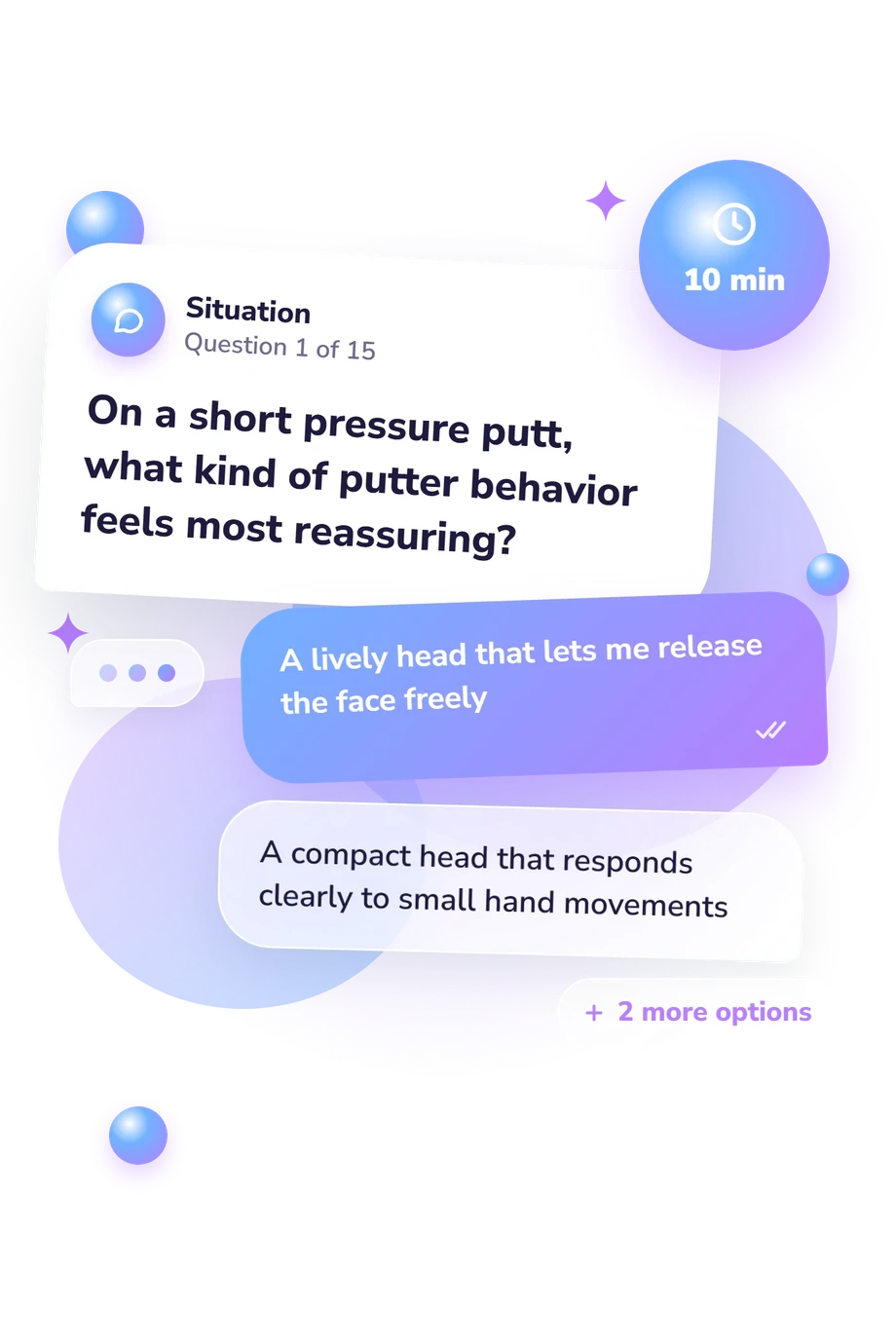
Example Questions From the Test
- A narrow traditional blade
- A compact blade with a wider flange
- A rounded or winged mid-size head
- A large mallet with weight positioned around its perimeter
- A large geometric head with long alignment lines
- A rounded, medium-size head with visible perimeter weighting
- A compact head with a modest rear flange
- A slim, traditional blade with minimal visual bulk
- No line, just the face and the ball
- A tiny dot or very short mark
- A bold multi-line track running far behind the ball
- A clear, medium-length line on a restrained rear section
What Putter Is Best for Me Quiz - Description and methodology of the test
Golfers preparing for a fitting can use this assessment to organize the playing experiences and design priorities they want to discuss with a fitter. The What Putter Is Best for Me Quiz helps turn those observations into a practical plan for deciding what to test first. This putter quiz gives a player a focused starting point for noticing which equipment responses feel natural during a fitting.
What This Assessment Explores
The questionnaire explores how a golfer balances feedback, alignment, stability, and face rotation. Its scenarios cover pressure putts, address appearance, off-center contact, aiming aids, stroke arc, and the desired compromise between compact response and forgiveness. It turns the question of the best putter for me into a comparison of preferences, not a judgment of skill.
The result uses three style-fit dimensions:
- Classic Blade Putter Fit: 0-15 shows affinity for compact shape, direct feedback, and controlled rotation; Different Direction (0-5), Possible Match (6-10), and Strong Blade Affinity (11-15).
- High-MOI Mallet Putter Fit: 0-15 shows preference for stability, alignment help, and off-center protection; Different Direction (0-5), Possible Match (6-10), and Strong Mallet Affinity (11-15) are displayed.
- Versatile Mid-Mallet Putter Fit: 0-15 shows preference for balance among feedback, maneuverability, alignment, and stability; Different Direction (0-5), Possible Match (6-10), and Strong Mid-Mallet Affinity (11-15).
Methodology and Scientific Basis
Each question offers four alternatives about head size, alignment guidance, mishit protection, strike feedback, and face rotation. As a self-report format, the respondent selects the option that best matches their experience or preference. Results are reported as three parallel fit scores: the highest indicates strongest affinity, while scores within one point indicate a blended result. As a putter fitting quiz, it turns those comparisons into a practical testing shortlist without requiring manual calculations.
The assessment is conceptually consistent with MacKenzie and Henrikson (2018), whose research links toe hang and face-balanced design with golfer-applied kinetics. Chae and Jung (2025) are relevant to the alignment items, while Emerson, Morris, and Potts (2018) offer related evidence on putting range variability. These studies support the design themes, but this questionnaire is not presented as an adaptation or validation of them.
Interpret the bands as guidance for comparing equipment preferences, not putting skill. Because answers are self-reported judgments about feel and preference, recent practice or familiarity with designs may influence selections. Use the profile to prioritize hands-on testing of shape, hosel, toe hang, length, and lie.
- MacKenzie, Sasho, and Erik Henrikson. "Influence of Toe-Hang vs. Face-Balanced Putter Design on Golfer Applied Kinetics." Proceedings, 2(6), 244, 2018. 10.3390/proceedings2060244
- Chae, Woen-Sik, and Jae-Hu Jung. "Analysis of Putting Alignment Differences based on Putter Head Type and Aiming Line." Korea Journal of Applied Biomechanics, 35(3), 184-190, 2025. 10.5103/KJAB.2025.35.3.184
- Emerson, Nicholas J., Tom Morris, and Jonathan R. Potts. "A Novel Putter Design to Minimise Range Variability in Golf Putts." Proceedings, 2(6), 242-247, 2018. 10.3390/proceedings2060242
Updated: