
Mexican Quiz
How the Scales are Structured
Who Usually Takes This Test?
See How You Compare
Below is a preview of how scores are typically distributed across each scale.
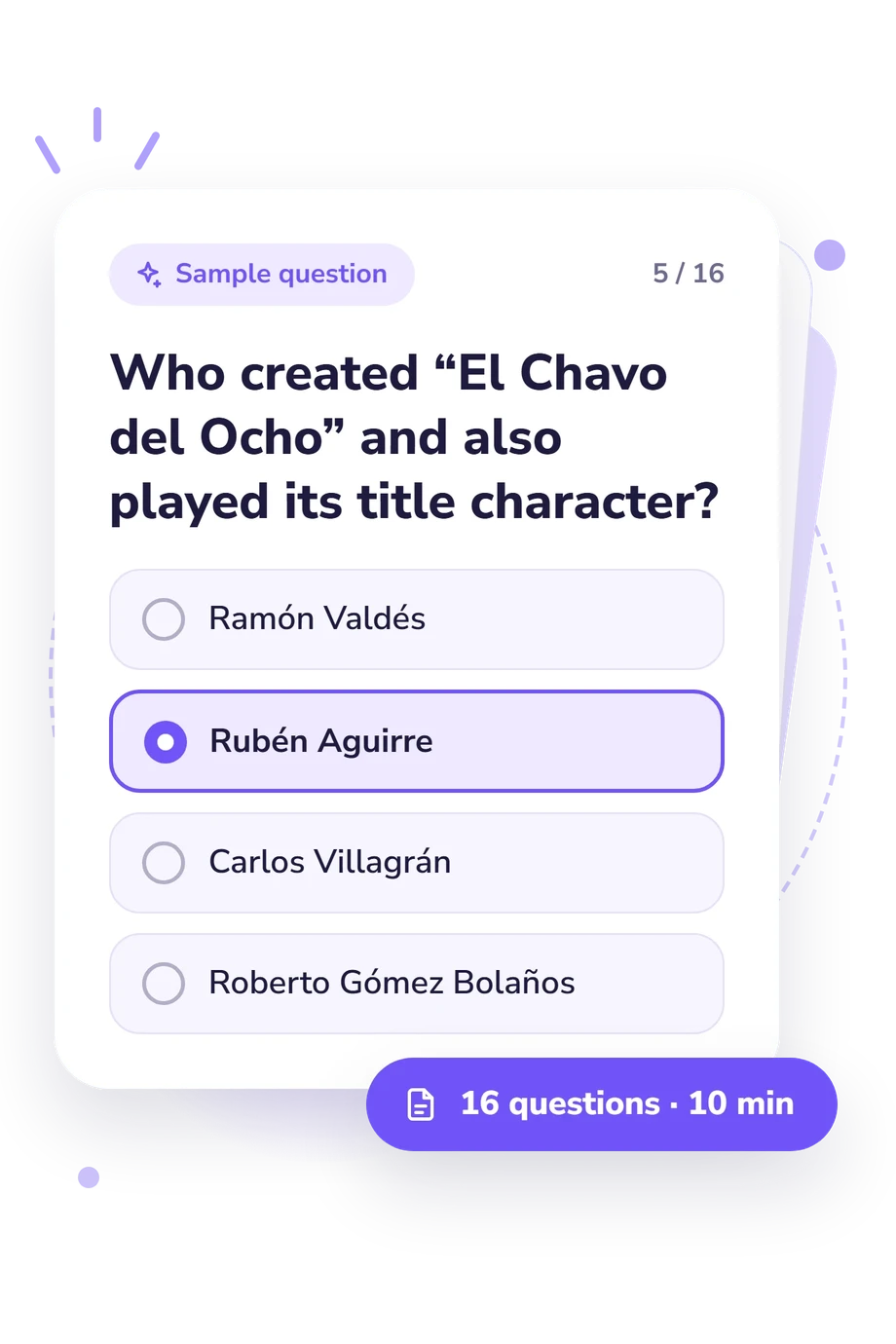
Example Questions From the Test
- A wrapped figurine reserved for Three Kings Day
- Photographs and favorite foods of deceased loved ones
- A piñata filled for a birthday celebration
- A suitcase packed for a New Year’s ritual
- Bolero
- Cumbia
- Norteño
- Ranchera
- Ramón Valdés
- Rubén Aguirre
- Carlos Villagrán
- Roberto Gómez Bolaños
Mexican Quiz - Description and methodology of the test
For readers who enjoy connecting entertainment, customs, and everyday symbols, this Mexican Quiz offers a focused way to assess the references covered. It suits people who want a light but informative way to assess knowledge of Mexican pop culture encountered through media, family life, travel, education, or personal interest. The questionnaire centers on recognizing and applying references in context, not on proving identity.
What This Assessment Explores
Across its items, the assessment examines Mexican television, music, traditions, food, art, and sport. It moves from telenovela formats and performers to Día de Muertos, mariachi, lucha libre, artists, celebrations, and dishes. Respondents connect each reference with the format, practice, person, object, or setting it belongs to. This makes the questionnaire useful for exploring Mexican pop-culture references.
These groups show the kinds of recognition represented:
- Media and music measure familiarity with television, comedy, genres, and regional traditions.
- Traditions, food, and art show whether rituals, dishes, artists, styles, and crafts are recognized in context.
- Sport and spectacle indicate familiarity with practices, clothing, rules, and public-event conventions.
Scores for Mexican Pop Culture Knowledge (0-16) fall into Foundations (0-6), recognizing some major references with room to explore; Developing Knowledge (7-12), showing solid grasp across several areas; or Strong Knowledge (13-16), showing accurate recognition and application across a broad range of Mexican pop-culture topics.
Methodology and Evidence Base
Each item presents a situation and four answer choices, making the questionnaire a pop culture knowledge test focused on Mexico. Selecting the best match tests recognition and contextual recall rather than agreement with a personality statement. Respondents choose the option that fits each reference, and the resulting score summarizes performance across the items.
The cultural frame is conceptually consistent with Aldama and Stavans (2013), whose work connects Latino popular culture with media, performance, and everyday identity. Aldama’s 2016 collection and the historical-cultural work edited by Joseph, Henderson, Kirk, and Starn (2002) add context. The questionnaire is not an adaptation of those publications; they support interpretation of its subject matter, not its scoring.
The result is a descriptive score for this selected set of references. Results may reflect language, education, regional background, media exposure, and familiarity with traditions. A score therefore describes performance on the selection rather than complete cultural understanding, and guessing or current familiarity can affect answers. The displayed total is interpreted through the result bands, so it summarizes this performance without identifying every strength or unfamiliarity.
- Aldama, Frederick Luis, and Ilan Stavans. ¡Muy Pop!: Conversations on Latino Popular Culture. Ann Arbor, MI: University of Michigan Press, 2013. 10.3998/mpub.4393443.
- Aldama, Frederick Luis, ed. The Routledge Companion to Latina/o Popular Culture. New York: Routledge, 2016. 10.4324/9781315637495.
- Joseph, Gilbert M., Henderson, Timothy J., Kirk, Robin, and Starn, Orin, eds. The Mexico Reader: History, Culture, Politics. Durham, NC: Duke University Press, 2002. 10.1515/9780822384090
Updated: