
Ideal Man Quiz
How the Scales are Structured
Who Usually Takes This Test?
See How You Compare
Below is a preview of how scores are typically distributed across each scale.
Example Questions From the Test
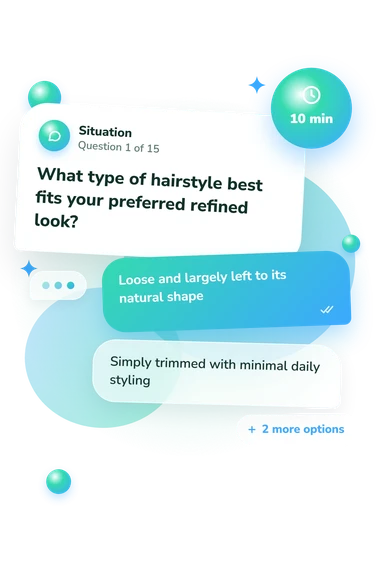
- Loose and largely left to its natural shape
- Simply trimmed with minimal daily styling
- Intentionally shaped and kept consistently neat
- Precisely cut and styled for a sleek, controlled finish
- A soft or lightly built frame without visible emphasis on fitness
- A balanced frame with subtle signs of activity
- A lean, visibly toned build
- A strongly athletic build with pronounced definition
- A clean shave with sharp, maintained edges
- Occasional light stubble
- Regular stubble or a softly shaped short beard
- A fuller beard with a deliberately natural finish
Ideal Man Quiz - Description and methodology of the test
People who want to clarify their preferred appearance in men can use the ideal man quiz as a guided preference profile. It suits personal reflection, dating preferences, and comparing several style impressions without forcing attraction into a single type. In this perfect man quiz, the result identifies which visual pattern most strongly shapes the ideal and whether profiles within one point of the highest score may form a blended preference.
What This Assessment Explores
Taken as an ideal guy quiz, the assessment isolates visible elements of a preferred male appearance: build, movement, clothing, grooming, facial hair, texture, posture, and overall presence. Its focus stays on attraction and styling preferences rather than judgments of character or compatibility.
These are the three profile dimensions shown in the result:
- Athletic & Energetic (0-15) shows how much fitness, definition, energetic movement, and sporty dress shape your ideal: Light affinity (0-5), Moderate affinity (6-10), or Strong affinity (11-15).
- Polished & Refined (0-15) shows how much tailoring, coordination, and finished grooming matter: Light affinity (0-5), Moderate affinity (6-10), or Strong affinity (11-15).
- Rugged & Natural (0-15) shows how much texture, practical clothing, and outdoor ease appeal: Light affinity (0-5), Moderate affinity (6-10), or Strong affinity (11-15).
Methodology and Evidence Base
Each item presents a visual or social situation with four response options covering hairstyles, grooming, facial hair, body shape, clothing, posture, movement, and settings. The respondent selects the preferred appearance in each situation.
Chosen responses are converted into the three profile totals, but no per-answer point rule is stated. Interpret the displayed scores as presented: the highest is the strongest affinity, and any profiles within one point of it form a blended result.
Conceptually, the overlapping facial, hair, and body-appearance content can be read alongside Cunningham et al. (1990) on facial cues in male attractiveness judgments, Dixson and Rantala (2016) on facial and body hair, and Lei et al. (2019) on body composition, facial masculinity, and attractiveness. These studies provide conceptual context for those shared themes, not validation of this questionnaire, its scales, or its scoring.
As a male appearance quiz, this online self-report profile can be influenced by current context and self-perception, and it has no established norms or validation; read the displayed affinity scores as comparative indications of how strongly each appearance style shapes your ideal.
- Cunningham, M. R., Barbee, A. P., & Pike, C. L. (1990). What do women want? Facialmetric assessment of multiple motives in the perception of male facial physical attractiveness. Journal of Personality and Social Psychology, 59(1), 61-72. 10.1037/0022-3514.59.1.61
- Dixson, B. J. W., & Rantala, M. J. (2016). The role of facial and body hair distribution in women’s judgments of men’s sexual attractiveness. Archives of Sexual Behavior, 45(4), 877-889. 10.1007/s10508-015-0588-z
- Lei, X., Holzleitner, I. J., & Perrett, D. I. (2019). The influence of body composition effects on male facial masculinity and attractiveness. Frontiers in Psychology, 9, 2658. 10.3389/fpsyg.2018.02658