
Subjunctive vs Indicative Quiz
How the Scales are Structured
Who Usually Takes This Test?
See How You Compare
Below is a preview of how scores are typically distributed across each scale.
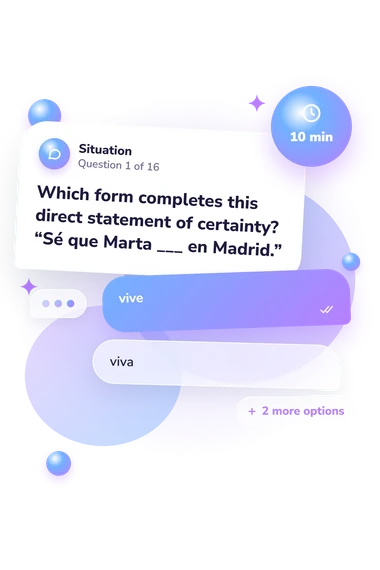
Example Questions From the Test
- vive
- viva
- viviera
- viviría
- haga
- hiciera
- hará
- haría
- salude
- saluda
- saludaría
- saludara
Subjunctive vs Indicative Quiz - Description and methodology of the test
Readers who want to check their working knowledge of Spanish mood can use this subjunctive vs indicative quiz to examine how context changes verb choice. It suits independent learners and students seeking Spanish mood practice that compares the two moods in context. The result points to the kind of practice that would make further study more focused.
What This Assessment Explores
The questions examine mood selection rather than overall proficiency. Each item places a verb in a meaningful clause and asks which form fits the speaker’s intended meaning. This suits learners who recognize forms in isolation but want more reliable Spanish subjunctive practice in context.
The main themes are:
- Certainty and evidence show how the indicative presents information as established.
- Doubt, denial, wishes, emotion, and evaluation show contexts for the subjunctive.
- Relative clauses contrast a specific known referent with an indefinite or sought one.
- Conditions and time clauses show how hypothetical or future meaning affects mood choice.
The result uses one scale, Subjunctive vs Indicative Knowledge, scored 0-16. Foundations to build covers 0-6, Developing knowledge covers 7-12, and Strong command covers 13-16. This summary suggests whether to review the basic contrast, practise tense selection, or extend use across present, future, and past contexts.
Methodology and Evidence Base
This multiple-choice assessment uses short Spanish sentences with four answer choices. Items contrast indicative and subjunctive forms across present, past, future, conditional, relative, and temporal contexts. Choosing an answer requires interpreting certainty, doubt, reference, sequence, or hypothetical meaning, so it tests contextual judgment rather than simple conjugation recall.
Responses are summarized on one displayed scale. Its bands indicate study priorities rather than certification of overall Spanish proficiency, helping distinguish foundational review from practice with contextual contrasts and tense selection. Results can reflect current exposure, sentence interpretation, and familiarity with mood triggers.
Conceptually, it is consistent with Ahern and Torrens (2021), who connect Spanish mood development with clause meaning. Borgonovo, Bruhn de Garavito, and Prévost (2015) examine variability in relative-clause mood selection, while Dracos, Requena, and Miller (2019) address mood selection in Spanish-speaking children. The questionnaire is conceptually consistent with these published discussions; they do not validate this online questionnaire or make it an adaptation.
Reviewing a missed answer against its clause meaning and trigger makes the result more useful. As a Spanish mood test, it offers a focused study profile, while broader Spanish ability also involves vocabulary, comprehension, production, and sustained use.
- Ahern, Aoife, and Vicenç Torrens. 2021. "The acquisition of mood in child Spanish." In L1 Acquisition and L2 Learning: The View from Romance, edited by Larisa Avram, Anca Sevcenco, and Veronica Tomescu, 355-378. John Benjamins. 10.1075/lald.65.14ahe
- Borgonovo, Claudia, Joyce Bruhn de Garavito, and Philippe Prévost. 2015. "Mood Selection in Relative Clauses: Interfaces and Variability." Studies in Second Language Acquisition 37(1): 33-69. 10.1017/S0272263114000321
- Dracos, Melisa, Pablo Requena, and Karen Miller. 2019. "Acquisition of Mood Selection in Spanish-Speaking Children." Language Acquisition 26(1): 106-118. 10.1080/10489223.2018.1464006