
What City Am I Quiz
How the Scales are Structured
Who Usually Takes This Test?
See How You Compare
Below is a preview of how scores are typically distributed across each scale.
Example Questions From the Test
- One peaceful neighborhood, with plenty of time to linger
- A single planned activity followed by an easy meal
- Several stops across town, with a break built in
- A packed route of events, food, and late-night possibilities
- A lively gathering with a large guest list and plenty of movement
- A structured dinner with a clear start, courses, and finish
- A relaxed evening for a small group with food and conversation
- An intimate, candlelit night where everyone settles in for hours
- It wears me out, so I look for a quiet route home
- I can tolerate it when the event was worth the effort
- I settle into the flow and enjoy watching the city move
- It gives me a second wind and makes me want to continue the night
What City Am I Quiz - Description and methodology of the test
People considering a move or planning a trip can use the What City Am I Quiz to connect ordinary preferences with an urban fit. The question behind the what city are you quiz-how urban preferences fit different lifestyles-drives comparisons of pace, space, social energy, planning, and discovery across four city profiles. The result is a reflective profile, not a ranking, and it can show a clear or blended affinity.
What This Assessment Explores
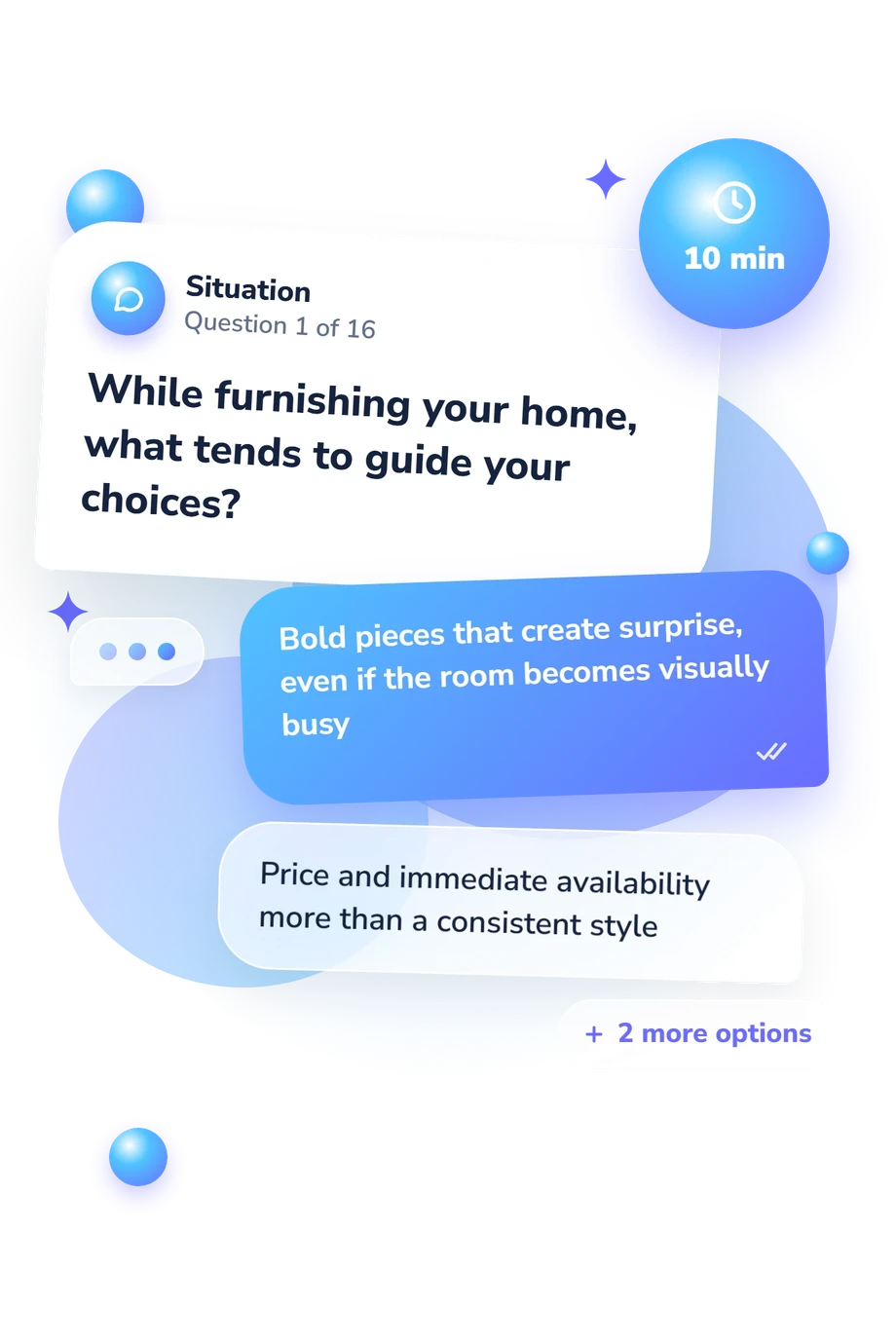
Items explore furnishing, dining, customs, disrupted plans, housing, commuting, hosting, navigation, exploration, and crowded streets. They contrast privacy with density, predictability with spontaneity, and space with access.
The profiles turn this which-city-am-I quiz into a guide to what place suits the respondent:
- Barcelona (0-12): Private & Structured (0-4) favors predictability; Sunlit Flexibility (5-8) balances outdoor life and spontaneity; Barcelona Affinity (9-12) suits expressive, late-sharing life.
- Copenhagen (0-12): Higher-Intensity Preference (0-4) favors stimulation; Balanced Simplicity (5-8) balances calm and variety; Copenhagen Affinity (9-12) suits cycling and cozy routines.
- New York City (0-12): Roomier Rhythm (0-4) favors space; Selective City Spark (5-8) balances activity and downtime; New York Affinity (9-12) suits density and momentum.
- Tokyo (0-12): Loose & Familiar (0-4) favors informality; Curious Planner (5-8) balances order and discovery; Tokyo Affinity (9-12) suits precise systems and solo exploration.
Methodology and Evidence Base
Each item presents a city-life situation with four response choices. The options move across differences in space, intensity, flexibility, sociability, and planning, while the respondent selects the choice that best matches a personal preference. Scoring compares four profile totals: the highest indicates strongest affinity, and any city within one point becomes part of a blended result.
The questionnaire's preference-and-fit dimensions are conceptually consistent with residential-preference research in a 2020 study by Li and colleagues: both consider how desired surroundings relate to a person's sense of fit. The questionnaire's familiarity-related choices are also conceptually consistent with the familiarity-and-preference relationship examined in a 1976 urban-place study by Herzog, Kaplan, and Kaplan. These studies provide context for the themes, not psychometric evidence for this questionnaire.
It is an online self-report questionnaire without documented standardization, norms, reliability, or validity. As a what place am I quiz, it offers a snapshot of lifestyle compatibility. Scores may shift with mood, travel history, self-awareness, and response bias, so the result describes current preferences rather than a fixed identity or clinical condition.
- Chen Zhang, Zhenfang Huang, Fangdong Cao, and Xiaoyan Chen (2019). Recognise me from outside to inside: Learning the influence chain of urban destination personalities. Tourism Management, 70, 390-403. 10.1016/j.tourman.2018.09.005
- Jingjing Li, Amy H. Auchincloss, Daniel A. Rodriguez, Kari A. Moore, Ana V. Diez Roux, and Brisa N. Sanchez (2020). Determinants of Residential Preferences Related to Built and Social Environments and Concordance between Neighborhood Characteristics and Preferences. Journal of Urban Health, 97(1), 62-77. 10.1007/s11524-019-00397-7
- Thomas R. Herzog, Stephen Kaplan, and Rachel Kaplan (1976). The Prediction of Preference for Familiar Urban Places. Environment and Behavior, 8(4), 627-645. 10.1177/001391657684008
Updated: